

Stanford’s Early Landscape History
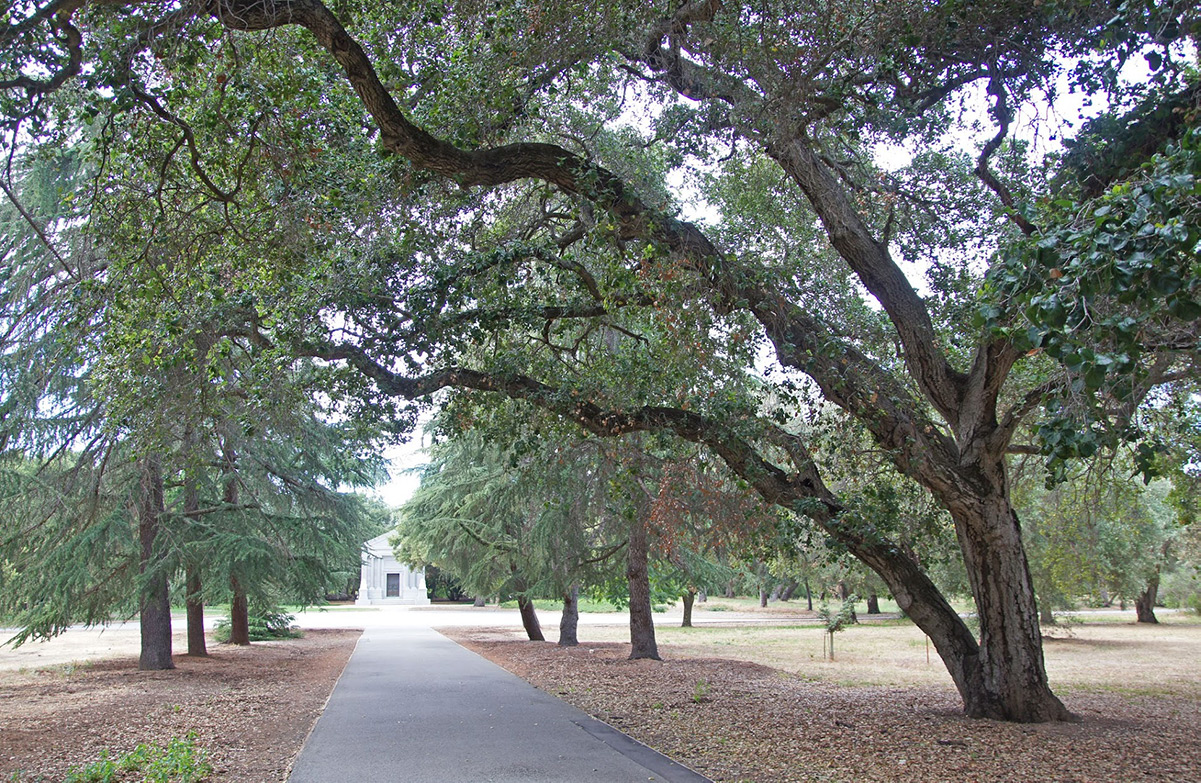
No buildings of any kind whatever should ever be erected within the grounds of the original Arboretum. It should always be retained in its present condition as a Park for drives and walks so long as the University exists. This Park was a favorite project of my husband and carried into effect twentyeight years ago. There are many miles of drive[s] within, or connected with shaded avenues, with this beautiful park. The choicest trees are there planted from all parts of the world, and as the years roll on and this most beautiful valley of Santa Clara becomes, as I have no doubt it will, the educational center of our State and thickly settled with beautiful homes, this park will be unique and of itself memorable and monumental. It should, accordingly, always be sacredly preserved from mutilation.
– excerpt from Jane Stanford’s address to the Trustees, 1903
The cessation of both intensive gardening (including the ongoing thinning of many rapidly growing blue gums) and irrigation following Senator Stanford’s illness and death in 1893 resulted in the decline of the great collection of tens-of-thousands of trees and shrubs planted since 1876. Even though at the time of Mrs. Stanford’s 1903 remarks a great variety of trees and shrubs were still growing in the Arboretum, Stanford botanist William Dudley wrote a few years later:
Unfortunately, work ceased in 1890 or 1891, and since then it has been a pathetic struggle for existence among them all, and not always a successful one.
– William Dudley, Stanford Alumnus, Dec., 1906
Preliminary list of trees lost from the two heroic planting phases during 1876–1893.
For accounts of the vegetation and landscape in the Palo Alto area in the 18th and 19th centuries see:
- Timby (1988) The landscape of the Palo Alto area in the early Spanish Period: observations of the vegetation cover from original sources. SU Special Collections MISC 0034 Manuscript Collection.
- Cooper (1926) Vegetational development upon alluvial fans in the vicinity of Palo Alto, California. Ecology 7:325–473.
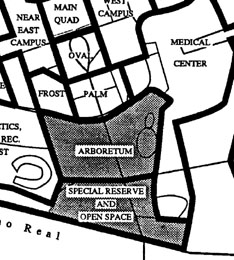
For the early years of Stanford read Julie Cain’s articles on the Arizona Garden and Arboretum in Sandstone & Tile 27, Spring/Summer 2003. For Arboretum land-use issues in later years read Donald Price’s manuscript The Stanford Arboretum, University Archives sGW403; and the official SU Arboretum Region Plan, April 1992. Map on right is from the 1992 Plan. See Tutorow (2004) The Governor: the Life and Legacy of Leland Stanford, a California Colossus, v. 1, p. 428–, for a detailed account of the assembly of Stanford’s Menlo holdings. For more information on the founding of the University see History of Stanford.
Timeline
| 1769, Nov. 4 | Portola overland expedition. Plain of San Francisquito Creek: “...wooded with oak and some live oak. We stopped near a good stream that flowed through the middle of the large plain and estuary. All the land is so very good and mellow that it can not be excelled.” Fray Juan Crespi, missionary explorer on the Pacific coast, 1769–1774, by Herbert Eugene Bolton, 1927, p.28. |
| 1776 | de Anza expedition foundation of San Francisco Presidio and mission. |
| 1777 | Foundation of Mission Santa Clara. |
| 1820 | Alta California: 3,270 settlers and soldiers; 20,000-plus mission Native Americans; many thousands head of cattle. |
| 1830–1832 | David Douglas collects in the Bay Area. |
| 1831–1832 | Thomas Coulter collects in Santa Cruz Mountains. |
| 1833–1836 | Mexican land grants issued. |
| c. 1850–1869 | Oaks and especially white oaks taken by wood cutters for charcoal during the time squatters, including Mr. Julian, William J. Little, Thomas Bevins, Jerry Eastin, and Thomas “Sandy” Wilson, had settled on Rancho San Francisquito. A wealthy San Franciscan, George Gordon (d. 1869), bought out the squatters and Buelna heirs in 1863 (Rancho San Francisquito (Buelna) in Wikipedia, 13 May 2010). “The few cherished trees that remain on campus today give but a faint idea of the groves that once stood there. The charcoal obtained from the slaughter [from 1840s–1860s] of these great trees were sacked and taken to the mouth of San Franciquito Creek, where it was loaded on barges and shipped to San Francisco.” (Teiser, 1948, Historic Spots in California, Rev. ed., Stanford University Press, p. 347). |
| 1850 | United States Census of 1850 for California: 92,597. |
| 1853 | Rapid cutting of redwoods made possible with introduction of water-powered sawmills. Stanger (1967) Sawmills In the Redwoods: Logging On the San Francisco Peninsula, 1849–1967. San Mateo County Historical Association. |
| 1860 | United States Census of 1860 for California: 379,994. |
| 1863 | San Francisco–San Jose Railroad completed. |
| 1867– | Railroad promotes chaparral clearance for firewood. Contractors employ Chinese contractors. Cooper (1926) The landscape of the Palo Alto area…, p.13. |
| 1870 | United States Census of 1870 for California: 560,247. |
| 1876 | Leland Stanford (hereafter LS) began purchase of Menlo property for his stock farm, and also cultivated alfalfa, wheat, barley, wine grapes, and fruit crops. At that time the lower, eastern part of the present-day campus had already been intensively farmed and grazed. European ranching and agriculture had eliminated much of the original vegetation but for old, large oaks in open areas and riparian plants along some sections of the creeks. Land clearance, ranching, wheat cultivation, localized logging, and other uses had also altered the vegetation on Stanford lands to the west, extending beyond the current-day Academic Preserve and onto today’s Jasper Ridge Biological Preserve. For an account of the vegetation and landscape changes in the Palo Alto area in the 19th and early 20th centuries see William Cooper (1926) Vegetational development upon alluvial fans in the vicinity of Palo Alto, California. Ecology 7:325–473. |
| 1879–80 | Reports in news sources of LS’s estate plans included planting an arboretum and orchards. Residential gardens and park were supervised by Chinese gardener Ah Jim. LS made some of the largest nursery stock purchases ever known. (J. Cain, Sandstone & Tile 27, Spring/Summer 2003, p.5). |
| 1881–1884 | LS hired landscape architect Rudolph Ulrich, who created the Arizona Garden and supervised planting of the Park (the original arboretum). Twelve-thousand trees and shrubs were known to have been planted in a single year. In 1881 or earlier Ulrich collected in Arizona Territory and Mexico returning with 15 boxcar loads of plant material, divided among the railroad owners, Hotel del Monte, Golden Gate Park, and San Jose Normal School. |
| Mar. 1884 | Leland Stanford Jr. died. |
| 1885 | LS Jr. University Founding Grant. |
| 1886 | LS hired F.L. Olmsted to design landscape and overall plan for the university. |
| 1888 | Mausoleum was built after Olmsted re-sited construction to preserve a great, old coast live oak. Olmsted compiled a master list of plants, and revised it. In December Olmsted hired Thomas Douglas to supervise university landscaping including a university arboretum. LS approved an Arboretum/Forest memorandum including a foothill arboretum; later LS reversed approval of Olmsted’s plan for a foothill forest, preserving for the future a part of that area’s character as a California oak woodland. (Some of the Stanford foothills have been developed, including the extensive Syntex complex and SLAC.) The Olmsted landscape plan, as revised in accordance with LS’s requirements, was reported in Garden and Forest, 1888. (J. Cain, Sandstone & Tile 27, Spring/Summer 2003, p.23). |
| 1889–1892 | Douglas supervised Chinese gardeners carrying out propagation, planting, and gardening. |
| Spring/Summer 1890 | Quad circles planted using many plants transplanted from Arizona Garden and the Stanford family residence on San Francisquito Creek. |
| Oct. 1, 1891 | University opened to students. |
| 1892 | Thomas Douglas left SU employ. |
| 1893 | Senator Stanford died and university financial crisis began. Chung Wah and Ah Wah tended the Arizona Garden (until 1925). |
| 1903 | Jane Stanford’s address to the Trustees including comments on the Arboretum, excerpted at top of page. |
| Feb. 1905 | Jane Stanford died. |
| Apr. 1906 | The Great San Francisco Earthquake strikes. |

