

Quercus agrifolia
 coast live oak, encina
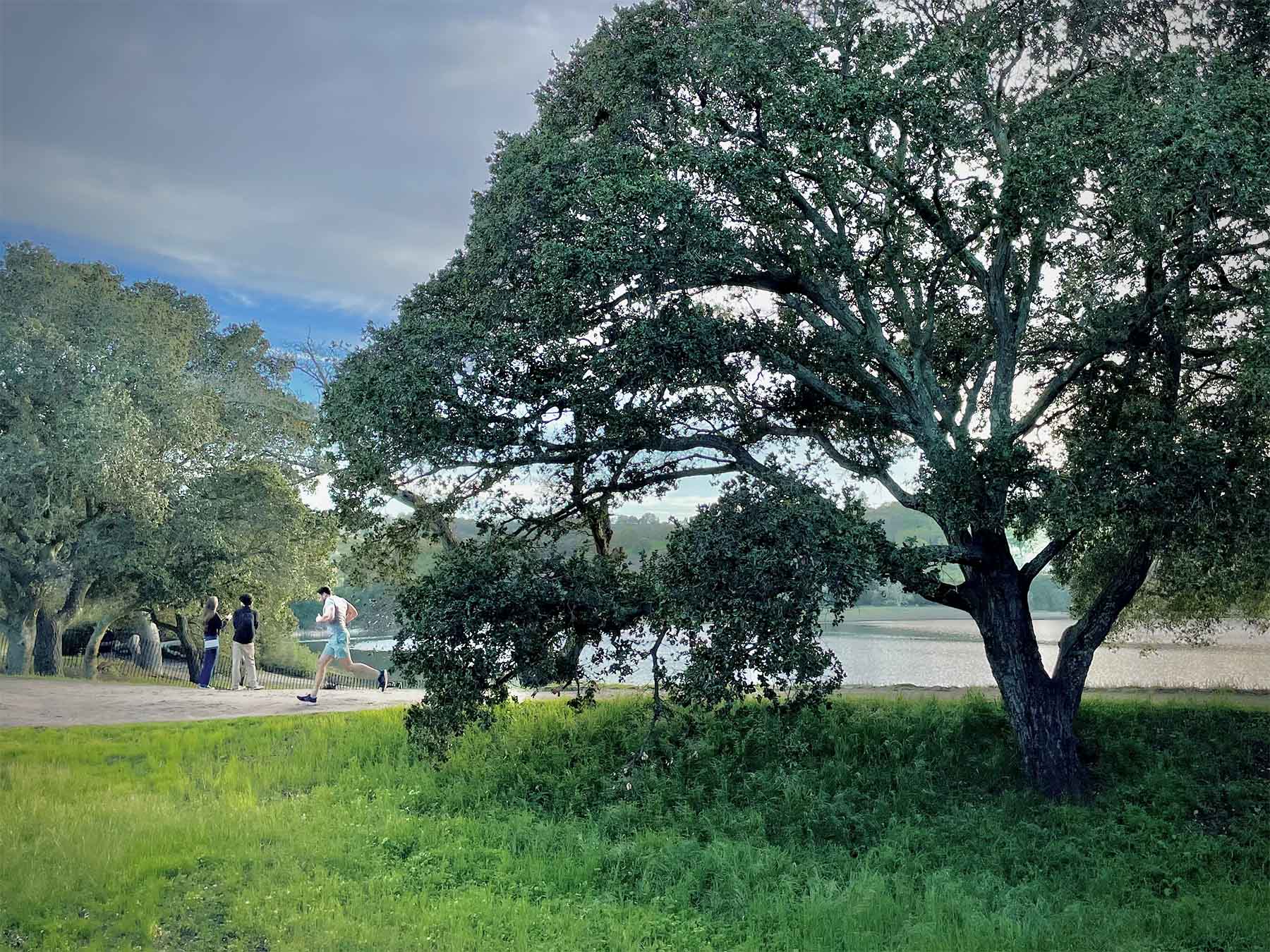

Truly indigenous to campus and by far its most abundant tree, coast live oak is the one to know if you learn only a single tree here. Stand anywhere and look around; chances are one is in sight – evergreen (the “live” part of its name), with tough dark green leaves, cupped and edged with a few spiny teeth. Most leaf undersides bear tufts of hair where the secondary veins meet the midvein – an important diagnostic missed by Luis Née, the European botanist who first described it. These tufts may serve as domatia (think “domestic”), tiny abodes for mites. The ashen bark begins smooth in youth, later cracking into gray-brown furrows as the trunk thickens.
In March, creamy catkins of male flowers dangle from the crown, releasing clouds of wind-borne pollen – alas, oaks are highly allergenic, and coast live oak is no exception. Female flowers are inconspicuous (most lovers of oaks live and die without ever noticing them), squatting in leaf axils at twig ends, developing into bullet-like acorns 1–1½ inches long. The acorns can be distinguished from the valley oak’s by the cup’s fine, overlapping scales rather than knobby ones, and sometimes by longitudinal striping along the nut itself.
Acorns germinate all over campus, seemingly pushing out of every hedge. Acorn woodpeckers custom-drill holes in trees and in wood siding, including the ornamental wooden panels on Littlefield Center; I’ve watched them hammering there in broad daylight. The Board of Trustees used to meet in that building, but – perhaps significantly – not anymore.
Agrifolia is a Medieval Latin form of aquifolium, meaning holly (Italian agrifoglio). Aquifolium means sharp-leaved (aqui- ultimately from acer, sharp). Encina, the name given it by the Spanish settlers – after the dominant live oak of Europe – bears no kinship to Encaenia, the old Greek word for a festival of dedication, and still the name of formal ceremonies at Oxford and a few American colleges around commencement. Stanford has already borrowed one Cambridge tradition: the Lessons and Carols service held annually at King’s College, which Memorial Church has made its own. Why not borrow Encaenia, too, for departmental graduation ceremonies held beneath our encinas?
Significant specimens
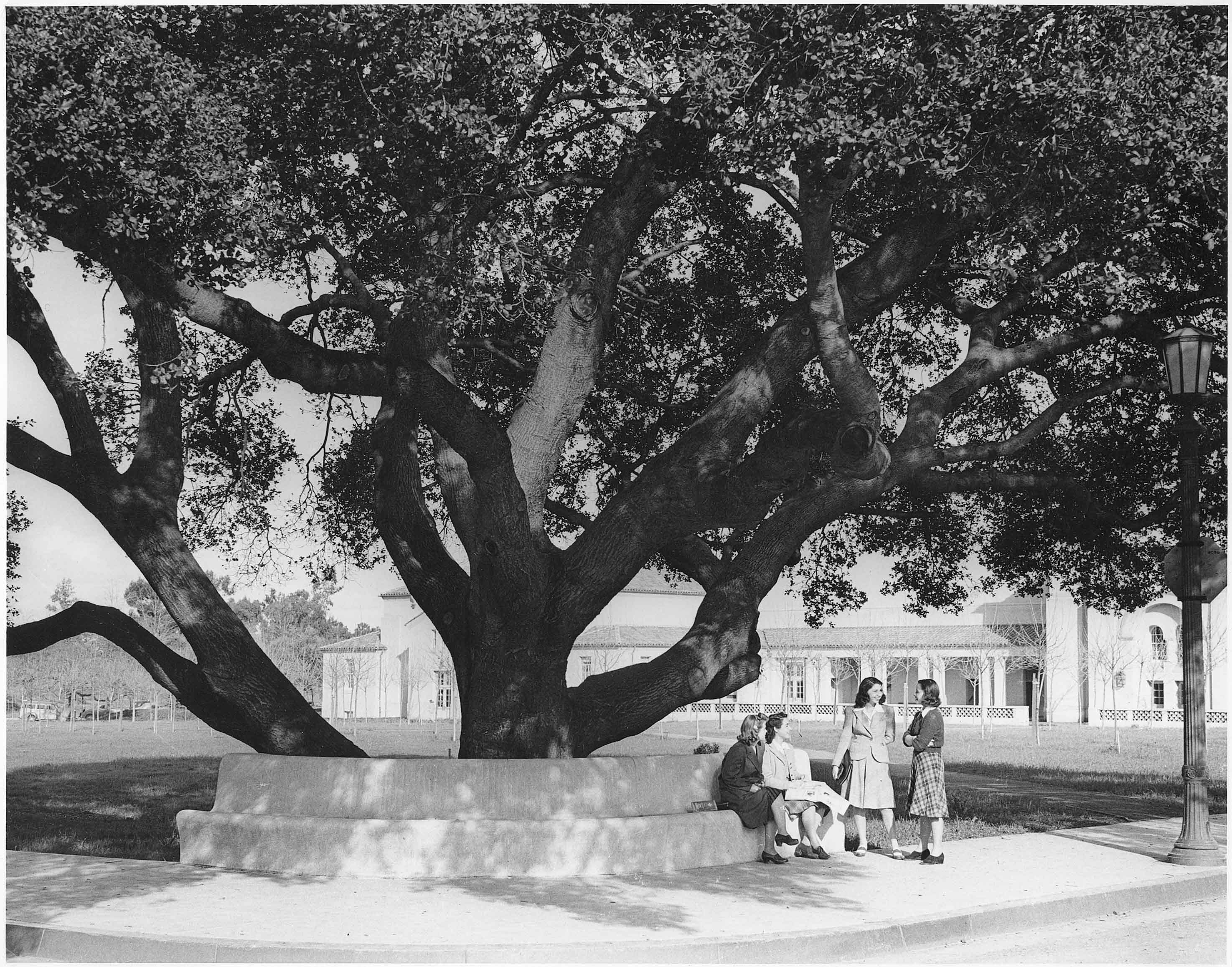
Stanford’s class of 1895 – the Pioneer Class – adopted as its own a magnificent round-crowned coast live oak just northwest of the Inner Quad, then an isolated specimen with only bare fields between it and the women’s dormitory to the west (now the site of Packard Electrical Engineering). At its dedication, it was hailed as a pioneer tree in its own right, and the most “distinct and noteworthy” on campus. The ’95 Oak was cut down in 1901 to make way for the Outer Quad; it had stood at approximately where the sunken court lies behind Math Corner.
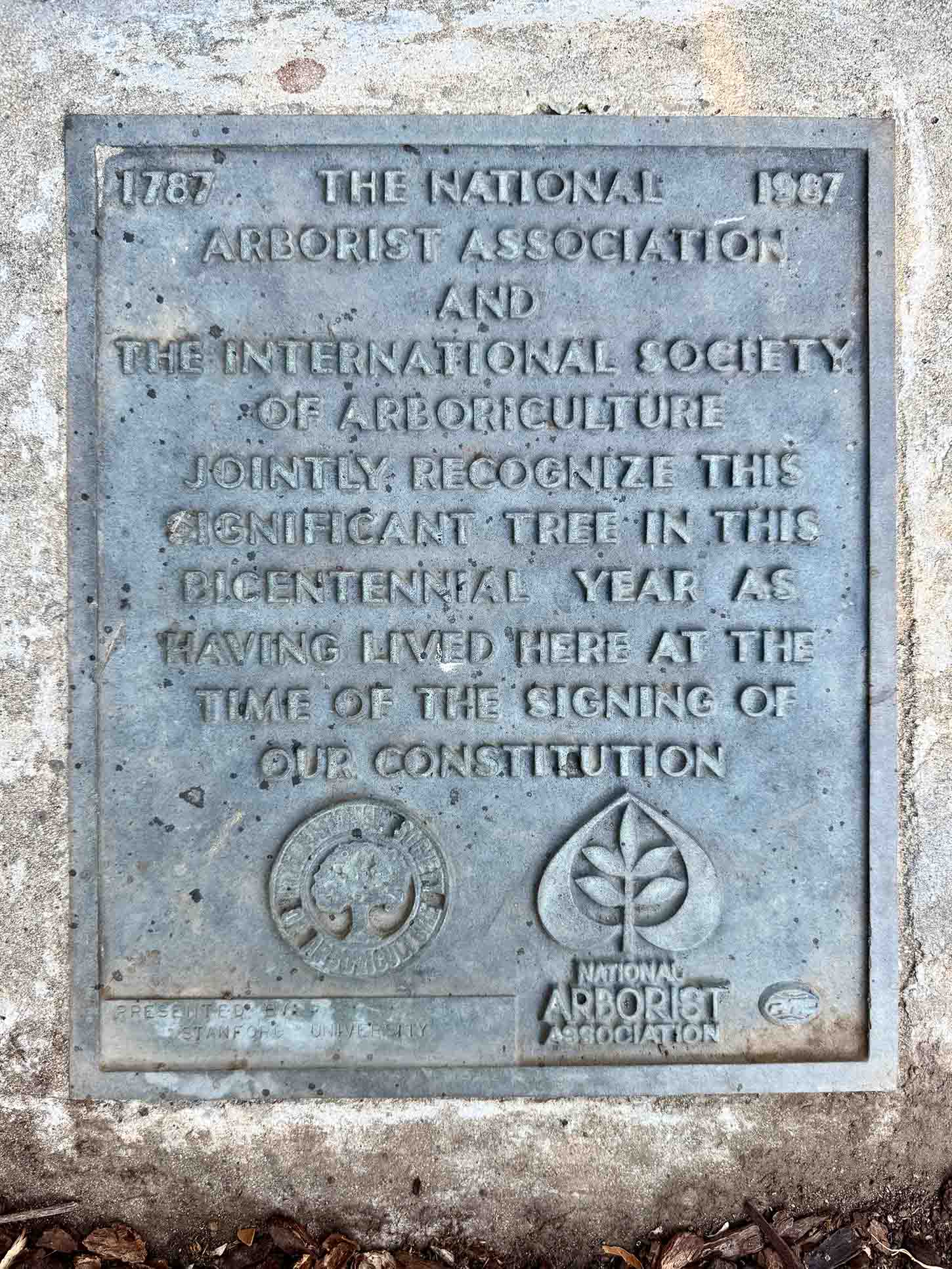
In 1945, at its fiftieth reunion, the Pioneer Class sought another oak to claim and, in a re-dedication ceremony, named a grand specimen at the northeast corner of Jane Stanford Way (then Serra Street) and Lasuen Mall as the ’95 Oak. In 1966, when the Graduate School of Business building (now Lathrop Library) rose on that corner, the Pioneer Oak was reportedly renamed the Alumni Oak, though the name never took hold. At the 1987 bicentennial of the U.S. Constitution, a plaque was installed asserting that the tree was already alive when that charter was signed in 1787, giving rise to the alternative name Bicentennial Oak. Cut down in 2008 after major sections collapsed, the tree has since resprouted from the stump into a two-trunked form, now nearly full height. Pioneer Oak remains the most fitting name, a living link to Stanford’s first graduating class.
Another of the university’s most storied oaks once kept sentinel at the Mausoleum until removed in 1993, claimed by leaf and twig diseases cryptocline and diplodia. Estimated at some 300 years old, it rose 70 feet, with a trunk 55 inches across and a canopy spreading 120 feet. Not entirely lost, wood from its bole now forms the patterned veneer on the round table in the rotunda of Green Library’s Bing Wing.
Other venerable specimens have followed in recent decades: one south of Arrillaga Alumni Center (removed 2012), another to the left of Green Library’s Bing Wing entrance (2019), and the Gordon Hampton oak at the southwest corner of Campus Drive and Galvez Street, with its plaque recounting a 1931 Big Game escapade (2020). A replacement for the latter tree, planted in 2022 and informally dubbed Gordon Hampton Junior, is thriving – and has acquired a plaque of its own.
Two fine examples grow in front of Lagunita Court. See massive specimens in the inner court of Governor’s Corner alongside several valley oaks. Behind the Mausoleum, a decades-old fallen tree still grows vigorously, its branches having become upright oaks in their own right.
The Rinconada Oak, Palo Alto’s second Heritage Tree (after El Palo Alto) is over two centuries old, 52 inches across and 75 feet tall, in Rinconada Park along Embarcadero Road. A cabled giant at the north corner of the house at Filoli in Woodside was estimated to be 340 years old in 2018.
Mature transplants

Seeing coast live oaks and other mature trees in large transplanting boxes is commonplace on campus. Stanford’s extensive transplant program began in 1996 with planning for the Science and Engineering Quad; Serra Grove, west of the Main Quad, was established with transplants from that site.
In May 2017 a 275-ton transplant was moved just across Pasteur Drive to make room for the planned BioMedical Innovations Building. It did not survive crossing the road and was removed two years later.
In 2015, large oaks were removed in massive transplanting boxes in preparation for the David and Joan Traitel building on Lasuen Mall.
A mature coast live oak at Homer Park, across from 315 Homer Avenue, Palo Alto, was successfully transplanted in August 2003 at 35 feet high; it weighed nearly 35 tons.
Gallery
- Main References for New Tree Entries.
- Coltharp, Erin, Chloe Knowd, Ella Abelli-Amen, Andrew Abounayan, Sophia Alcaraz, et al. 2021. “Leaf Hair Tufts Function as Domatia for Mites in Quercus agrifolia (Fagaceae).” Madroño 67 (4): 165–69.
- Daily Palo Alto. 1894. “Miss Kate Herrick.” April 14. (Re. dedication of original ’94 Oak.)
- Daily Palo Alto. 1895. “Commencement Week.” May 9. (Re. Pioneer plate to be affixed to the tree.)
- Fairley, David, George L. Batchelder. 1986. “A study of oak-pollen production and phenology in northern California: Prediction of annual variation in pollen counts based on geographic and meterologic factors.” Journal of Allergy and Clinical Immunology, 78(2), 300-307.
- Née, Luis. 1801. “Descripcion de varias especies nuevas de Encina (Quercus de Linneo). Por D. Luis Née.” Anales de Ciencias Naturales 3:271–272.
- Sarkar, Urmimala. 1993. “Dying oak tree to get the ax.” The Stanford Daily, February 25. (Re. Mausoleum oak.)
- Stanford Alumni Review. 1945. “Old-Timers, 100 Strong, Attend ’95 Class Reunion; University Re-dedicates Oak to Pioneer Class.” July, 1945, p. 8 (e-reader p. 338).
- Stanford Report. 2008. “Bicentennial Oak Now History, but Wood Being Saved.” June 19.
About this Entry: Authored Aug 2025 by Sairus Patel. Last updated Oct 2026 (SP).

