

Quercus lobata
 valley oak, roble

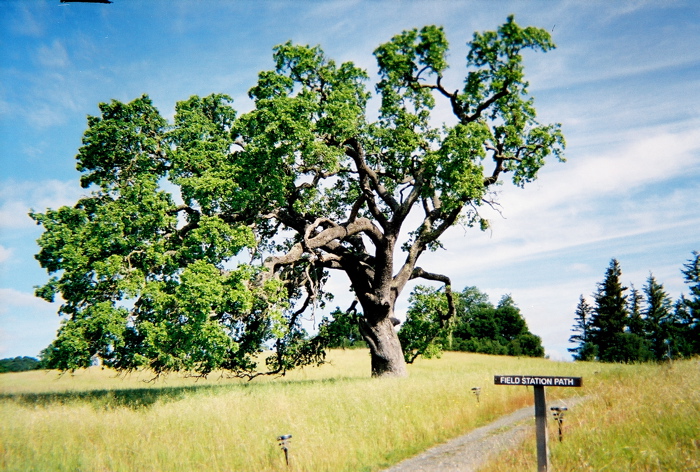
Quercus lobata, once reigning over the rich alluvial floors of California’s interior valleys, is the state’s classic white oak, much as Q. alba is to the forests of the eastern United States and Q. robur to the woods and parklands of Europe. Its deeply lobed leaves earned it the name lobata from a botanist who never beheld the living tree. On thick trunks, the bark is more coarsely and deeply furrowed than in blue oak, sometimes developing a checkered aspect. Likely the tallest of North American oaks, the largest known valley oak stands in Covelo, California, 153 feet high and more than 28 feet in girth. It often rises straight up in its first few decades, then branches out into an immense canopy of long sinuous limbs.
Valley oak and coast live oak are the principal native oaks of main campus. A monumental specimen grows between 24 and 25 Olmsted Road in Escondido Village; another fine example is between 708 and 712 Salvatierra Street. The most conspicuous exemplar on central campus, north of the Bookstore, is not looking particularly vigorous. Many of its leaf lobes are oddly pointed, suggesting hybrid influence, though the species has notoriously variable leaves. Sizable valley oaks can be found along Santa Teresa Lane and Arboles Avenue, and in parking west of there. A spreading specimen rises from the center of Lyman Commons. Valley oak is oddly absent from Palo Alto’s list of heritage trees; good contenders are at 300 Homer Avenue and 450 Sequoia Avenue.
Frank Lloyd Wright designed Hanna House (737 Frenchmans Road) in 1936, nestled among a grove of scrawny valley oaks and a Monterey cypress. With attentive care over nearly a century, including the propping of great outstretched limbs, the oaks have matured into magnificent creatures of immense presence.
Valley oak limbs are sometimes adorned with clumps of mistletoe, most visible in winter when the branches are bare, as well as with round, brown, golf ball–sized oak apples – galls formed from the plant’s own tissue in response to wasps depositing their eggs. Other smaller galls, some intricately shaped or brightly colored, may be found on their leaves. Tiny jumping galls are sometimes seen under the tree, the larvae inside contracting their muscles and pressing against the gall walls to bounce towards shade – much like a Mexican jumping bean – where they later complete their development.
Gallery
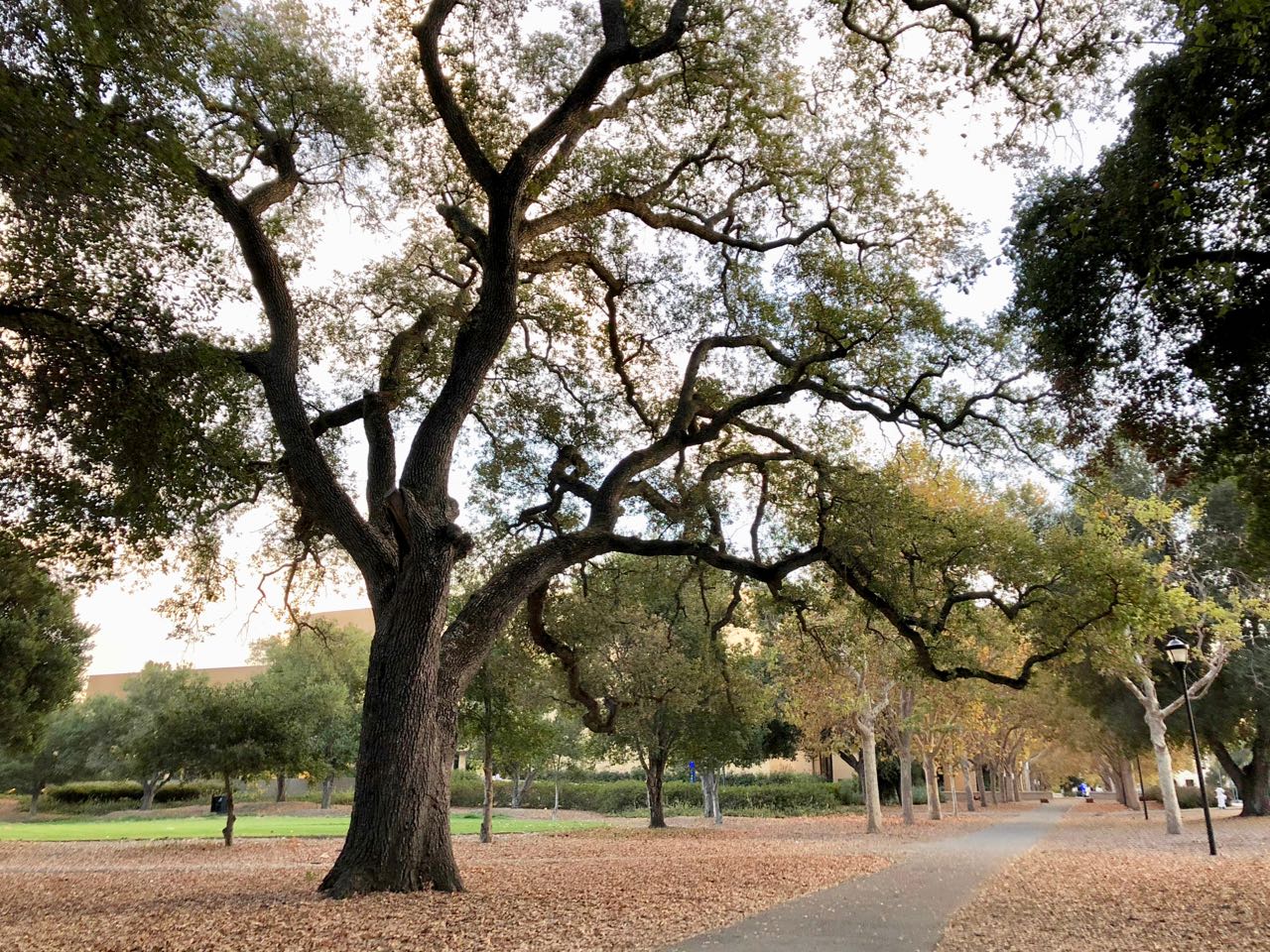
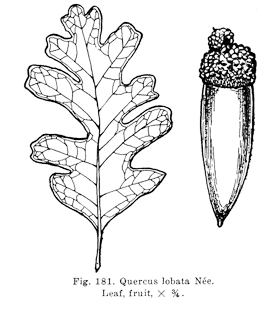
Illustrations: Jasper Ridge Quercus lobata on Flickr.
- Main References for New Tree Entries.
- City of Palo Alto. 2026. “City of Palo Alto Heritage Tree List” at www.paloalto.gov, accessed 11 Jun 2026.
About this Entry: Authored Aug 2025 by Sairus Patel. Updated Jun 2026 (SP).

