

Malus
 apple, crab apple

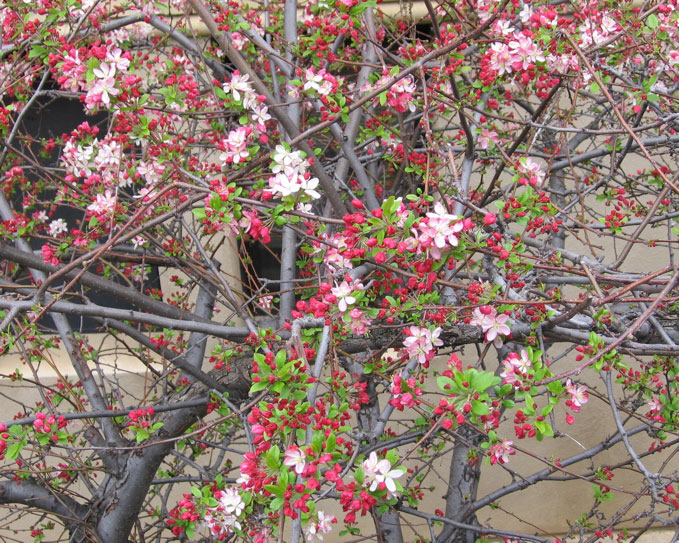
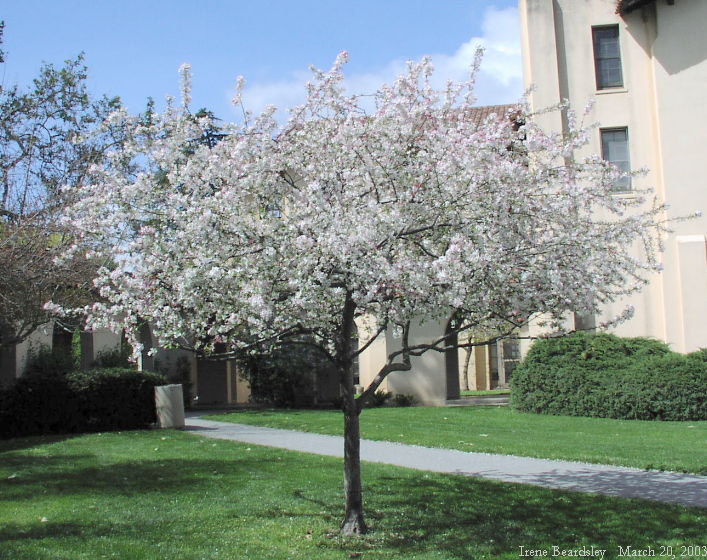
Crab apples of different species grow wild from England to Japan and in America and have a long history of cultivation. Consequently there are now innumerable varieties of these reliable ornamental trees to choose from. Campus plantings are mostly M. × floribunda (Japanese, or showy, flowering crab), but M. baccata (Siberian crab) and M. × purpurea (Aldenham crab) have also been reported. Four showy medium-to-dark pink flowered varieties can be seen in the courtyard of Toyon. Another stout crab apple is nearby, at the northeastern corner of Encina Commons, in the courtyard. Two grow in the sunken area just south of Margaret Jacks Hall (Building 460) in the Outer Quad. Japanese flowering crabs are in the Bechtel Courtyard lawn at Littlefield Center; two flank the front path at 680 Salvatierra Street. The varieties ‘Callaway’ and ‘Prairifire’ are at Bing Nursery School. Pink-petaled ‘Centurion’ is on the right at 708 Salvatierra Street, and at 1570 Cowper Street in Palo Alto.

Trees for ornamental purposes or for shade have been developed by selective cultivation for thousands of years in some parts of the world; fruit trees have an even longer history. However, it is rare to find fruit trees in our public spaces. Apples, avocados, guavas, jujubes, kumquats, lemons, loquats, olives, oranges, persimmons, pomegranates, strawberry trees, and walnuts are among the few exceptions.
See an old fruiting apple (M. domestica) on the left of the stairs at Owen House (552 O’Connor Lane), originally from the yard of the Griffin-Drell House before both tree and house were transplanted just across the street to their current locations in 2006 when the Munger complex was built. Persis Drell recalls the tree being planted in the back yard in the 1970s, replacing an ancient apple felled by a downed eucalypt in a storm. The rosy fruit are large and tartly sweet. Another apple is on the southwestern corner of Jenkins (251 Governor’s Avenue). At 657 Santa Ynez Street and around the corner onto Salvatierra Street, three remain of nine varieties of apple.
There are about 7,500 varieties of apple. As the world’s No. 1 fruit, it has a history far older than all others, having been picked by Eve (so say certain traditions), who was cynically deceived by the serpent in the Garden of Eden. Atalanta the huntress, cared for by a she-bear after having been exposed at birth, could outrun anyone but was snared by the wily Milanion with the aid of apples unfairly provided by Aphrodite. Snow White was the victim of a poisoned apple prepared by the wicked queen. On the bright side, an apple figured in saving the life of the son of William Tell.
Malus is from the Greek melon, for apple, which of course is also applied to certain other fleshy fruits. Malum meaning wicked in Latin has led to wordplay-based tradition that the fruit that Eve picked, unnamed in the Bible, was the apple.
Image gallery

About this Entry: The main text of this entry is from the book Trees of Stanford and Environs, by Ronald Bracewell, published 2005. Updated number of apple varieties (ref. Elzebroek, Ton; Wind, Koop (2008). Guide to cultivated plants.); added and updated locations; edits (Mar 2024, SP). Salvatierra locations, Centurion locations, Malus etymology added (Apr 2025, SP).

