

Eriobotrya japonica
 loquat

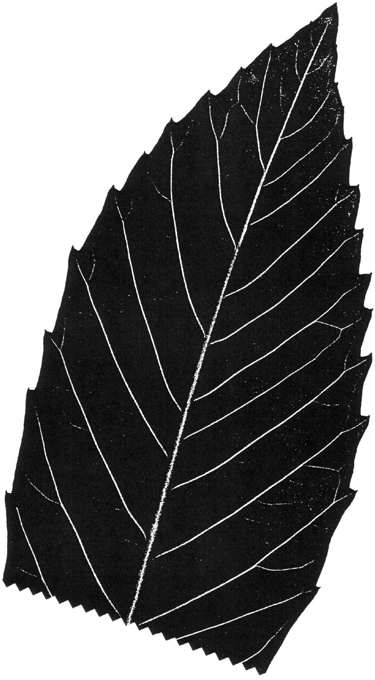
One of the most attractive broadleaf evergreens, lending a tropical air with its immense, glossy leaves – oval, pointed, and up to a foot long – with impressed veins giving a ribbed or quilted effect. Young leaves emerge pale green and upright, then droop and darken as they mature. The handsome bark is often overlooked: irregular patches of grays and browns, cracking off to reveal a striking inner layer of burnt orange, a deeper echo of the ripe fruit though quite unrelated in chemistry. (The tropical jackfruit, Artocarpus heterophylla, shows a similarly hued inner bark.)
The scented white flowers come in late fall and into winter, subtler in both fragrance and showiness than those of bronze loquat. Clusters of fruit follow, ripening to the size and color of apricots in spring to early summer – especially vivid against the dark foliage. The fruit is sometimes pear-shaped, and is coated in a light fuzz, best wiped away before eating; within are smooth, glossy brown seeds, a surprise to those expecting a rough, stonefruit-like pit.
The genus name derives from Greek erion, woolly, and botrys, a cluster of grapes – referring to the bunches of downy fruit. Japonica is a geographical misdirection, belying its Chinese origin; the tree has been cultivated in Japan for more than a millennium. For the Chinese etymology of “loquat,” see Citrus Notes.
Frederick Law Olmsted specified four loquats in a single Inner Quad circle in a sketch made around 1889 – set around ten palms, with shrubs and bamboo interwoven between them. Loquats were planted there in 1890, and have had a presence in that vast court until the 1970s or ’80s.
Today several are at Language Corner, with another south of Building 60. Four occupy an octagonal bed north of the historic Escondite Cottage, with another nearby. Most recently, a row of young loquats as been planted parallel to North Pasteur Drive near the above-ground garage there. Seedlings have appeared near the east entrance to Kingscote Gardens.
Loquats are well represented at a number of student residences. Two remain – whether originals or successors – of those planted by landscape designer Thomas Church at the north entrance of Florence Moore Hall when it was built in 1956. One in the west courtyard there is known for particularly plump, juicy fruit; residents have made upside-down loquat cake from its harvest on more than one occasion. Stern Hall has several in its south courtyard, laden with fruit that are all but ignored by students.
In the Arboretum, a white-fleshed variety removed in 2018 had lasted for at least forty years in the northeast corner of Palm Drive and Arboretum Road, perhaps cut down and resprouted more than once. Another old specimen still endures, untended, near the Angel of Grief.
Name derivation: See text above.
About this Entry: Authored Apr 2026 by Sairus Patel.

