

Sequoiadendron giganteum
 giant sequoia, Sierra redwood, big tree
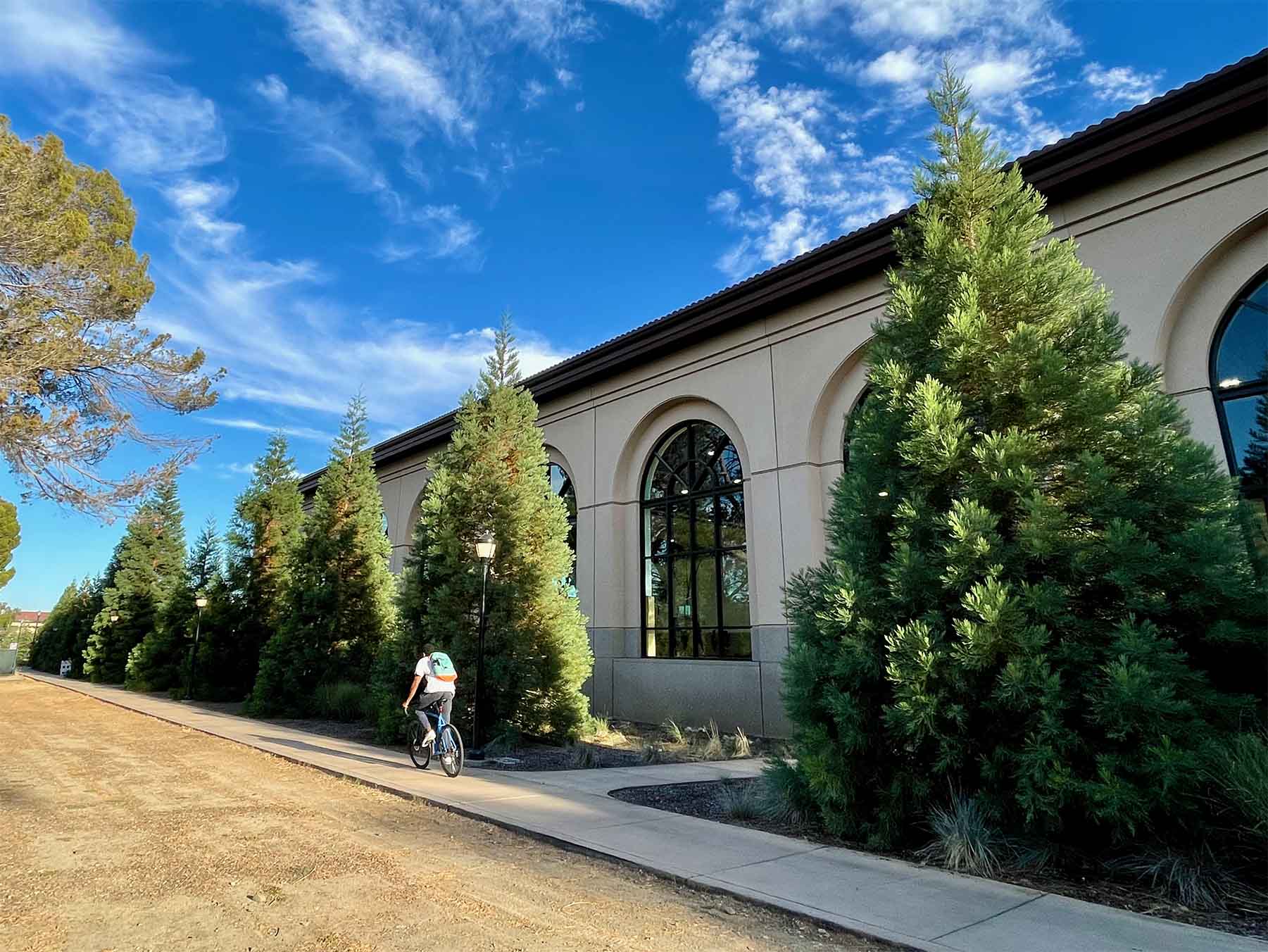
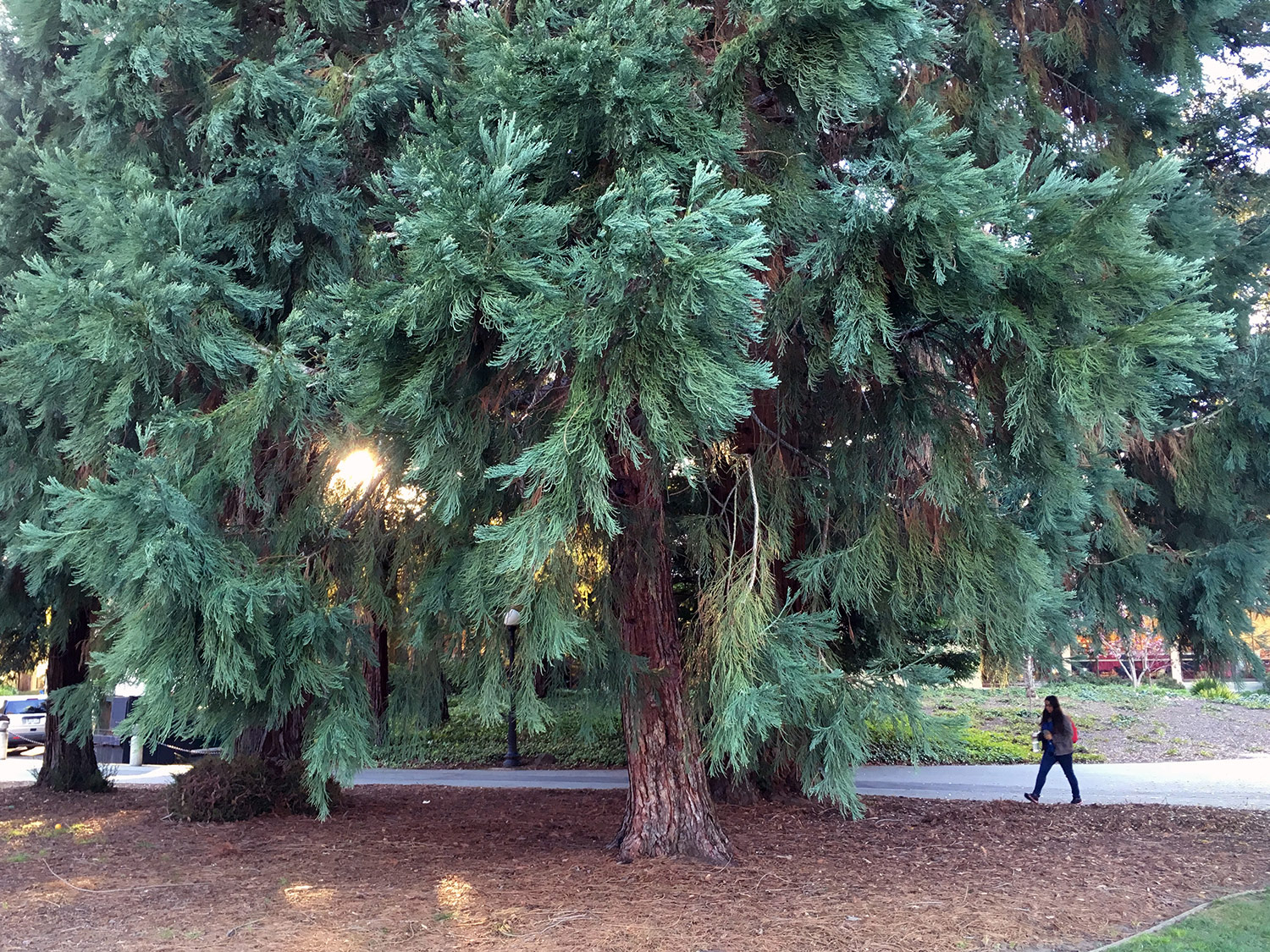
The well-known big trees, or giant sequoias, need no introduction. They grow to around 300 feet and live to over 3000 years. The bark and cones resemble those of the coast redwood, except that the cones are at least twice as big, but the leaves are quite different, being small and packed tightly like tiles around the branchlets.
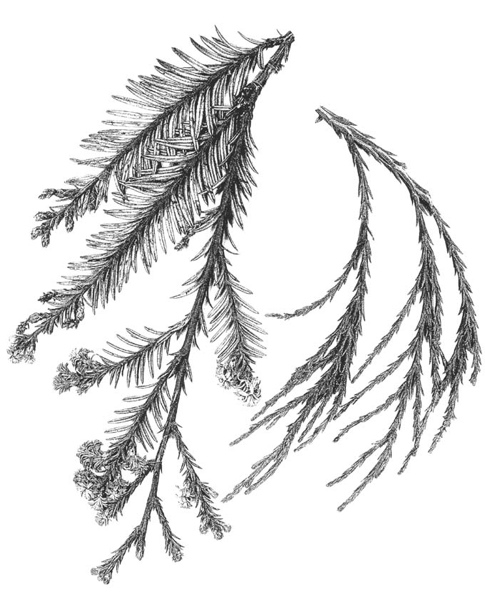
Perhaps campus residents are deterred by visions of trunks wide enough to drive a car through, but growth is relatively slow; as a result the giant sequoia does not drop much litter (a problem with coast redwood) and the tiny awl-shaped leaves, at most ½ inch long, melt inoffensively into shrubbery.
Giant sequoias are not as hungry for water as coast redwoods. They may not be as tall either, but, with their greatly larger girths, may contain twice the weight of wood, around 1300 tons. The mass of such a tree is hard to appreciate. Imagine 45 automobiles, each weighing 2 tons, balanced precariously on top of one another to match the height of a giant sequoia; that would be 90 tons, rather more than the weight of a big whale. The weight of a mature giant sequoia is more than 14 times greater.
Fossil evidence shows that this tree once grew in Europe.
Like the incense cedar, it typically grows well on campus for a few decades into beautiful young trees before their leader branches suffer wilting and dieback from Botryosphaeria canker.
Locations
Peter Coutts planted a pair of giant sequoias at the north end of his lake, now Frenchman’s Park, in the 1870s. They are echoed currently by a pair of incense cedars. Giant sequoia was cultivated in the Arboretum from 1889, including from seed, and for some years afterward. When President Benjamin Harrison visited on April 29, 1891, five months before the University opened, eight giant sequoias were planted to commemorate him and other notable figures. The choice was apt: the previous year, Harrison had signed into law the creation of three national parks, including Yosemite and Sequoia, the latter established specifically to help protect this magnificent species. In those early years, giant sequoias served repeatedly as commemorative trees on campus. Alas, none remain from that era.

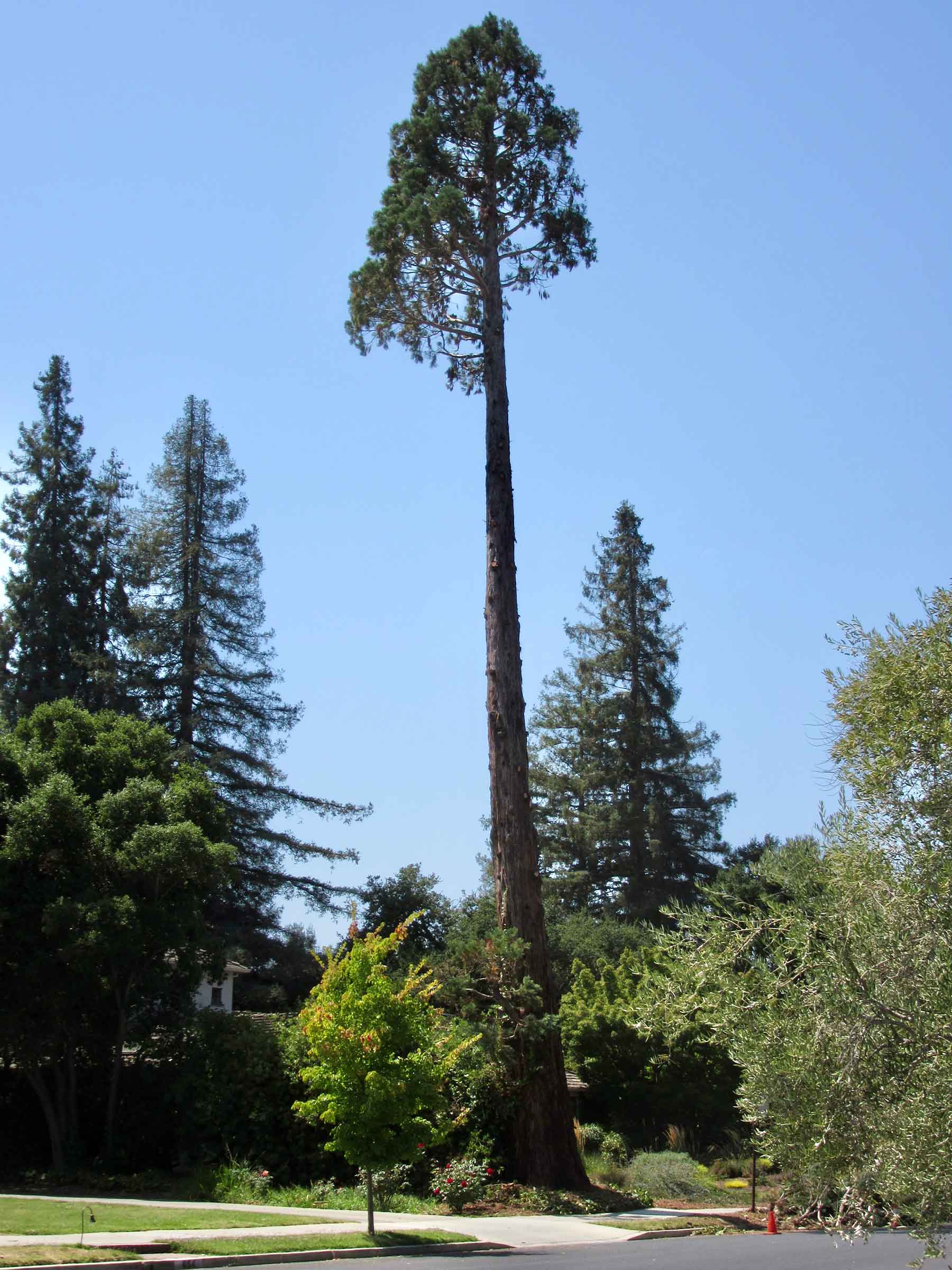
The specimen most centrally located on campus makes its home in Canfield Court, east of the Bookstore, growing in company with coast redwoods and deciduous dawn redwoods, allowing convenient comparison. Two specimens stand in front of Storey House (544 Lasuen Mall). Another pair is on the east side of Keck Science Building at the California Native Garden, appropriately enough. In the faculty housing area, specimens have been lost over the decades, including a sizable specimen between 676 and 694 Alvarado Row dating to 1930, over 58.5 feet in circumference and about 100 feet tall when it was removed in 2017. One still remains of a trio at 817 Pine Hill Road.
Giant sequoia has been featured in some major plantings since 2005. A formidable plantation of 32 edges three sides of the Arrillaga Outdoor Education and Recreation Center on Santa Teresa Street. Another similarly sized planting fronts the Arrillaga Family Sports Center and the median of Campus Drive in the vicinity. Twenty rim the north edge of Frost Amphitheater, outside the fence, with a few extending into the lawn of Bing Concert Hall.
On Lomita Drive at Harmony House, there is a crazy cultivar named ‘Pendula’, about 10 feet tall, that looks more like a praying mantis than a tree. The younger half of the trunk is horizontal; there are a few short vertical leaders, but they are doomed to fall of their own weight and hang down as all their numerous predecessors have done. A striking young S. giganteum, rapidly reaching upward in the form of a narrow cone, is in Serra Grove, off Jane Stanford Way at Sequoia Hall. Distinguished by its intense blue coloration, it is a cultivar named ‘Hazel Smith’, planted in 2002.
Nomenclature
The giant sequoia has gone through a flurry of botanical name changes on both sides of the pond, including Wellingtonia gigantea and Sequoia gigantea. The correct name is now widely accepted as being Sequoiadendron giganteum. For a rather entertaining account of its nomenclatural journey, see its entry in the Gymnosperm Database. In a Kew Gardens grove the sign still uses the name Wellingtonia (Wellingtonia gigantea Lindley 1853), as of 2005.
Sequoiadendron, Sequoia, and Metasequoia were all part of the Taxodiaceae, but are now considered to be in the Cupressaceae.
Name derivation: Sequoiadendron – combination of Sequoia and the Greek dendron (tree); giganteum – giant
About this Entry: The main text of this entry is from the book Trees of Stanford and Environs, by Ronald Bracewell, published 2005. John Rawlings edited nomenclature discussion, added Botryosphaeria note ca. 2010. Sairus Patel reorganized entry, added recent planting locations & images, updated family from Taxodiaceae to Cupressaceae Mar 2017. Added Alvarado Row removal and dimensions (ref. José G. Pérez); removed 525 Los Arboles Avenue, 1519 Mariposa Drive; added Storey House; all locations up to date (Jan 2023, SP). Harrison and early history added; edits (May 2024, SP).

