

Schinus polygama
 Chilean pepper tree
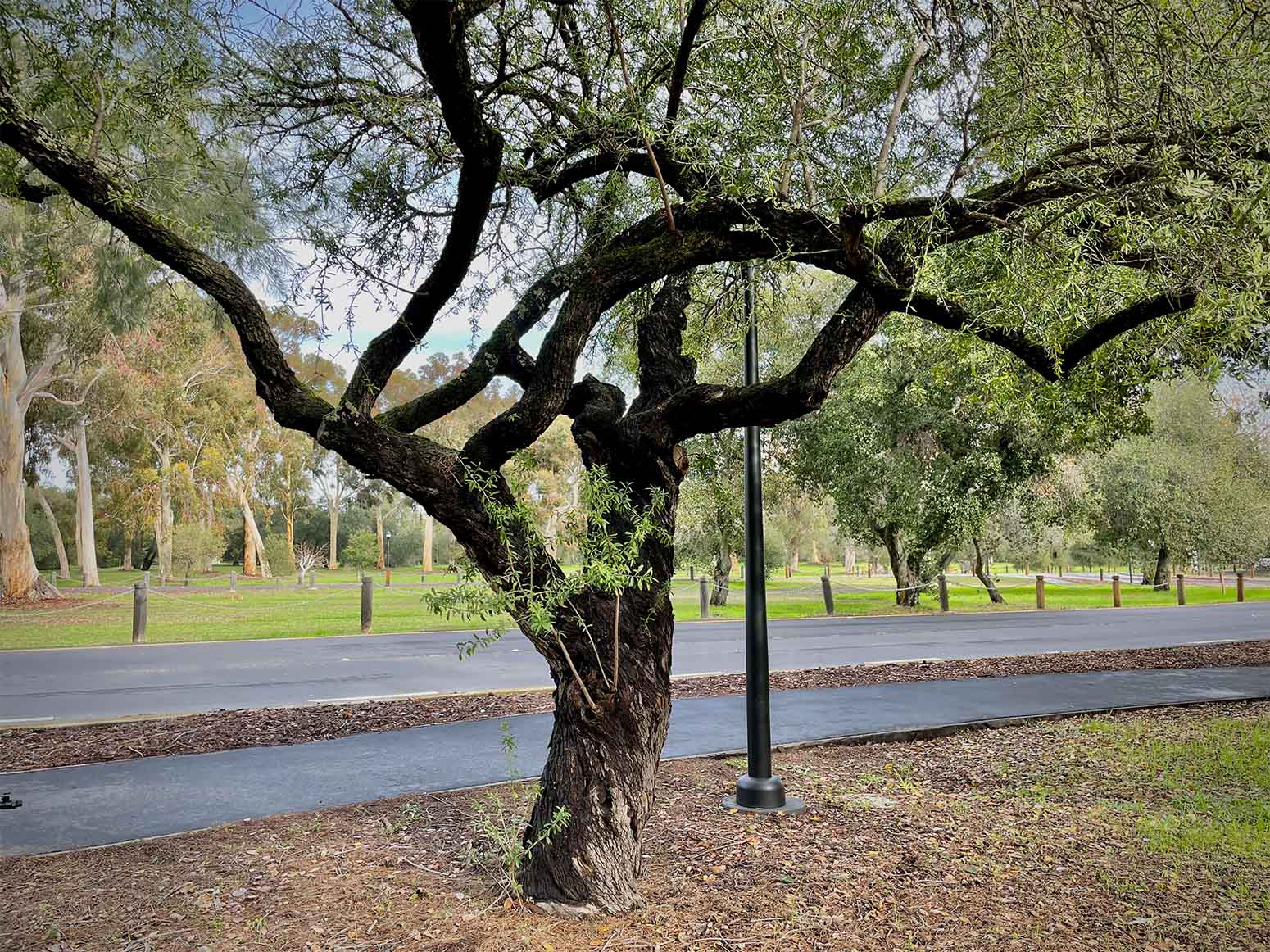
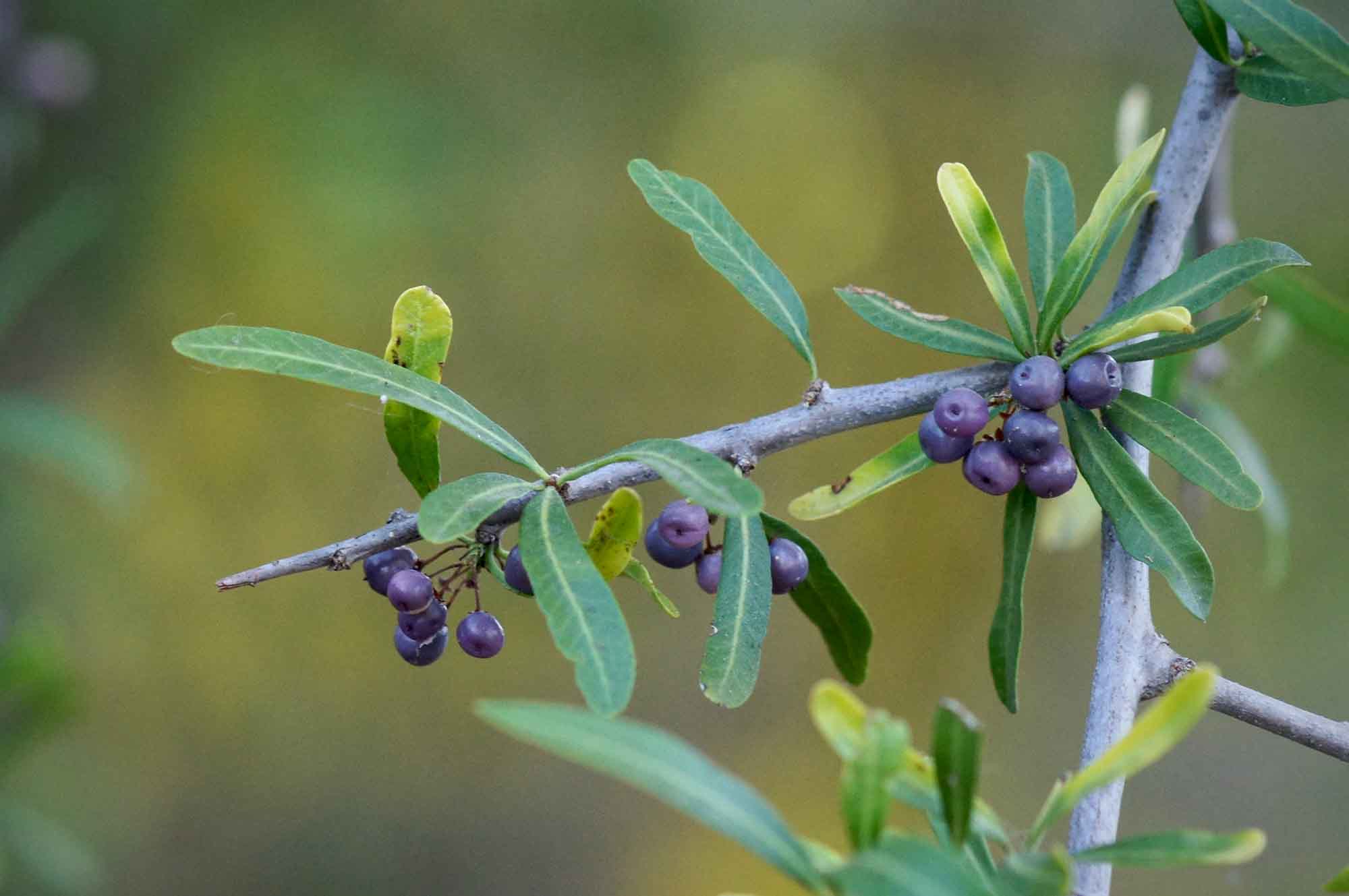
This tangled shrub or small tree was planted as an ornamental in California and even occasionally used as a street tree, though it has long since vanished from planting lists. Remnants still survive at Stanford, usually along property edges and on the slopes of The Dish.
Its leaves are simple, not pinnately compound as in the other two pepper trees on campus, and release no peppery scent when crushed. When Linnaeus first described the genus in 1753, five of the six species he named were compound-leaved; however, most Schinus species in fact have simple leaves. The broader-at-the-tip leaf shape, together with the stiff spines at the ends of shoots, often lead to confusion with pyracantha. But the leaf undersides are green, rather than whitish, and the blades tend to lie flat rather than folding slightly along the midrib. It has also been confused with S. longifolia, a species virtually unknown in this country and one that lacks the downy leaf stalks one sees in S. polygama. A recent study proposes that the spiny, interlaced structure – described as a cage-like growth form – likely evolved as a deterrent to browsing mammals in its native Chilean haunts.
Small yellowish flowers emerge in the spring and summer, maturing into attractive tiny purple fruit.
An old, picturesque tree is on Campus Drive near the Anderson Collection. Others persist along property margins: a tangled thicket of trunks and branches, possibly campus’s largest, is on the right at 625 Mayfield Avenue. Another is clipped into a hedge at Lane B near Coronado Avenue. Younger ones, likely volunteers, appear near the periphery of Frenchman’s Park along Gerona Road south of Mirada Avenue. A thick-trunked specimen also survives on the northwest edge of Palo Alto’s Mayfield Park.
As with S. terebinthifolius, its name was changed from S. polygamus to S. polygama when a 2015 paper in Phytotaxa revealed the true gender of Schinus.

Name derivation: Schinus – Greek name for mastic tree (Pistacia lentiscus), which it resembles; polygama – having both imperfect (pistillate and/or staminate) flowers and perfect flowers on the same plants.
- Main References for New Tree Entries.
- Barker, Philip A. 1975. “Ordinance Control of Street Trees.” Journal of Arboriculture 1 (11) 212–216. (Re. lists the species in “Candidate Use” section.)
- Mathias, Mildred E., and Elizabeth McClintock. 1963. Checklist of Woody Ornamental Plants of California. Berkeley: University of California College of Agriculture. (Re. planted as an ornamental.)
- Silva-Luz, Cíntia Luíza da, et al. 2019. “Phylogeny of Schinus L. (Anacardiaceae) with a New Infrageneric Classification and Insights into Evolution of Spinescence and Floral Traits.” Molecular Phylogenetics and Evolution 133: 302–351.
- Zona, Scott. 2015. “The Correct Gender of Schinus (Anacardiaceae).” Phytotaxa 222 (1): 75–77.
About this Entry: Authored Jan 2026 by Sairus Patel.

