

Pseudotsuga menziesii
 Douglas fir
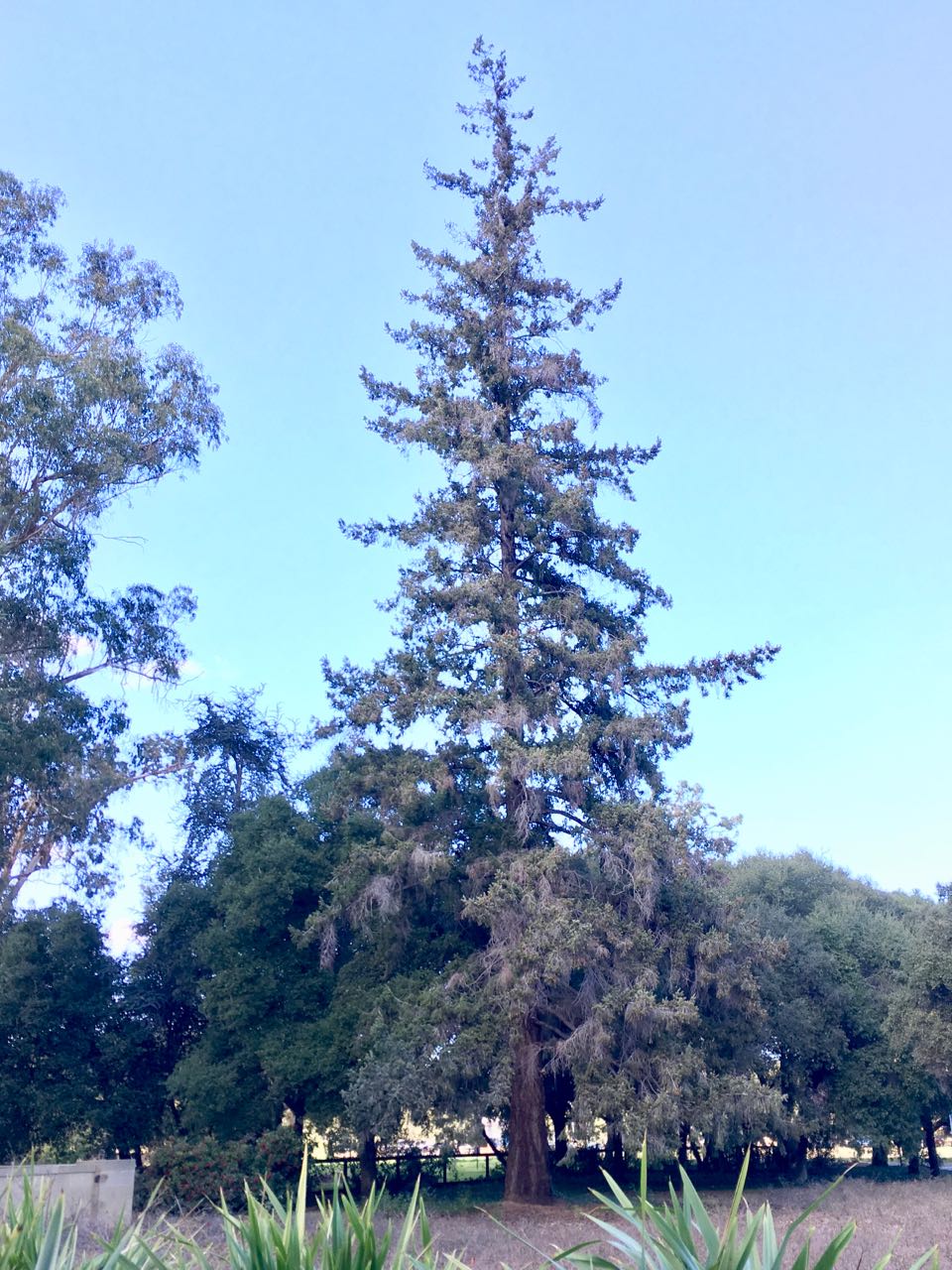
Native to the foothills running down to the campus, and a main constituent of the mixed evergreen forest of the Santa Cruz Mountains, the Douglas fir is the principal lumber tree of the United States (now that pines and redwoods have largely been exhausted). It is the leader in plywood production and contributes many other products such as bark wax for shoe polish.
A Douglas fir in Coos County, Oregon, is almost the tallest tree in the world at 327 feet, beaten in 2017 only by a Eucalyptus regnans in Australia (327.5 feet) and a coast redwood in Redwood National Park (380.1 feet). Douglas fir probably occupies the most area of land among California conifers – for the time being. Douglas fir plantations were established in England in the early 19th century as a source of masts.
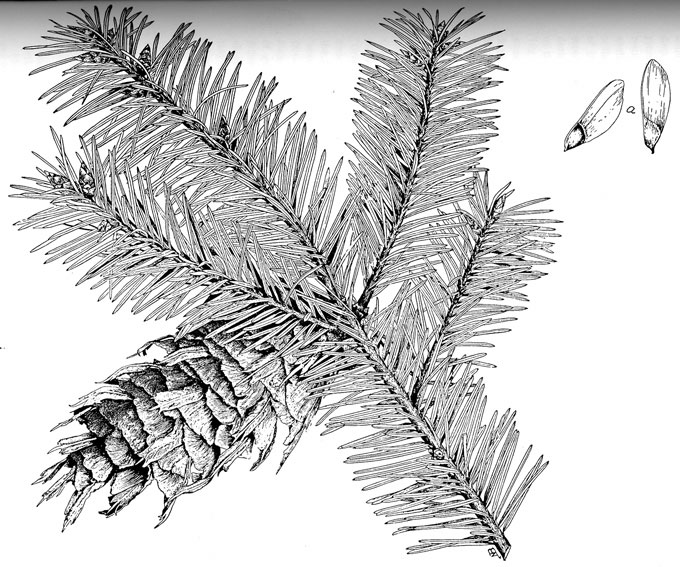
The Douglas fir is identifiable with certainty by its characteristic pendent 3-inch cones, which are not as woody as most, and show long thin three-pointed bracts protruding between the cone-scales. The general form and texture of the foliage permit it to be recognized at a glance from a distance. Clearly, problems for future generations can be created in built-up areas by the use of large trees, but more honor should be accorded this noble native of our area by planting of a few groves.
Locations
See a specimen 70 paces north of the west entry gate at Palm Drive and El Camino Real (map). An individual about 70 feet tall, rather sickly looking in 2017 and the survivor of a pair, is located approximately 70 yards from the north end of the avenue of Atlas cedars and blue gums (and a single incense cedar) that runs toward Palm Drive from the intersection of Campus Drive and Lasuen Street (map). A specimen north of where Memorial Way runs into Galvez Street and one at 824 Mayfield Avenue were found to be missing February, 2018, the former probably due to construction.
A handsome specimen near campus is at 2067 Oberlin Street, on the right. Two nearby, at 1612 California Avenue, were removed around 2016. Other Palo Alto Douglas firs include a large individual about 20 yards in from the sidewalk at 1043 Parkinson Avenue, and one on the far right at 875 Melville Avenue (the one on the far left died and was removed in 2017, weakened by drought and then a beetle infestation in its roots). One reported at 1585 Mariposa Drive was not present in February, 2018.
Nomenclature
The name Douglas fir commemorates Scotsman David Douglas (1798–1834), who collected the species along the lower Columbia River in 1824. He collected plants from Hudson Bay to California for the Royal Horticultural Society (London), bringing back many wild flowers (such as Clarkia, Gilia, Mahonia, Mimulus). Moving on to Honolulu, he sadly fell into a pit trap, into which a young bull had fallen, and was gored to death in 1834, aged 36.
Pseudotsuga alludes to its similarity to hemlock (Tsuga); menziesii honors Archibald Menzies (1754–1842), a Scottish surgeon and botanist who collected plants with the Vancouver expedition.
Illustrations: Jasper Ridge photo archive.
About this Entry: The main text of this entry is from the book Trees of Stanford and Environs, by Ronald Bracewell, published 2005. In Feb 2018, Sairus Patel checked all locations (descriptions clarified, removals noted, Oberlin Street location added), and revised tall tree notes.

