

Prunus laurocerasus
 English laurel
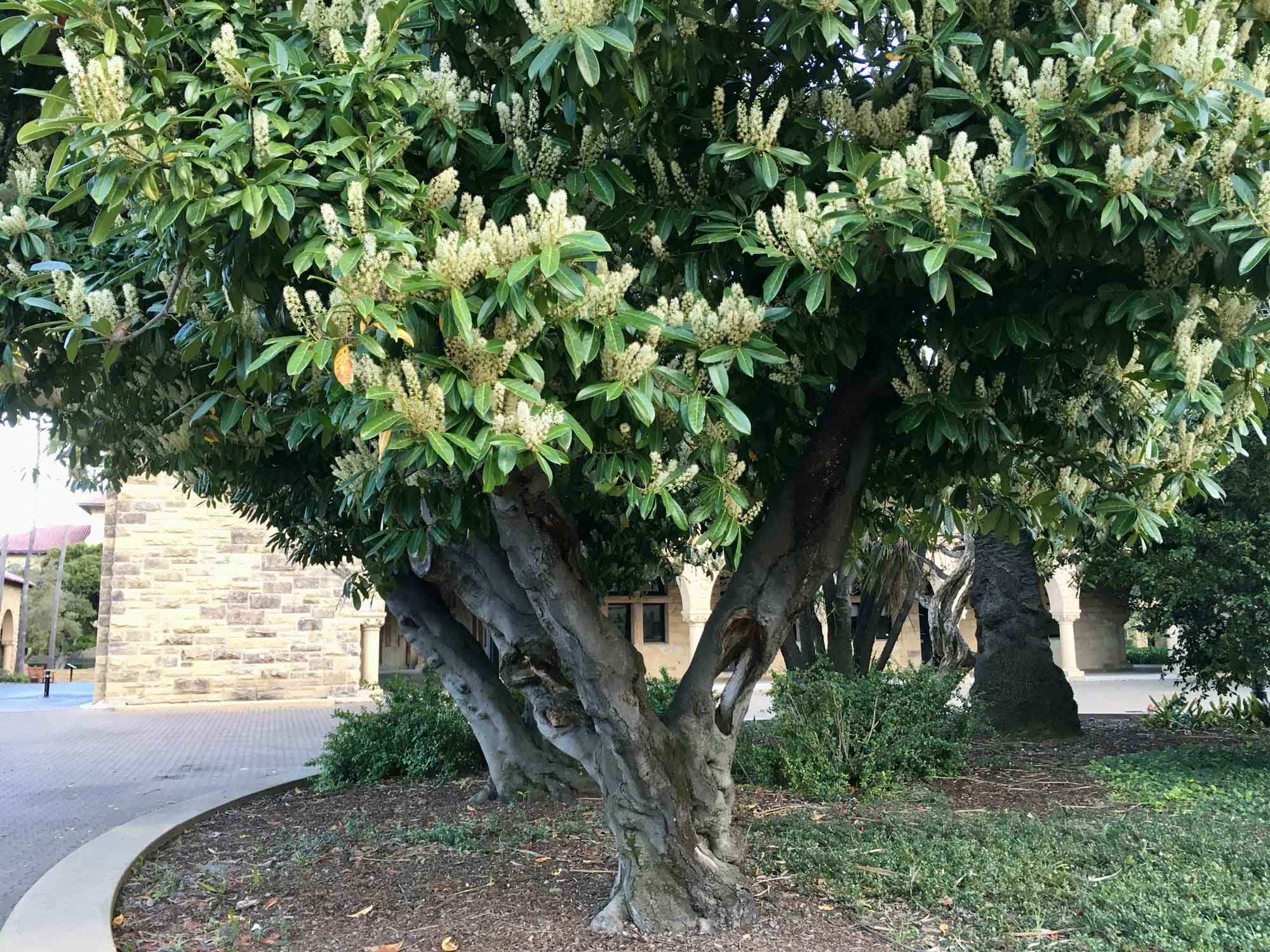
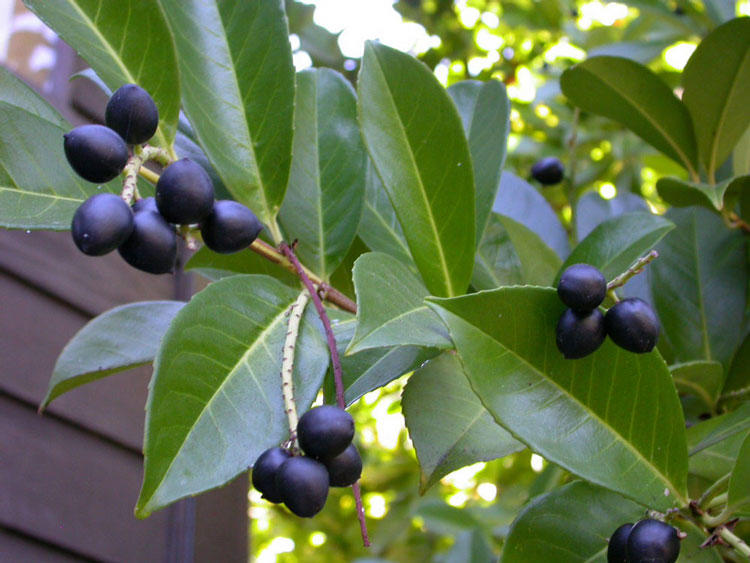
Numerous specimens planted around 1900 grow in the Inner Quad as small, spreading trees with furrowed mid-gray bark, some with windows in their gnarled trunks. The leaves are glossy and leathery, slightly toothed and up to 6 inches long. Prunus laurocerasus came to Europe from Turkey in the 16th century, reached England in the 17th, and California in the 19th. Understandably, it is not called English laurel in England but rather common laurel or cherry laurel. The white flower spikes stand up conspicuously in spring; March is the time to notice that all the islands, except the two nearest to Memorial Court, are distinguished by at least one laurel. Later, the small blackish-blue conical berries conspicuously litter the Quad and attract birds.
Laurel leaves contain amygdalin, a compound of prussic acid (HCN) and glucose, which is also found in bitter almond kernels (see P. armeniaca) and, to a high degree, in cassava. The last English alchemist, Dr. James Price (1752–1783), demonstrated a catalyst for transmuting mercury into verifiable silver and gold, but a year later, under pressure to make more precious metal, he prepared a lethal potion by macerating laurel leaves and drank the fatal cup. Do not confuse this poisonous tree with the California laurel (Umbellularia californica), leaf fragments of which can be used in cooking.
A finer-textured, low-growing variety ‘Zabeliana’ has spreading branches with narrower, shorter leaves. It can be seen on the north side of Braun Music Center at the bike racks, at the railings of the staircase near Lomita Mall that leads down to Terman Fountain, and at the northwest corner of the enclosed northwest courtyard of the main Stanford Hospital complex (map pin).
Name derivation: Prunus – Latin name for the plum tree; laurocerasus – the common name, cherry laurel.
Related material: Stanford Grounds Plant Information Sheet. List No. 14, p.2.
About this Entry: The main text of this entry is from the book Trees of Stanford and Environs, by Ronald Bracewell, published 2005. John Rawlings added the ‘Zabeliana’ note ca. 2006. Edits; Zabeliana updates (Feb 2025, SP).


