

Prunus ilicifolia
 hollyleaf cherry

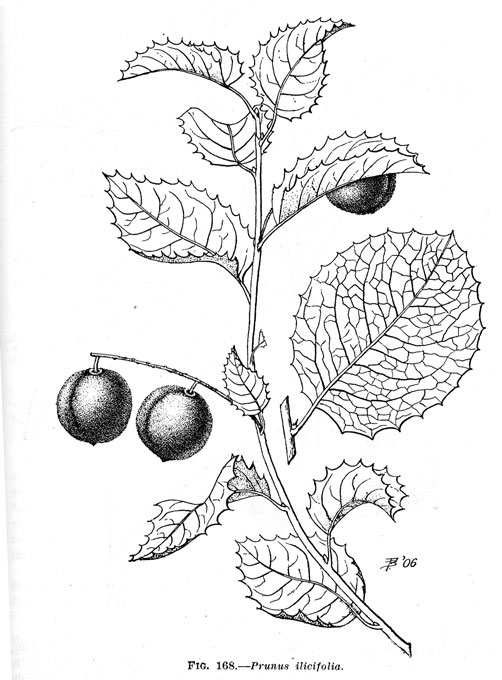
One of our loveliest California natives, with glossy evergreen leaves that smell of almond when crushed, and amenable to cultivation as shrubs or small trees. Spring spikes of creamy flowers give way to attractive cherry-like fruits. The scant flesh and thick, silky skin can be rather sweet when ripe, with a bitter aftertaste; the kernel inside the large stone, however, can release poisonous cyanide and traditionally required careful processing before eating. P. ilicifolia appears on Frederick Law Olmsted’s 1886 short list of trees and shrubs to be propagated at Stanford; it was gathered and planted on the grounds.
Subspecies ilicifolia, native to much of coastal mainland California – including throughout Jasper Ridge – south into Baja California, has roundish leaves with spiny-serrated, often somewhat wavy margins; hence ilicifolia, with leaves like holly (genus Ilex, though see also Quercus ilex). Islay, a Spanish adaptation of Salinan slay, is an old name for it; San Francisco’s Islais Creek is named for it. Prolifically fruiting clumps grow on Serra Street around the Recycling Center entrance and nearby.

Subspecies lyonii, the Catalina cherry, is native to Santa Catalina and several of the other Channel Islands. It was initially described as more tree-like on Santa Rosa Island, sometimes with a trunk 15 feet tall before branching. Intriguingly, it is also native to two mountain ranges in the central part of the Baja California Peninsula. Compared with subsp. ilicifolia, it grows much larger, and its leaves tend to be flat, larger, and more elongated, generally with smooth margins. It can be found in substantial clumps or small thickets throughout the Arboretum. It lines the bike path from Santa Fe Avenue to Stanford Avenue, where you can find fruits over an inch across; the stones are about 75 percent of that diameter.
When the two subspecies are instead treated as varieties, Catalina cherry is correctly named P. ilicifolia var. occidentalis. In any case, the two forms hybridize freely in cultivation, and intermediates are commonly encountered.
Illustrations: Jasper Ridge photo archive.
- Main References for New Tree Entries.
- Gudde, Erwin G. 1946. “The Solution of the Islay Problem.” California Folklore Quarterly 5, no. 3.
- Rebman, Jon P., and Norman C. Roberts. 2012. Baja California Plant Field Guide. 3rd ed. San Diego: San Diego Natural History Museum and Sunbelt Publications.
About this Entry: Authored Aug 2026 by Sairus Patel.

