

Gleditsia triacanthos
 honey locust
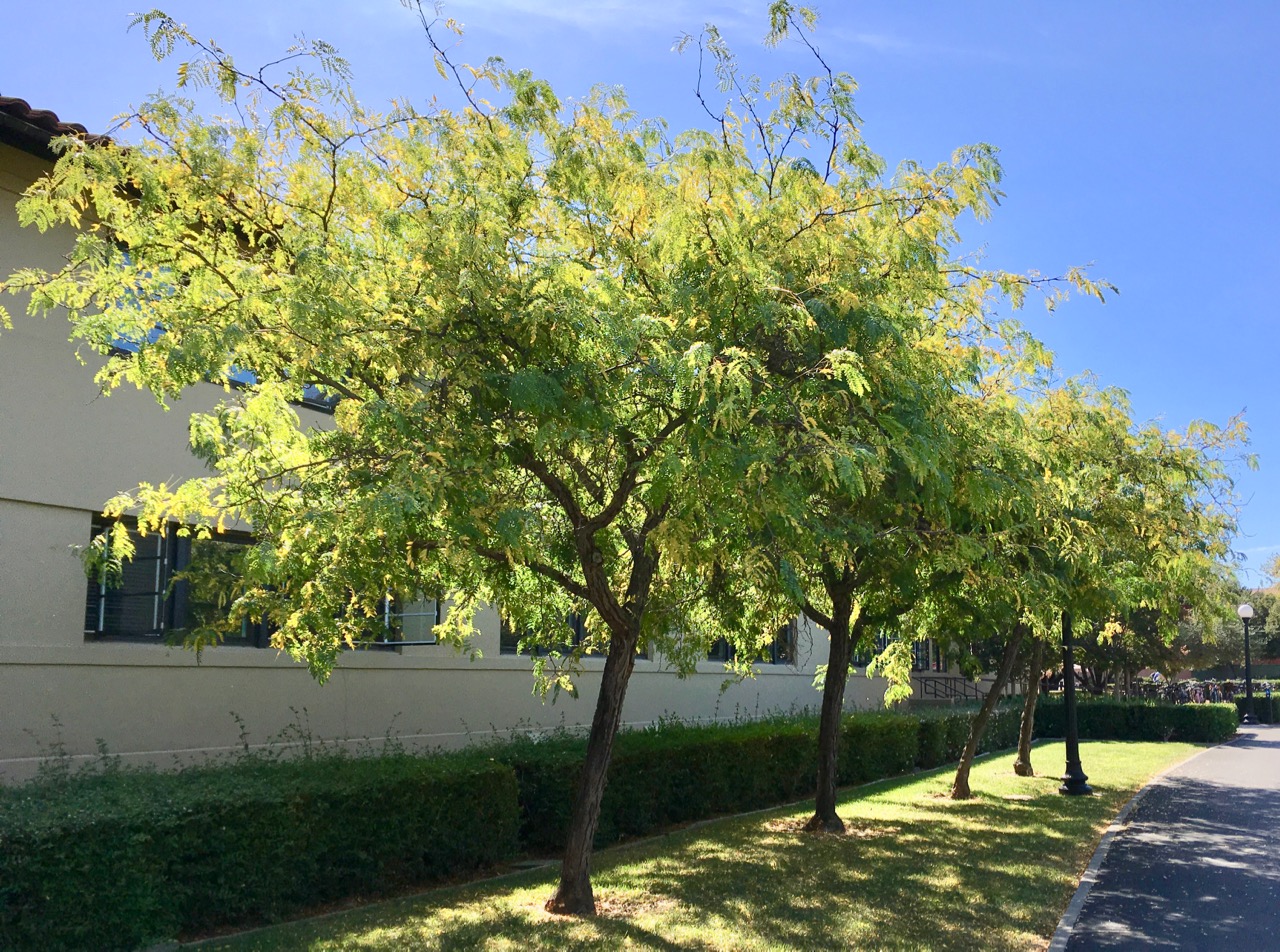
Trunks and lower branches of this tree in the wild often bristle with formidable armature: three-branched thorns (tri-acanthos) up to a foot or more in length emerge green, then flush red, settling into a glossy chestnut brown. Presumably they guarded against now-extinct megafauna from ravaging the tree for its sweet-fleshed legume pods, themselves about a foot long. Fallen pods are often abundant. Not surprisingly, most cultivars are selected for thornlessness and little to no fruit production.
The leaves are delicate and pinnate, with oval leaflets – smaller, more elongated, and more numerous than those of black locust – arrayed along the central axis. Trees may also bear bipinnate leaves, particularly when young. They emerge in March or April.
Two trees on the lawn with the male carob south of Arrillaga Alumni Center do produce trunk thorns up to 3 inches long, some of which can be seen to leaf out, demonstrating that the thorns are modified stems. As such, they are deeply integrated into the trunk and cannot be snapped off like the spines of black locust, which are leaf stipules.
Landscape designer Thomas Church placed 11 ‘Moraine’ trees in the west and east courtyards of Florence Moore Hall in 1956, when it was built. This cultivar – introduced only seven years earlier and the first widely promoted thornless selection – is podless and develops a broad, vase-shaped crown. Only three remain. A row of four young trees stands on the west side of Crothers Hall, near Escondido Mall. Three rather gaunt, gold-leaved specimens, likely ‘Sunburst’, grow near Pampas Lane opposite the Public Safety Building. Another thornless specimen noted on the 2004 Wilbur Hall map has since been removed.
At Filoli in Woodside, a single ‘Sunburst’ behind the pool pavilion forms a striking focal point from the Sunken Garden, set against the Santa Cruz Mountains.
Name derivation: Gleditsia – after Johann Gottlieb Gleditsch, Director of the Botanical Garden at Berlin, 1714–1786; triacanthos – see text above.
About this Entry: Authored Apr 2026 by Sairus Patel.

