

Fraxinus americana
 white ash
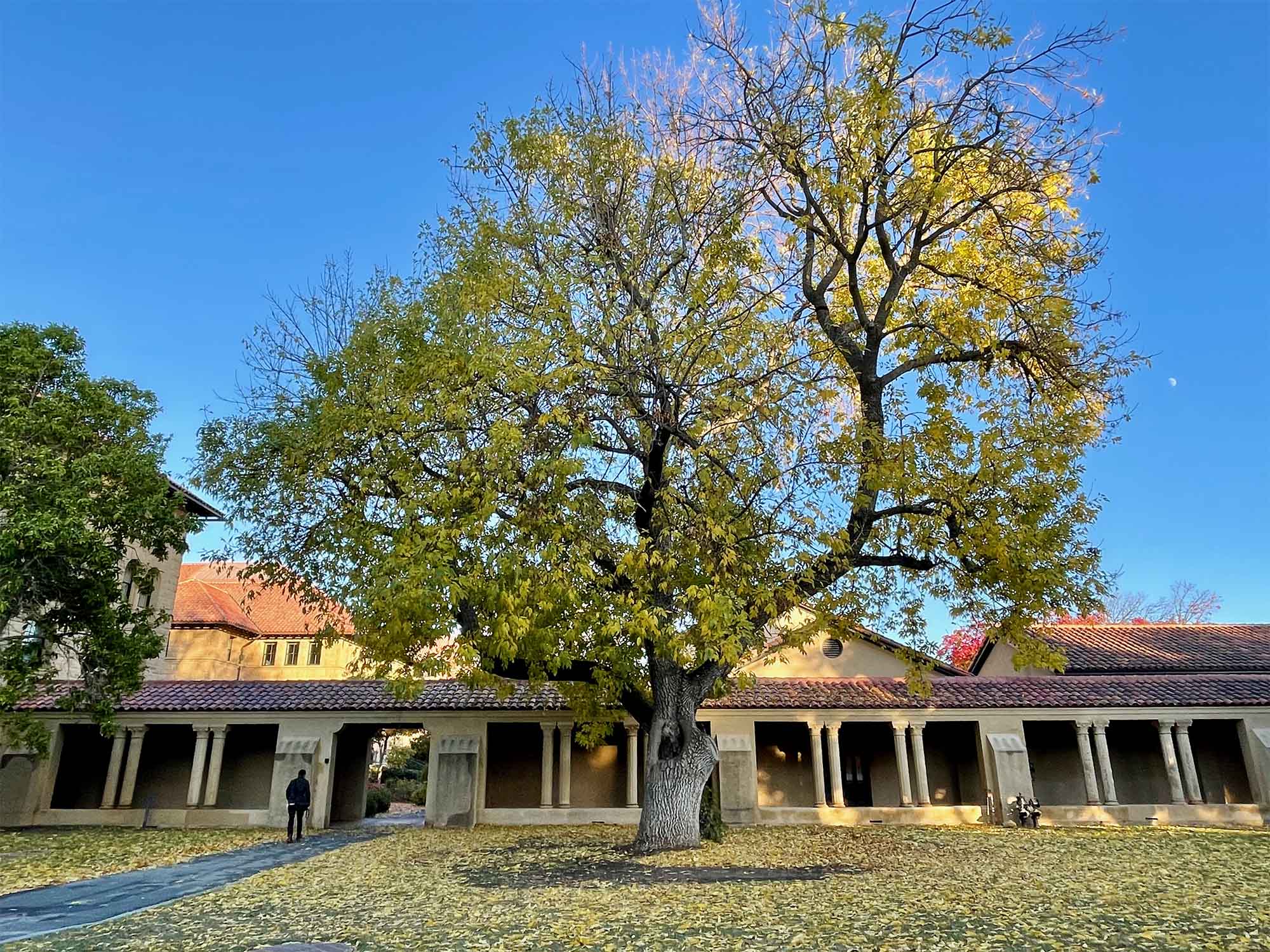
A colossal white ash stands west of Encina Commons, off Galvez Mall. It was reportedly planted in 1891 when adjacent Encina Hall, Stanford’s first men’s dormitory, was built – though in what seems a curious spot, behind and off to one side. Encina Commons itself did not appear until 1923, when it was erected as a dining hall for the men.
It has clearly lost at least two major limbs later in life but still commands an enormous spread, visible from atop Hoover Tower almost as a dome touching the ground. The fall leaves are gold, making a visit-worthy display – and worth another peek from Hoover Tower – when they carpet the expanse of bare lawn below. The thickly furrowed trunk can be appreciated all year, showing the ridged diamond pattern also seen in Modesto ash; nearby pepper trees germinate within its branch crotches.
The pinnate leaves usually have 7 or 9 leaflets, paler beneath (hence white ash). Distinguish it from green ash (F. pennsylvanica) by its broad, squat buds at the tips of twigs, rather than longer conical ones, and by its U-shaped leaf scar, within which the axillary bud more or less nestles; in green ash the scar is D-shaped, with the bud sitting above its flat upper edge.
Another old specimen stands on Lasuen Street just north of Littlefield Center, with yet another in the dip west of that building among the gnarled buckeyes. A magnificent pair grows at 2332 Williams Street in Palo Alto.
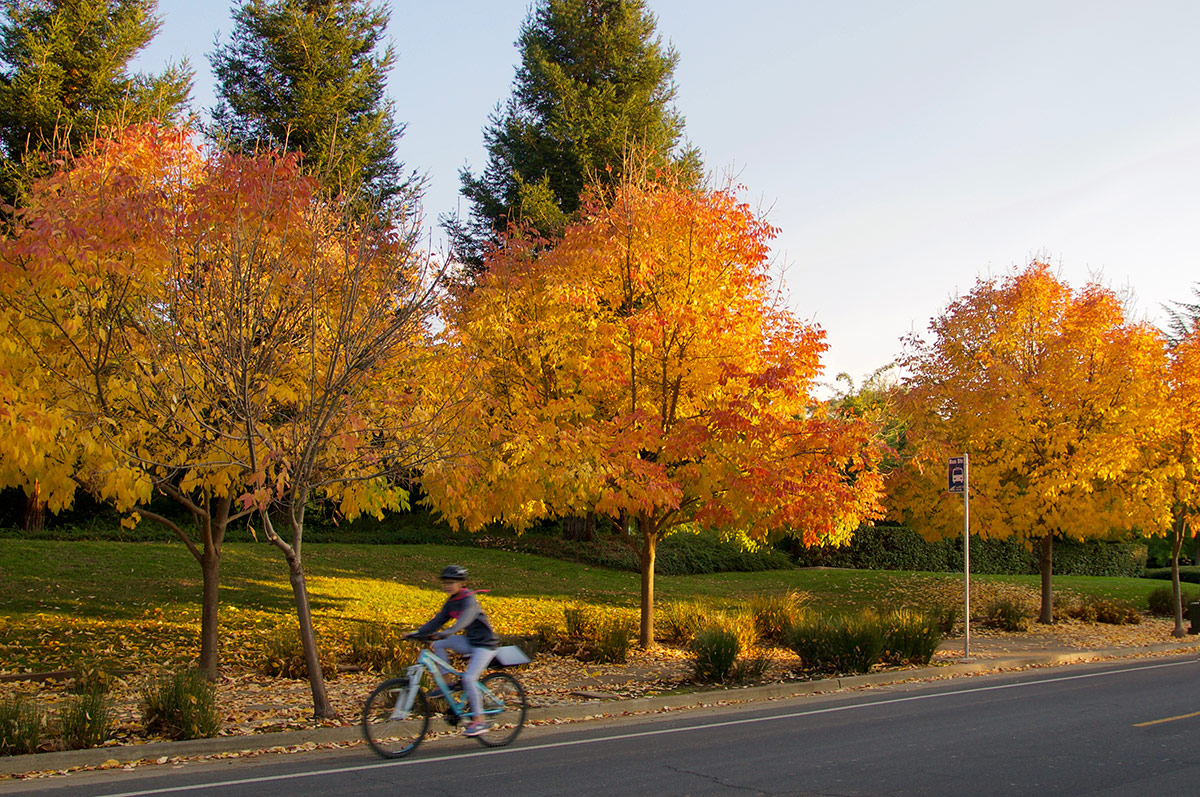
Autumn Purple ash is the trade name of a male selection; the fall foliage of those grown locally is not so much purple as golden, with sections of peachy orange-rose and a few russet highlights here and there. The crowns seem to glow from within, like embers. It is our earliest fall color, lighting up in October and going mostly bare by Halloween.
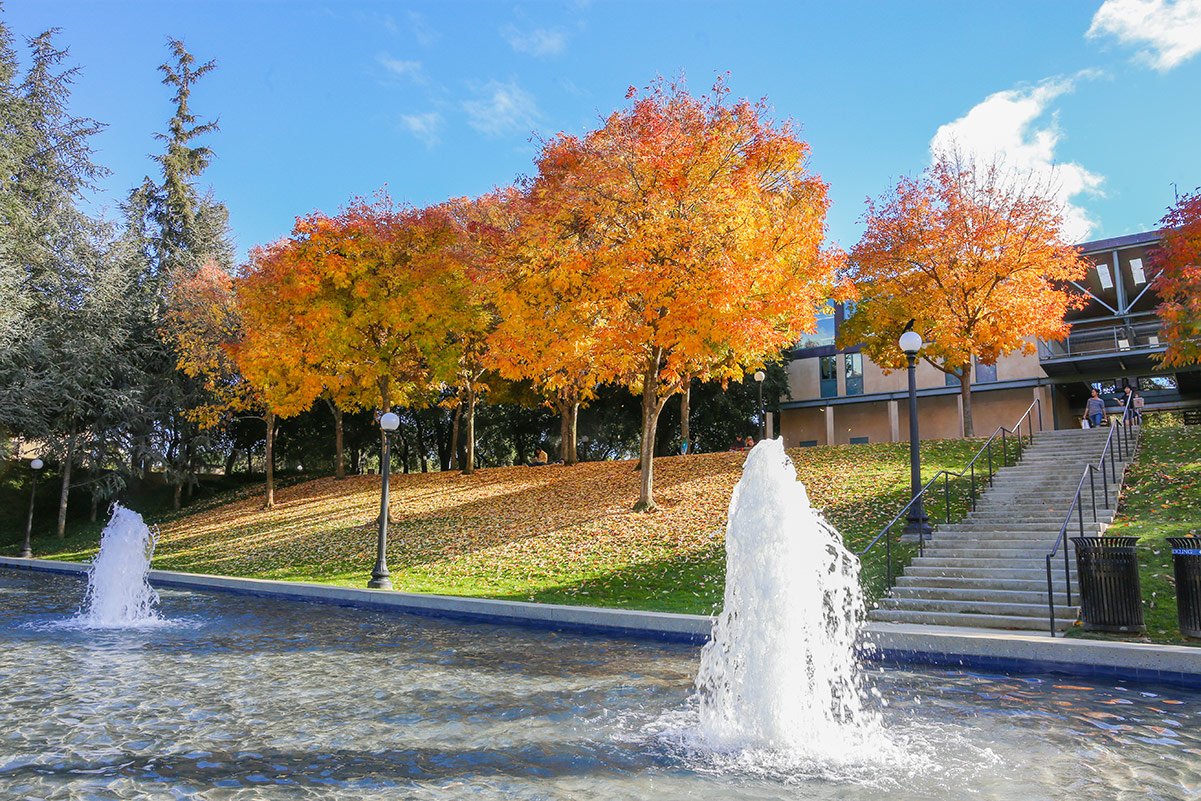
An impressive planting is in the sunken garden around Terman Fountain at the old Terman Engineering Center site. A couple of dozen are arrayed between Thornton Center and the fountain. You may notice that the grouping on the right, as you descend the stairs, is almost twice the height and trunk girth of the grouping on the left. The former dates from 1995, the latter from 2012, when the Terman building was demolished. Note the distinct graft line at the base of the trunks.
In Palo Alto, Autumn Purple began to be used in the early 2000s. A sidewalk allée fronts a row of coast redwoods on California Avenue, at 2475 Hanover Street. The sidewalk was built over Engineered Soil Mix, part of Palo Alto’s “structural soil” program. The trees’ thick roots snake across the soil surface. Their delightfully perky winter profile is almost a cartoon of a symmetrical, neatly branching tree, at least at this stage of their lives.
- Re. Parker’s planting date for the Encina Commons ash: a low-branching tree in approximately the same spot as the current tree can be seen during the construction of the Commons in 1923 in this photograph. Its size seems plausible for a 20- or even 30-year-old tree at Stanford, especially if it received limited irrigation, given how slowly Autumn Purple ash appears to grow even in lawn. It would also seem unlikely that a tree of that size was transplanted there during construction of the Commons, since major landscaping would ordinarily have been installed only after the building work was complete.
- Main References for New Tree Entries.
- Parker, William. 1977. “Some Stanford Heritage Trees.” SC 486, 2005-041, Box 1. Stanford University Special Collections. (Re. 1891 date for Encina Commons tree.)
About this Entry: Authored Aug 2026 by Sairus Patel.

