

Eucalyptus sideroxylon
 red ironbark

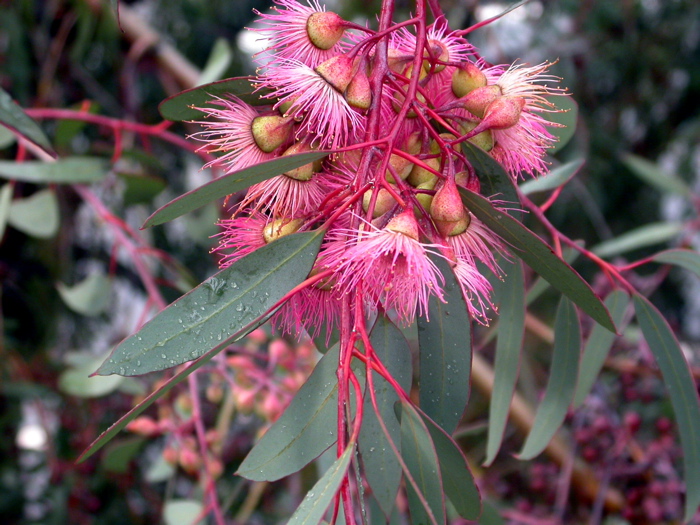
Much beloved by landscape designers, red ironbark is instantly recognizable among all eucalypts on central campus, yes, even with your eyes shut. Feel the hard, deeply furrowed bark, the rough ridges often large enough to grasp. This “ironbark” is retained on the trunk, unlike the peeling bark of most other eucalypts. Open your eyes and observe that the bark is ensanguined with a reddish resinous material which solidifies the bark and sometimes oozes beyond it in frozen and transclucent red-black nubs. This substance, kino, helps guard against the predation of insects and makes the bark so dark the trunks look inky black from a distance.
Flowers in the wild are white to pink to red. The ‘Rosea’ variety popularizes the red and pink, and sports foliage with a particularly bluish-gray cast. You can see why Thomas Church chose 100 ‘Rosea’ to plant around Meyer Library in his 1967 plan, 70 of which were swapped in at the last minute for 70 Atlas cedars. (What prompted this rather dramatic change is not known.) Many of these eucalypts grew quite large, shading the surrounding pathways. Fifty-six had survived by 2000. When the library was replaced by Meyer Green in 2015, more young red ironbarks were added to the green in happy extension of the historic theme. The cafe at its edge, near Green Library, is entirely ensconced in red ironbark, possibly the only such situation in California, or even the world.
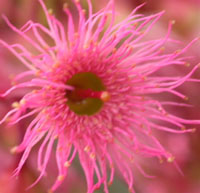
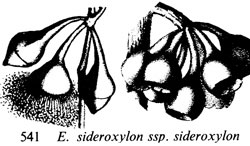
Buds are in groups of 7 on slender branchlets that are often reddish. The inner and outer opercula are shed simultaneously, pushed off by the emerging colorful stamens. Red ironbark has a remarkably extended flowering season, from fall to spring. In early January it is the only campus tree with colorful flowers, except perhaps for one or two saucer magnolias. Its blossoms are regarded as the most reliable nectar producer in Australia. The honey produced is redolent of almonds and coconut. Locally, hummingbirds are attracted to it and campus squirrels have been seen sipping the nectar and discarding the flower clusters on the street below. The blossoms are not a rich source of pollen, however; many of the outer stamens lack anthers, just as in the closely related smooth-barked E. leucoxylon, which is also from southeastern Australia. That both these species produce flowers in colors other than white is unusual, given that most eucalypts with such flowers are from southwestern Australia and its tropical north. The two species are also known to hybridize, which boggles the imagination, given how very different their bark looks.
Red ironbark is highly variable in habit. Quite a few of the youngsters at Meyer Green stoop, lean, curve, or branch out in all kinds of picturesque ways. All were supposed to be ‘Rosea’, but they may have been raised from seed since some reasonable proportion of such seedlings will produce flowers true to color. Nurseries may not consider it worth the bother to produce these fast-growing plants from genetically identical cuttings.
The heartwood is vivid reddish brown and highly durable. It is used in heavy construction such as for bridges or sleepers. The species name is Greek for wood (xylon) like iron (sideros): it will take 20 tons to crush a 2-inch cube, about the weight of 10 sedans.
In 1968 there were 103 young ironbarks on Panama Street. By 2002 additional plantings had brought the total back to 83 after some had been lost to accidents. Today, the remainder are mostly near the parking structure, softening its rather imposing impact. Thirty ironbarks were planted along the sidewalk on Arguello Way alongside McDonald Hall in 2016, when that hall was built. Their dark trunks strikingly contrast with the terra cottas and neon green accents of the building. They replaced a similar allee of red ironbarks at that spot, presumably removed to facilitate construction. They have grown in quickly. Alumni visiting campus almost certainly don’t notice that this is a new set of trees. Thus, campus planners provide a sense of continuity even while buildings, even neighborhoods, are demolished and raised at what seems like breakneck speed.
Gallery


- Main References for New Tree Entries.
- Thomas D. Church & Associates, et al. Planting Plan, Undergraduate [Meyer] Library. 1967. Maps & Records Archives.
About this Entry: Authored Jan 2025 by Sairus Patel.

