

Eucalyptus cinerea
 Argyle apple, mealy stringybark

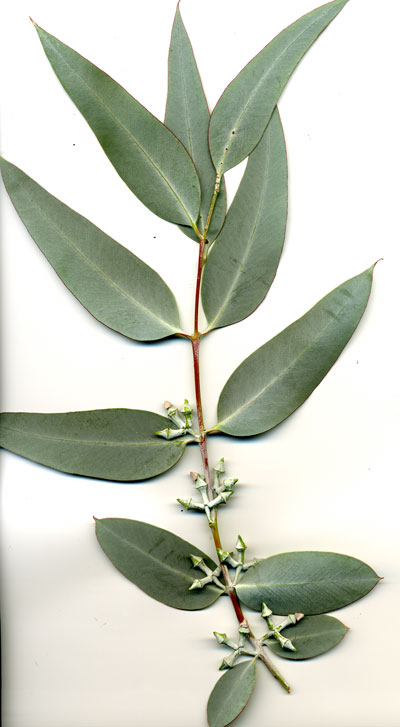
Covered with silvery blue foliage, this tree stands out in campus landscapes and attracts people looking for cut foliage for indoor use. Specimens may be seen on Stanford Avenue where Peter Coutts Road connects; on the south side of Bowdoin opposite Rains Houses; at 836 Santa Fe Avenue; and on Campus Drive East between Escondido Road and Serra Street. Some of these trees have a few mature leaves up at the top but most are covered by paired lanceolate leaves and paired, roundish, juvenile leaves. If you need to explain to somebody the difference between juvenile, intermediate, and mature leaves, take them to a mealy stringybark; December is a good time, a few new flowers are pushing their bud caps off and new leaf buds are revealing their interesting geometry.
Although eucalyptus leaves are usually described as alternate, you can find branchlets with intermediate foliage where the earlier leaves are opposite, or paired, and there follows a progressive separation of the leaves of a pair as new leaf buds developed on the branchlet. As the eye moves to the tip of the branchlet, opposite is seen to have changed to alternate.
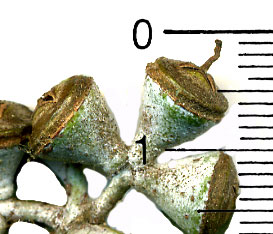
Flowers and fruit appear in threes in the leaf axils, often on both sides of the stem. The fruits and stems are covered with the same light blue wax as the leaves. The bark is reddish brown, rough and stringy, not only on the trunk but well out into the branchlets, and pulls off easily. It is favored for nest building by birds and rodents, who will travel considerable distances to collect it.
The tree is native on dry rocky slopes with poor soil and winter frosts, and forms an open savanna of small trees that you pass through when descending into Canberra on the road from Sydney. So it does well on the Stanford adobe, and maybe too well in a small garden where it gets water. The name “apple” is applied to various trees, including Angophoras, whose bark resembles that of an apple tree, especially if the leaves are opposite. The common name Argyle apple, in use since 1867, refers to Argyle County in New South Wales. The alternative name mealy stringybark, which is less mysterious, refers to the ashen color denoted by cinerea. Of course, ash comes in different colors; the fur of the koala (Phascolarctos cinereus) certainly does not match the leaves of E. cinerea.
Illustrations: Eucalyptus cinerea gallery.
Related material: Eucalyptus checklist.
About this Entry: The main text of this entry is from the book Trees of Stanford and Environs, by Ronald Bracewell, published 2005.

