

Carpinus betulus
 European hornbeam
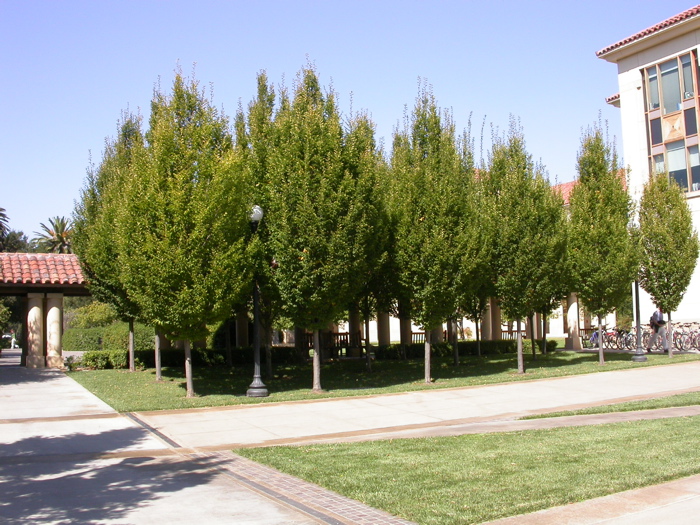
Carpinus is the Latin name for this tree with exceptionally hard, durable wood, long valued for uses demanding strength and resistance to wear, from tool handles to gears and other machine parts. The English name hornbeam likewise refers to the wood’s horn-like hardness. The finely toothed leaves resemble an elm’s, but are much more symmetrical at the base. The most distinctive feature is the charming fruit cluster: each nutlet is subtended by a large, papery, three-lobed bract.
‘Fastigiata’, the columnar form, is planted to the exclusion of the typical species, which is vanishingly rare. Alas, the cultivar fruits exceedingly sparsely here. The flame-shaped crown – slender and almost eerily symmetrical when young – is much beloved of landscape architects for formal rows, though the trees grow quite rotund with age. When planted too close to buildings, as they almost always are, their crowns eventually have to be sliced cleanly down, like cake, for building clearance, leaving a neat line of half-trees. Less obvious is what to do when the crowns begin clashing with one another. A trio in a raised bed on the east side of Hoover Tower shows what the form can do when given room, their crowns stretching to a full 20 feet in depth.
Panama Mall is lined with ‘Fastigiata’ at Buildings 540 and 550 and near Terman Fountain. Formal rows march from the north tip of Lathrop Library towards the Littlefield Center and continue east of that building (in half-trees); younger ones are south of the Center. An allée stands east of the McMurtry Building, picking up again near the north lawn of Cantor Center, where it runs parallel to another allée of Italian cypress.
- Bracewell (2005) identifies the row at the “east end” of Littlefield Center as Carpinus caroliniana, but all indications are that the row along the east side of the Center are C. betulus ‘Fastigiata’. The differences can be subtle, and further observations are welcome.
About this Entry: Authored Aug 2026 by Sairus Patel.

