

Brachychiton rupestris
 Queensland bottle tree
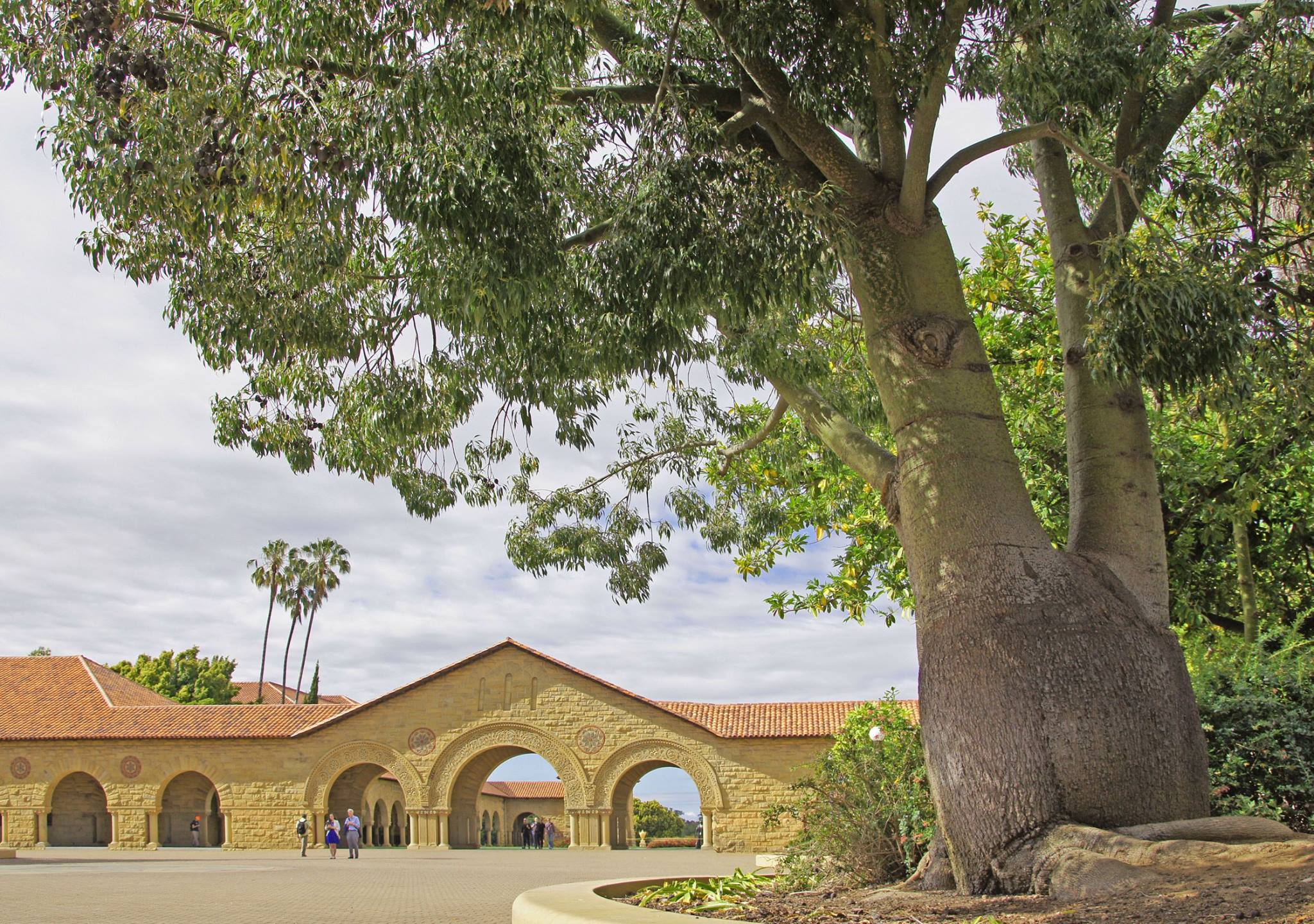
The bottle tree both looks like a bottle, contains potable sap, and is a characteristic sight of the dry inland savannah of Queensland, where the roots, shoots, and wood provided food for aborigines. In Queensland the trees have pronounced entasis, expanding to as much as 6 feet in diameter well above eye level.
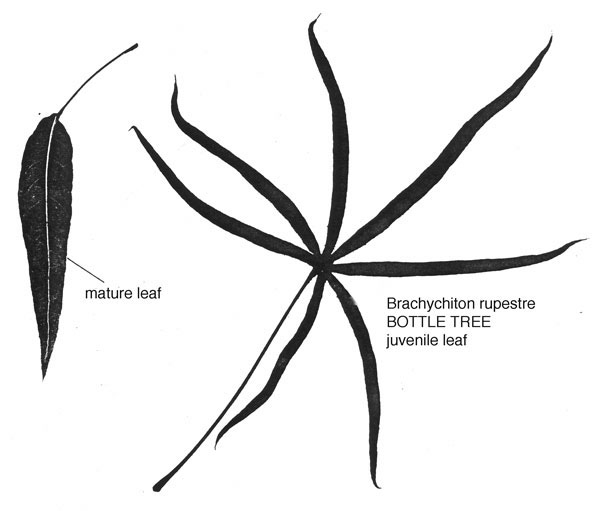
A stout specimen near the entrance to Memorial Church was raised by arborist William Parker in 1972. Its juvenile leaves were large but very delicate, with several lobes barely wider than the leaf vein, cut right back to the point of attachment of the long slender petiole. By 2000, the leaves had lost this charm. The small flowers, creamy with pinkish-red markings, were first observed around 2015. Like those of Eucalyptus, they have no petals. A smaller example is nearby, in the inner northwest island of the Inner Quad. A sizable example leans towards the light in the Stanford Avenue greenbelt near the back fence of 836 Santa Fe Avenue. A younger specimen on the eastern edge of the Arizona Garden is entirely clothed in juvenile form leaves, each with two to nine leaflets. One in front of 340 Bonair Siding has a mix of juvenile and adult leaves.
Name derivation: Brachychiton – from Greek, brachys, short and chiton, a tunic, a reference to the coating on the seed; rupestris – refers to growing among rocks.
About this Entry: The main text of this entry is from the book Trees of Stanford and Environs, by Ronald Bracewell, published 2005. Entry revised; flowering notes added; 3 young tree locations added (Aug 2023, SP). Stanford Avenue location restored; edits (Jul 2024, SP).

