

Acer rubrum
 red maple
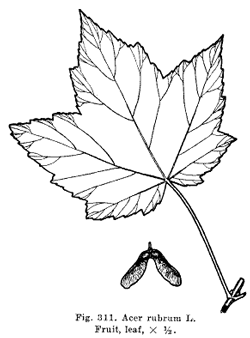
Red winter buds, red twigs and branchlets, red flowers in March – minute but collectively conspicuous – followed quickly by red samaras, and of course glorious red autumn foliage make Acer rubrum a deservedly honored tree, at least in eastern North America. There, it grows in a breathtakingly wide and varied array of settings ranging from wet and even swampy lowlands (its roots may sit in several feet of water for much of the year) to mountain forests, making it the most common tree in the U.S. and indeed the one most popularly planted along streets. Leaves are 2–7 inches long and three lobed, typically with the faint swelling of two additional lobes at the base.
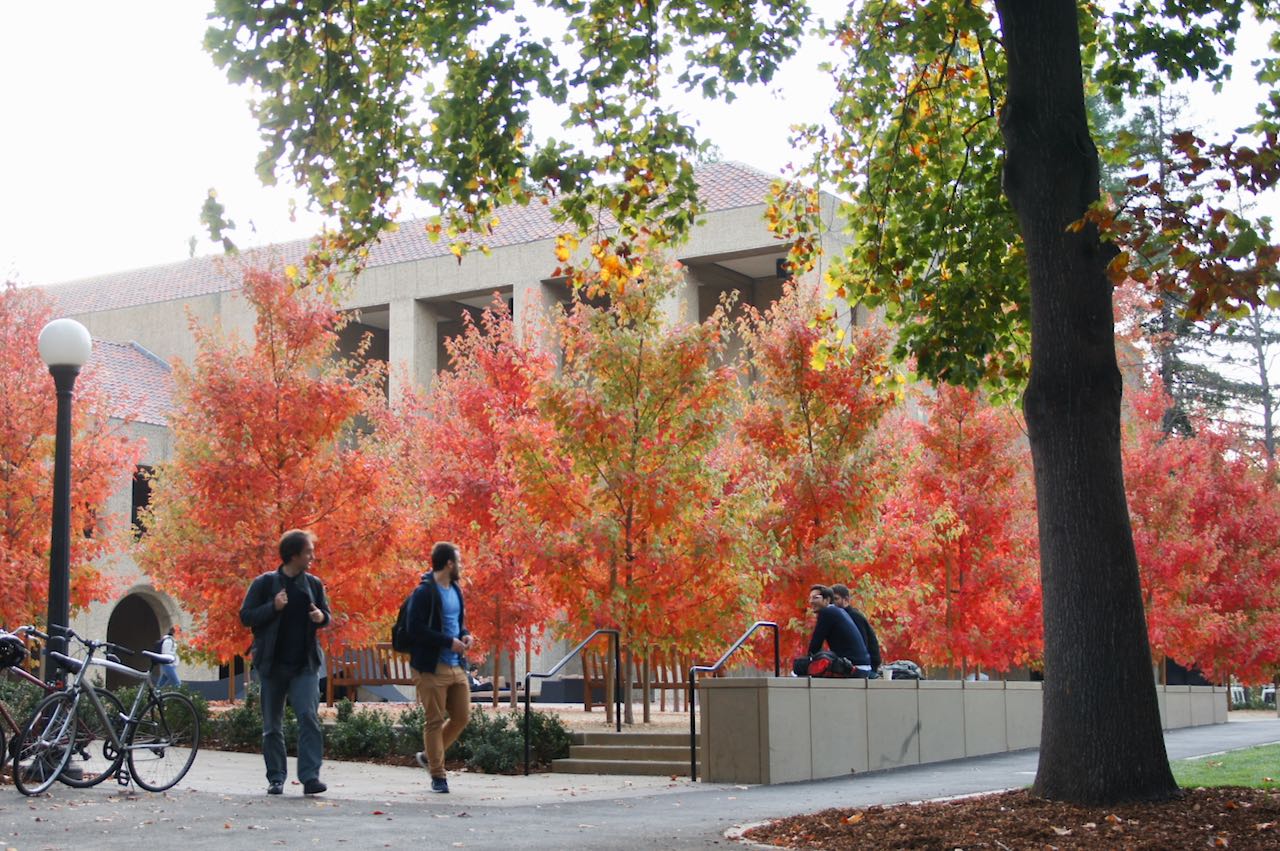
Eighteen of female selection October Glory, a trade name, were planted in front of the Law School in 2017. They have done well so far, their root zones having access to adequate moisture. Their smooth pale gray trunks uphold a bright green canopy in whose cool shade students lunch and lounge. The full fiery red and vermilion splendor of their foliage crests in the second half of November (the selection is not particularly aptly named), when other cultivars of red maple – and hybrid Freeman maple – are already bare. Their formal arrangement and dramatic placement at the end of the expanse of Canfield Court attract much attention in this season. More examples of this cultivar line Welch Road between 810 and 1000. Older October Glory maples are street trees in the Stanford Research Park on California Avenue, at 777 and at 975 (on the right side, when facing the building). Two red maples are at 1117; they have shed their leaves by the time October Glory is in full color.
Seven or so examples of trade name Red Sunset, regarded as best suited for more northern states, can be seen among the oaks in the swale depressions at the Central Energy Facility. Others of this female selection are at the north entrance and inner courtyard of ChEM-H and Neurosciences; the pair in the protected courtyard hold on to their leaves for longer than the others.
Name derivation: Acer – Latin for maple; rubrum – red (autumn color).
- Acer rubrum October Glory (‘PNI 0268’): U.S. Plant Patent No. 2116 (filed 23 Feb 1961, granted 26 Dec 1961; the selection unnamed in the patent). The clone was distributed in the nursery trade under the name October Glory from at least 10 Sep 1961 (e.g. Princeton Nurs., Princeton, New Jersey, Wholesale Price List, Fall 1961–Spring 1962, p. 10). The name October Glory was later registered in the U.S. as a trademark in 1974 and remains in force (U.S. Trademark Registration No. 983592, accessed 10 Feb 2026). October Glory was formerly accepted as a cultivar name, though the circumstances of its acceptance are now undocumented. Some European sources continue to treat it as the accepted cultivar name, reflecting its long use in commerce there; however, the accepted cultivar name is now ‘PNI 0268’ (a breeder code of Princeton Nurseries, Inc., which introduced the selection).
- Acer rubrum Red Sunset: cultivar name ‘Franksred’.
About this Entry: Authored Nov 2024 by Sairus Patel. Edits (Nov 2025, SP).

