

Washingtonia filifera
 California fan palm
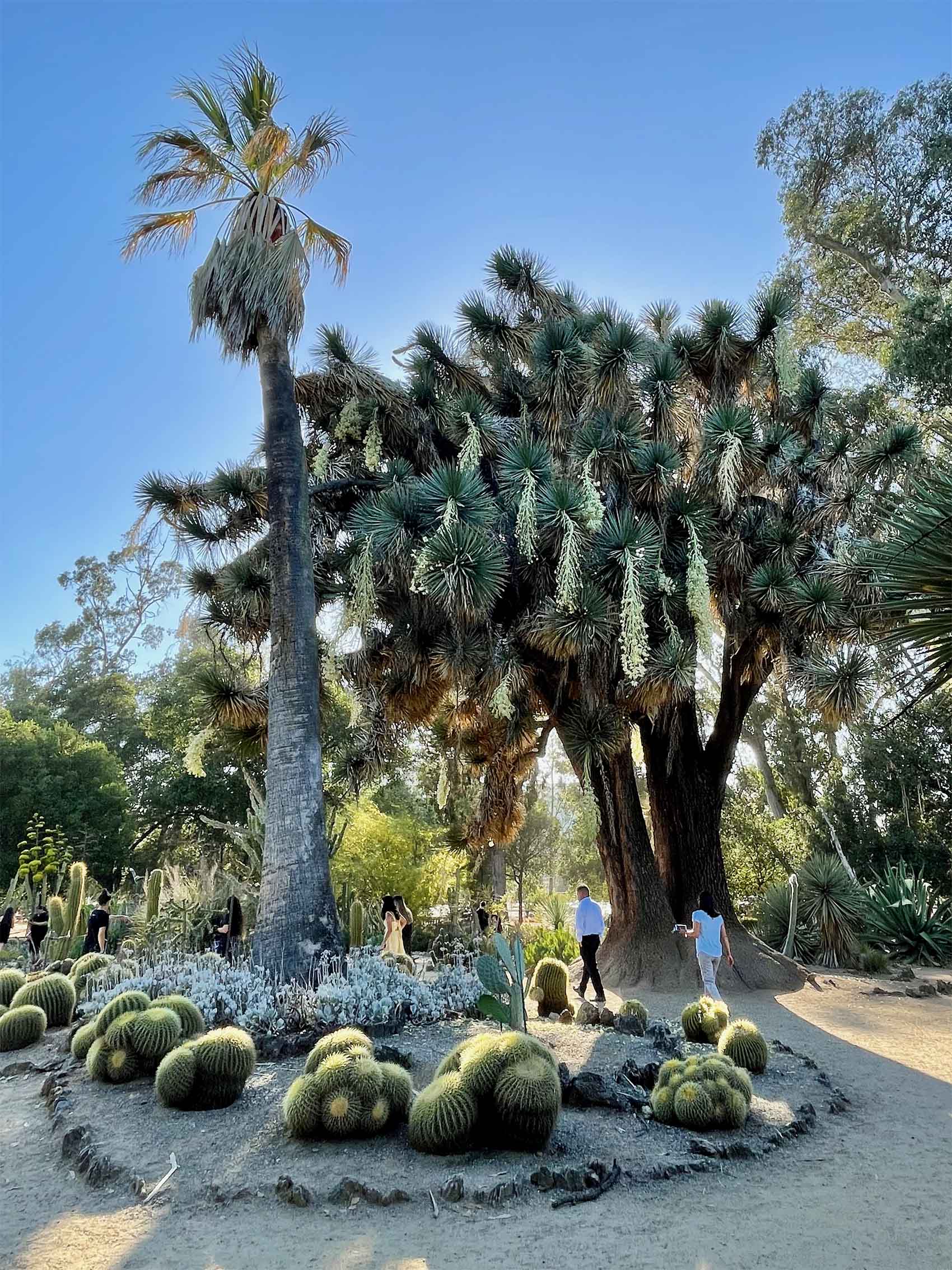
This immensely stout palm of desert oases matches the girth of the Canary Island date palm, which allowed for some visual evenness of trunk when the two – fan- and feather-fronded – alternated along Palm Drive in the University’s early decades. Our most ancient trio, in the Arizona Garden, predates the University itself: two still stand guard at the north entrance, their trunks splashed with colorful lichens, while a third anchors the center next to the gigantic tree yucca. These date back to the garden’s original planting in the early 1880s.
The majestic specimens in five islands of the Inner Quad are likely originals, dating to 1890. Compare them with the more recently planted Mexican fan palms: the Californias are thicker of trunk, shorter in stature, and more filamentous along the leaf margins (hence the species name). Two of medium height flank the Escondido Road entrance to Mirrielees House. Others, curiously rare, appear singly: one hidden among the oaks and cedar on the corner of the Bookstore, just left of the entrance; another near the Canary Island date palm in the middle of the grove along Jane Stanford Way in front of the Schultz Building.
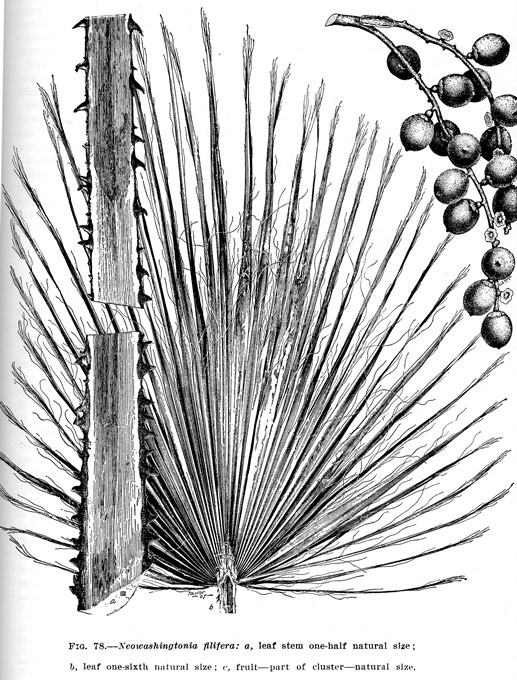
Name derivation: Washingtonia – after George Washington (1732–1799), 1st President of the United States; filifera – see text above.
Nomenclature note: Fred Hrusa’s Crosswalk.
About this Entry: The main text of this entry started off as published in the book Trees of Stanford and Environs, by Ronald Bracewell, published 2005. John Rawlings subsequently added the nomenclature note. Entry almost entirely revised, Bookstore and Schultz locations added, note on Palo Alto’s 918 Moreno Avenue trio removed (it is W. robusta); all locations up to date (Apr 2023, SP).

