

Yucca filifera
 tree yucca
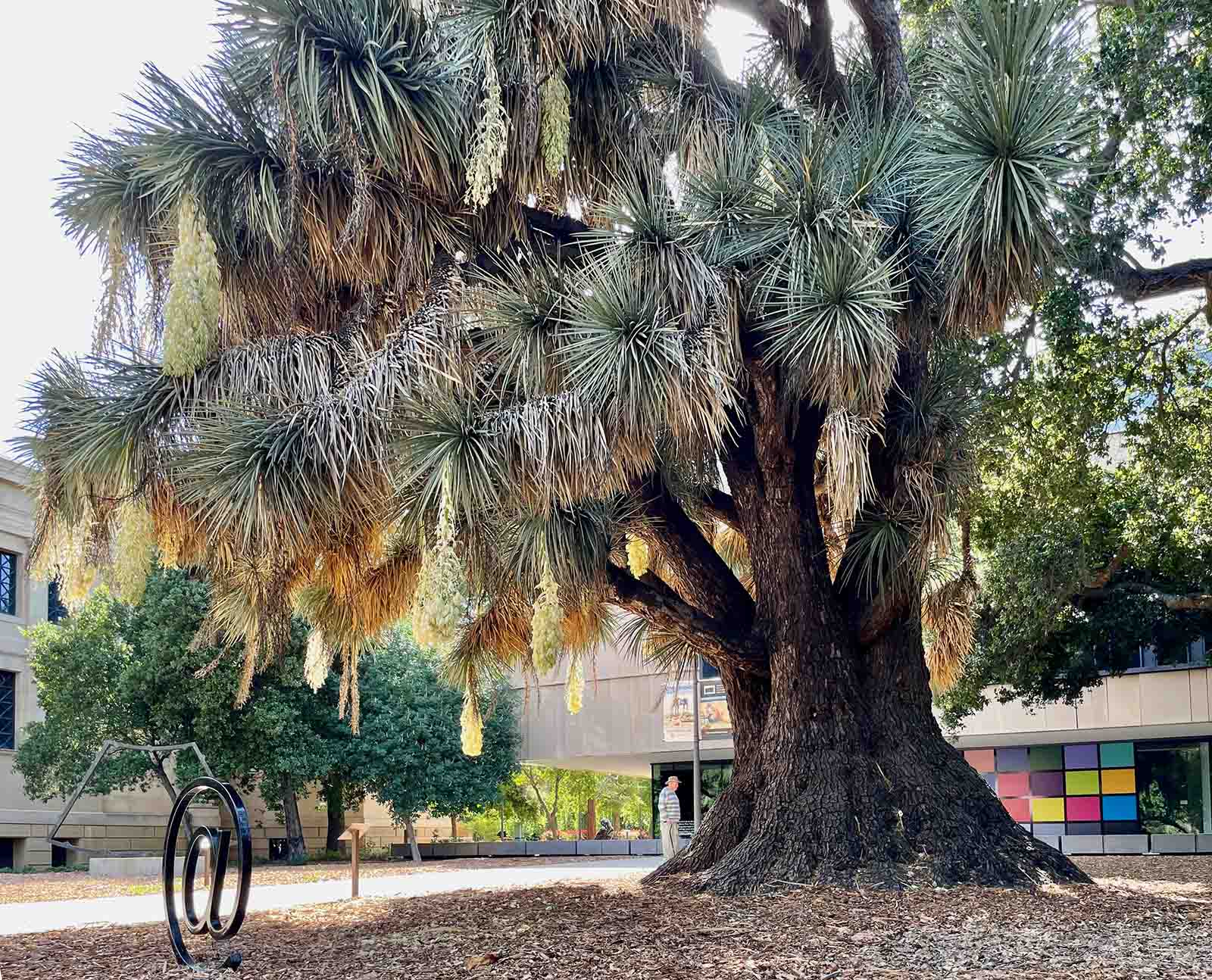

Unrivaled in California is our collection of majestic tree yuccas. Their swollen, elephantine bases and rosettes of sword-shaped leaves are impressive at any time of year. But to behold the clusters of creamy white flowers – many over a yard long – thickly drooping from their crowns is to see these relicts from the pre-University years in their full glory.
The pendant habit of the flower clusters most clearly distinguishes the species from the more familiar Joshua tree (Y. brevifolia), whose inflorescences stand upright. Both species branch – unusual for monocots, palms included – though Y. filifera does so more quickly in nature than in cultivation. Thread-like fibers curling from the leaf margins (hence filifera) further distinguish it from Y. brevifolia.
In the early 1880s, landscape gardener Rudolph Ulrich traveled on collecting expeditions to Arizona Territory and Mexico while designing and planting the Arizona Garden. The garden lay adjacent to the site of a planned mansion for Leland and Jane Stanford. After their son’s death, those plans were abandoned, and the site was instead used for the family mausoleum. Near the garden’s center, a massive two-trunked specimen lost one of its trunks in 2022; another at the southern edge has a pronounced, lopsided crown, perhaps in response to a since-removed oak.

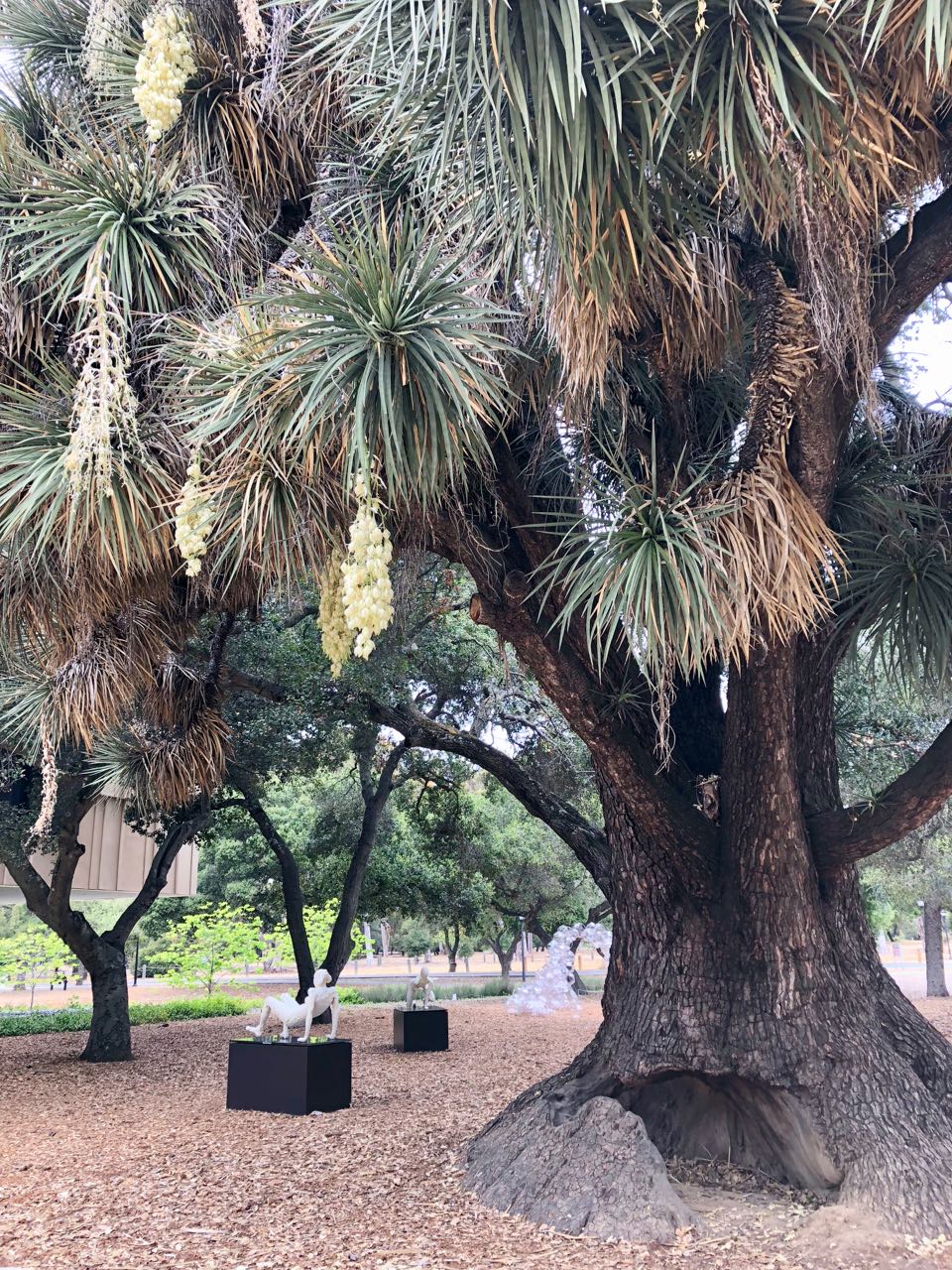
Most imposing of all is the ancient specimen in front of the Anderson Collection, declared national champion for its species by the California Big Tree Registry in 2023. Preserved during construction of that building in 2013, it received the rare distinction of its own interpretive sign. Now more than 40 feet tall, it was very likely transplanted in the late 1890s from the nearby Arizona Garden, soon after completion of the north extension to the Stanford museum – part of Jane Stanford’s ambitious expansion of her museum quadrangle, most of which was later removed after damage from the 1906 earthquake. The striking cavity at its base, with fire-charred walls, has been present since at least the 1960s. Mechanical damage may have initiated the cavity; as for the fire, one recalls that smoking was far more common on campus in earlier decades.

Another enormous specimen – likewise bearing a dramatically lopsided crown – once grew on the grounds of Cedro Cottage near San Francisquito Creek, now the site of Oak Knoll Elementary School, Menlo Park. The cottage, set among elaborate gardens, was home to one of Jane Stanford’s brothers and later to various early faculty and staff. There, Mrs. Stanford and little Leland spent many happy hours at the bench beneath their favorite tree, a giant oak festooned with a climbing rose. A 1985 photograph shows the yucca to have been nine feet across at the base and more than 35 feet tall. As with the museum specimen, it was likely transplanted from the Arizona Garden at Mrs. Stanford’s direction. The redesign of the school’s track area in 2011–2012 led to its removal.
Yucca filifera is native to the dry eastern and southern reaches of the Chihuahuan Desert and its margins, where it may form extensive forests and thrives in heat; its flowers are pollinated by a specialized yucca moth (Tegeticula sp.). Its sweet fruits, dátiles – absent on our trees, since we lack the moth – are eaten fresh or dried and sometimes fermented, while hollow trunks have been used as beehives. At Stanford it has proved eminently suited to local conditions; few comparable specimens exist elsewhere in the state. One hopes that more will be planted, for the enjoyment of those who will tread these grounds in the century to come.
Gallery


- Main References for New Tree Entries.
- Allen, Peter C. 1985. “The Cottage by the Creek.” Sandstone & Tile, Volume 9, No. 3, Spring, Stanford Historical Society. An addendum, “Cedro Cottage Mysteries,” was published by the editors in Sandstone & Tile, Volume 9, No. 4, Summer.
- Allen, Peter C (likely). 1985. Photo of Cedro Cottage tree yucca. SC1071, Box 11, Folder Cedro Cottage #2. Stanford University Libraries Department of Special Collections and University Archives.
- Matschat, Cecile Hulse. 1935. Mexican Plants for American Gardens. Boston and New York: Houghton Mifflin Company.
- Pampanini, R. 1908. “La Yucca australis Trelease.” Bullettino della R. Società Toscana di Orticultura 13, No. 2/3: 62–67.
About this Entry: Created by Sairus Patel (Aug 2024). Updated Mar 2026 (SP). Updated Jun 2026 (SP).

