

Umbellularia californica
 California bay
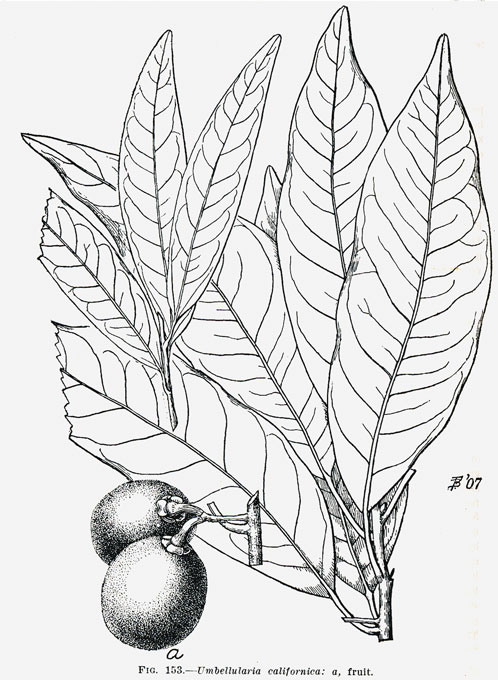
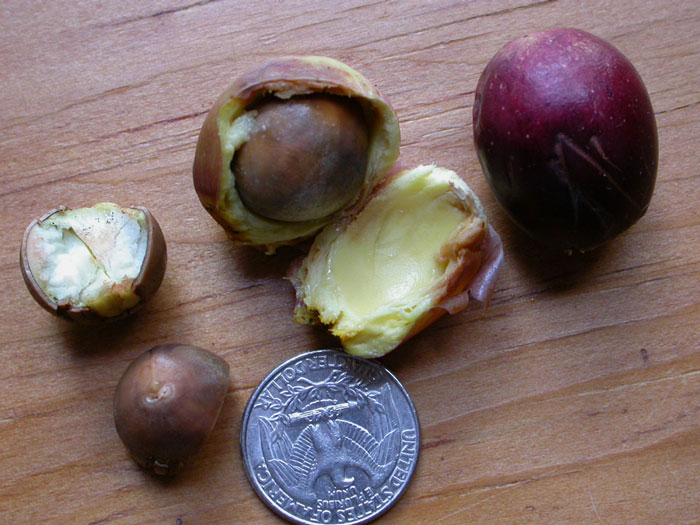
Native to the Stanford campus and Jasper Ridge Biological Preserve, California bay is instantly identifiable by crushing a leaf, even an old fallen leaf. The pungent aroma is quite pleasant but sniff deeply with care; it can be overpowering. Try a leaf in your stew (maybe half a leaf – see Laurus nobilis, the Grecian laurel, or sweet bay). Grape-sized purplish fruits contain a single seed.
The wood is homogeneous and almost as dense and hard as that of Q. chrysolepis. It is attractive for craft projects and can readily be antiqued with genuine tiny beetle holes just by letting it lie around outside for a season or two while green. Pin borers, so called because the escape holes left by the emerging beetles are so straight that a pin can be inserted, leave piles of fine frass on green firewood stacked below.
There is one at Lasuen Mall on the south side of Building 500. Those occurring naturally along San Francisquito Creek are multistemmed. Two old ones are 100 feet south of the Angel of Grief; more are nearby and behind the Mausoleum. Also see California laurel in the Junipero Serra Boulevard greenbelt east of Stanford Avenue.
Illustrations: Jasper Ridge photo archive.
About this Entry: The main text of this entry is from the book Trees of Stanford and Environs, by Ronald Bracewell, published 2005. Edits (Aug 2026, SP).

