

Quercus chrysolepis
 canyon live oak, gold cup oak
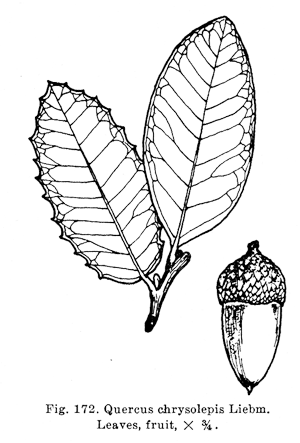
No other local tree is so striking in its beauty and also so notably absent from cultivation. Majestic, wide-crowned trees can be seen on the upper reaches of the local Santa Cruz Mountains (the few at Jasper Ridge have proved to be Q. palmeri, which see). Q. chrysolepis spans the widest geographic range of California’s oaks, extending into nearby states. The largest known is in the San Bernardino Mountains, with a girth more than 41 feet, but at exposed, high elevations elsewhere, shrubby forms crouch low, their foliage angling this way and that, cleaving close to short upright branches, exposing pale undersides. The blades are often oblong and pointed, though sometimes rounded; on young growth they may be spiny-toothed. Young twigs, the undersides of new leaves, and – most conspicuously – the turban-shaped acorn caps are clothed in an enchanting golden fuzz (chrysolepis means gold-scaled), making gold cup oak the most memorable name. Another name is maul oak, for its exceptionally dense timber was used to fashion splitting mauls and also whippletrees in the era of horse-drawn vehicles.
The closest known trees to campus, very likely wild, are a pair of shrubby clumps growing opposite the road from 357 Westridge Drive in Portola Valley. Records show that acorns were sown for propagation at Stanford in 1889, and the species was listed at Frost Amphitheater by 1956. In recent decades the only established campus tree known was a large specimen northwest of Old Chemistry, long shown on tree-walk maps (1973–2002) and prized for its gilded acorn cups; it was removed for construction of the chemistry labs. Magic planted two 1-gallon trees on the stadium berm in 2003, but both are now gone. Given the success of the trio of immense Pacific madrones elsewhere on the berm – another local species with a vast natural range and notoriously difficult in cultivation – it may be that seed provenance, along with careful siting and perhaps soil microbiomes, hold the key to establishing gold cup oak on campus.
Huckleberry oak (Q. vacciniifolia), once treated as a subspecies of Q. chrysolepis and known to hybridize with it, distinguishes the montane chaparral at Stanford Sierra Camp on Fallen Leaf Lake, forming low thickets about 3 feet high.
- Main References for New Tree Entries.
- Bracewell, Ron. 2002. “Tree Walk, SCRA to Cantor Center.” May 17. SC 896, Box 12. Stanford University Archives.
- Douglas, Thomas H. 1889–1991. “Daily Journals.” SC 195, Stanford University Archives. 27 Dec 1889 entry.
- Parker, William E. 1973. Untitled tree walk map from Biology Building to the Arizona Garden, with notation SES75/RNB on top right. April 15. SC 896, Box 12. Stanford University Archives.
About this Entry: Authored Sep 2025 by Sairus Patel. Last updated Aug 2026.

