

Vitex agnus-castus
 chaste tree
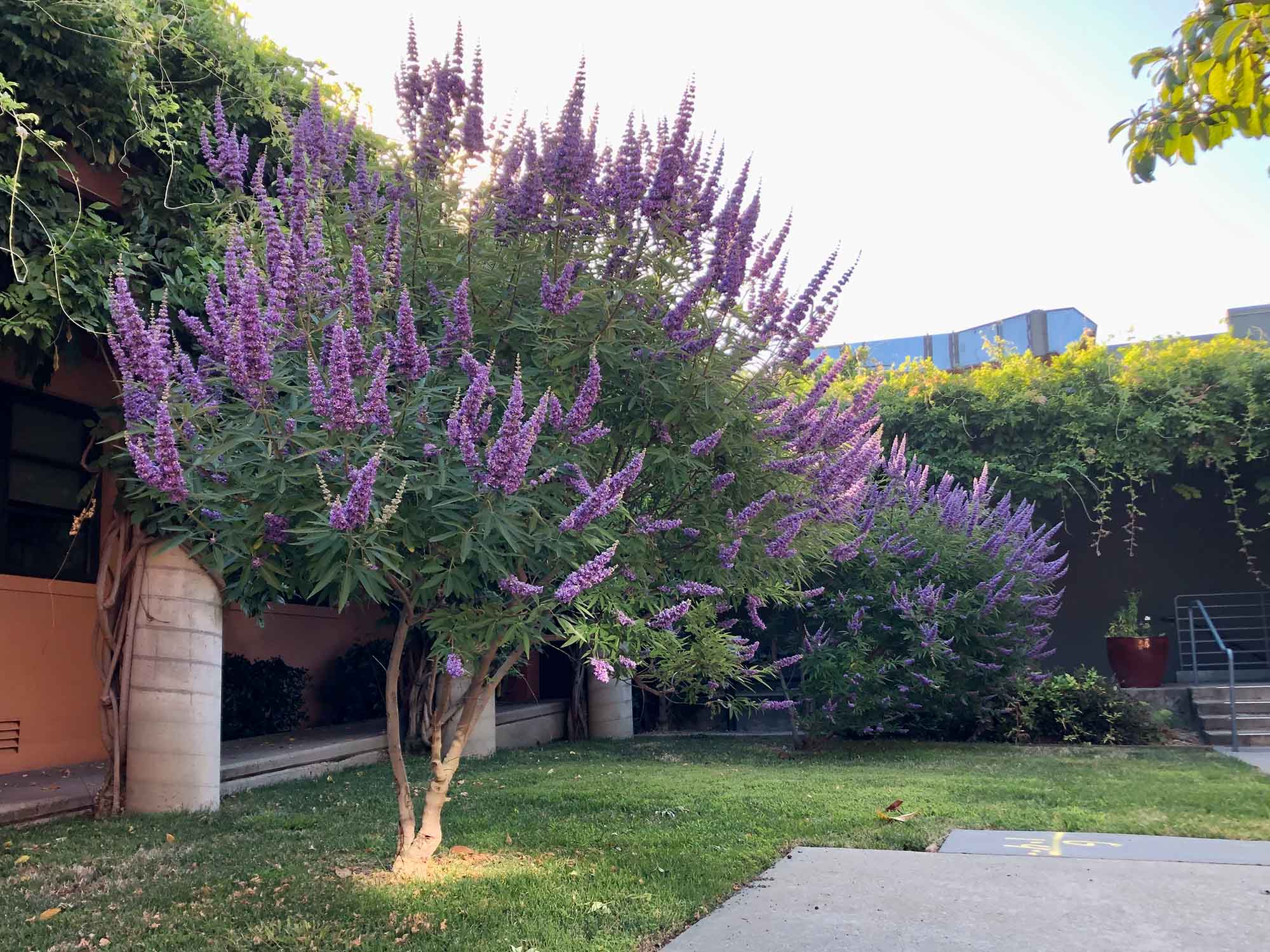
Striking panicles of violet-purple flowers rise from this heat-loving shrub or small tree in July and August. The oppositely arranged leaves are sage-scented and divided into five or seven slender, untoothed leaflets that fan outward like fingers. The genus name is ancient Latin; the species epithet means chaste lamb. The tree was thought to cool the passions; Pliny tells us that the dames of Athens made their pallets with its leaves to keep themselves chaste during the feasts of Ceres.
Two grow in the west courtyard of Stern Hall. A larger multi-stemmed specimen stands at 683 Alvarado Row, to the right of the house. At Gamble Garden in Palo Alto, cultivar ‘Shoal Creek’, selected for an extended blooming season, is at the north edge near the lattice fence, next to a smoke bush (map pin). Examples can be spotted in midsummer blooming on the southbound Highway 280 embankment near Cupertino, attesting to the species’ drought-tolerance.
The carved spirit house posts and slit-gong drum in the Papua New Guinea garden were made of a sister species, Vitex cofassus, and from Intsia bijuga (bean family), both native to Papua New Guinea; the wood was shipped to Stanford for the project. Another relative, V. trifolia ‘Purpurea’, is an ornamental shrub with attractive purple undersides to the leaves; see it at 2291 Columbia Street in Palo Alto.
- Main References for New Tree Entries.
- Pliny the Elder. 77–79 CE. Natural History. Translated by H. Rackham. Loeb Classical Library 393. Cambridge, MA: Harvard University Press. Book 24, Chapter 59.
- “Spirit House” interpretive sign, Papua New Guinea Garden, Stanford.
About this Entry: Authored Jul 2025 by Sairus Patel.

