

Trachycarpus fortunei
 windmill palm


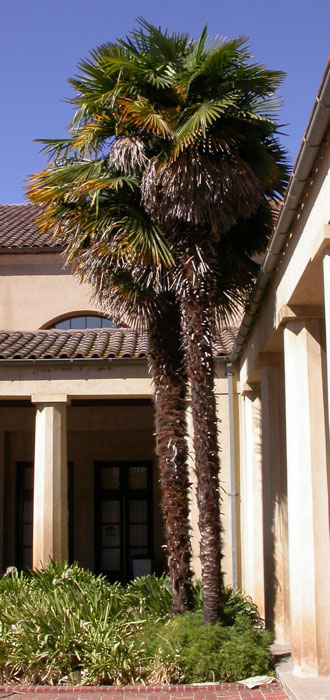
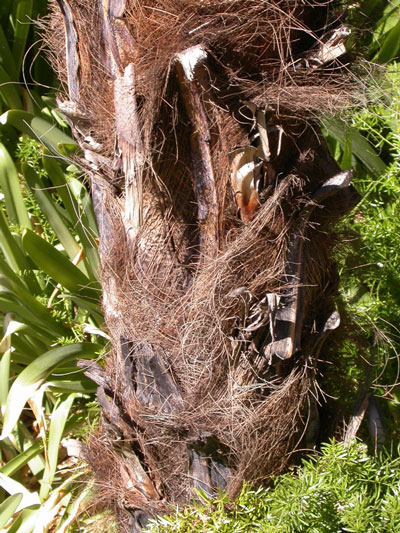
A slender, vertical accent of a fan palm, it is distinguished by pruned leaf bases entangled in masses of fibrous hair, thickest near the top of the trunk. This gives the appearance of a tapering form, though the trunk itself is cylindrical. Remnants of leaf bases jut at varied angles from the dark swirl of fibers, an attractive white midrib on their lower sides. As the eye travels down, the fibrous coating disintegrates first, and then the leaf stubs; finally, at the base, the bare gray trunk is revealed. The bouncy mats of hair are enticing to pet, recalling rough sacks, and are left in place for novelty and by convention. In parts of China, however, the trunk is pruned clean, yielding a smooth column perhaps not recognizable as belonging to this species. The leaf stalks are minutely toothed, an easy way to distinguish it from the more heavily armed Mediterranean fan palm.
In 1893, these were planted along the periphery of the Oval, and alternated with Cordyline australis on the street that fronted the Quad (see Palm Drive notes). Most were removed when the Oval and environs were replanted in 1924. Original specimens from 1890, in the inner and outer southeast circles of the Inner Quad were taken down around 2020, but younger ones can be seen in the inner northeast and inner northwest circles. A lush group is between Ng House and Vidalakis Dining; green fronds are staggered along the top half of the trunk under the main crown, giving the impression of a columnar canopy. Find two on the left of the Mausoleum, with another nearby on the northern periphery of the Arizona Garden. What may be our tallest stands on Campus Drive, south of 566 Mayfield Avenue.
Gallery
Name derivation: Trachycarpus – From Gk trachys (rough) and karpos (fruit); fortunei – after Robert Fortune (1812–1880) who collected in China, and introduced the tea plant from China into India. Also see Fortunella in Citrus Notes.
- Main References for New Tree Entries.
- Jordan, David Starr. 1922. Days of a Man. Vol. 1. Yonkers, NY: World Book, 376. (1893 plantings.)
About this Entry: Authored Jul 2025 by Sairus Patel.

