

Tilia cordata
 little-leaf linden
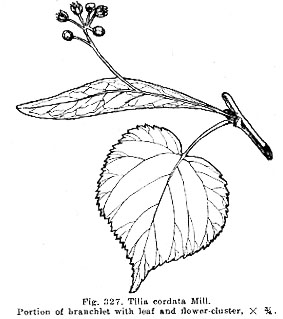
Named for the cordate, or heart-shaped, base of its leaf blades, T. cordata is more reliably distinguished by its yellow flower clusters, held above the foliage instead of hanging down as in other lindens common in cultivation. The fragrant flowers have long been infused as a tisane across much of Europe, a tradition shared with other lindens and extending into Turkey, where several Tilia species are used. The leaf undersides are blue-green (glaucous) with rusty tufts of fuzz in the vein axils.
The other linden species of western Europe, T. platyphyllos (which see), and their hybrid, were not distinguished by Linnaeus; his Tilia europaea initially covered them broadly, a name today used only for the hybrid, T. × europaea. Linnaeus’s family name itself derives from lind, Swedish for linden; the British name for lindens, lime, is another cognate, unrelated to the citrus fruit. A Tilia europus was noted as being propagated in the Stanford nursery in 1890; it’s unclear what this may have been.
The wood of lindens is eminently suited for ornamental carving, used most famously by Grinling Gibbons (1648–1721) in England. His work is most often encountered by sightseers and the faithful at St. Paul’s Cathedral, where intricate limewood cherubs and floral sprays decorate the oaken Quire and organ cases, though the carvings are not easy to view up close.
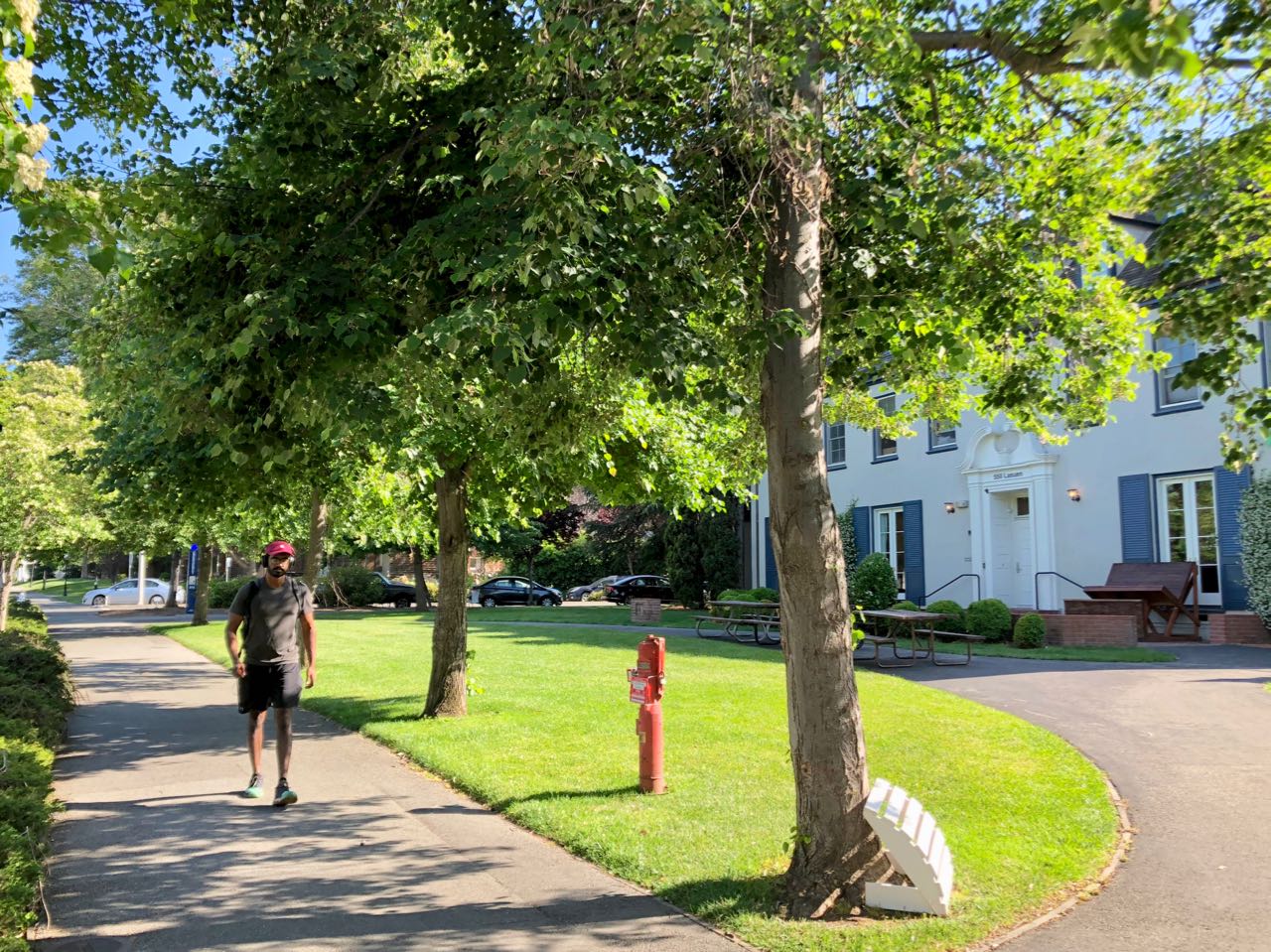
A row of T. cordata grows at 550 Lasuen Mall, with a few others across the street at Mars (553 Mayfield Avenue). A tall tree stands on the southwest corner of the Stauffer II Physical Chemistry building; its companion was removed in 2016 when Stauffer III was demolished. Half a dozen front Green Earth Sciences at the start of Panama Street. Three, reputed to be of trade name Greenspire, are on the northwest corner of Pi Beta Phi, at Campus Drive and Bowdoin Street (1967); they once formed a shady row with six more on the southwest side of Delta Delta Delta House, which were removed in 2015. Newer groups are in the courtyards northwest of Vidalakis Dining (2016) and northeast of Traitel Building (2017).
About this Entry: Authored Sep 2026 by Sairus Patel.

