

Schinus terebinthifolia
 Brazilian pepper tree
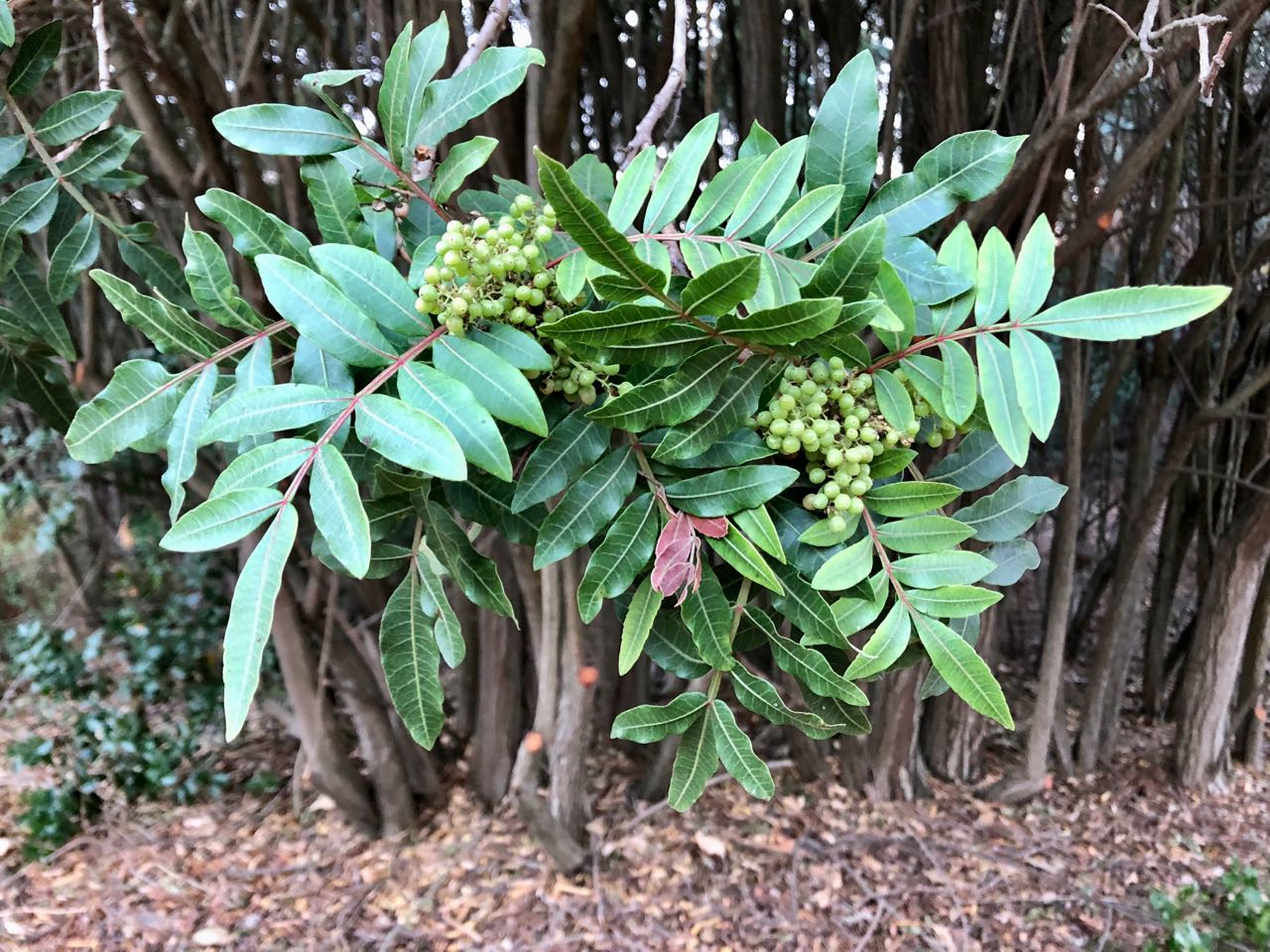
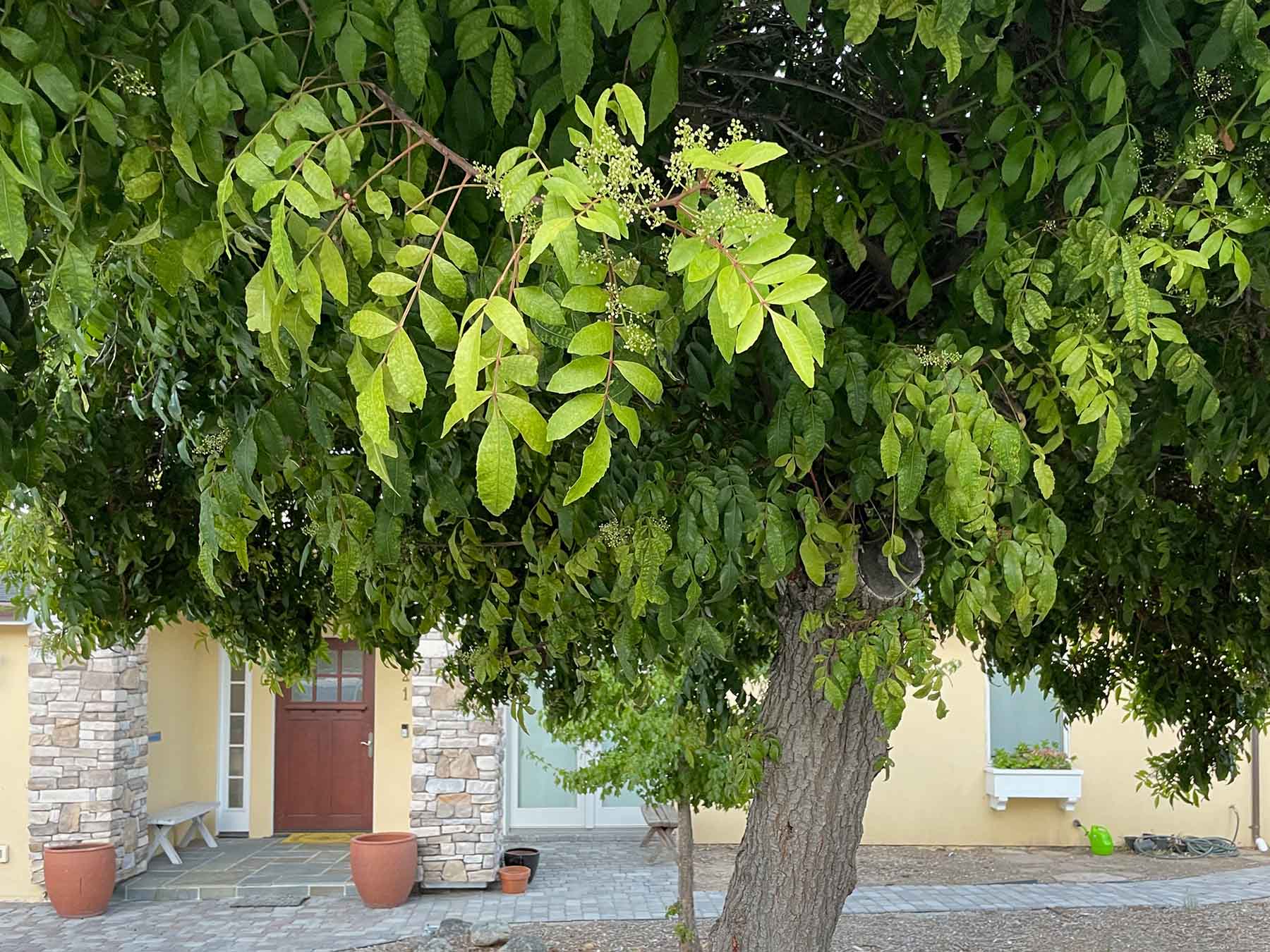
Quite distinct in overall character from the more familiar Peruvian pepper tree, this attractive evergreen bears pinnately compound leaves composed of just 7–11 relatively short leaflets, about an inch long and a quarter as wide, with the terminal leaflet the largest. The leaflets are paler beneath and irregularly toothed. The midrib – often pink – is winged, though the leaf stalk itself is not. New foliage emerges a lustrous pinkish-red. When crushed, the leaves are redolent of pepper, sometimes edged with the fruity tang of green mango. As the species name suggests, the foliage recalls that of the terebinth (Pistacia terebinthus); locally it is easy to confuse it with the Atlas terebinth (P. atlantica), which see for points of comparison.
Small, inconspicuous flowers give way to dry peppercorn-like fruits that ripen to pink and red, hanging in lush, pendulous clusters that create a striking, almost floral effect. These fruits are often encountered mixed with true black pepper (Piper nigrum), an unrelated species, in commercial peppercorn blends, or sold on their own.
In coastal Southern California the species self-sows only modestly, though in tropical Hawaii and Florida it is a notable invader. It also reproduces clonally, as can be seen in three colonies on Bowdoin Street, one east of 702 and two in the greenbelt opposite Rains Building 217. Each colony comprises dozens of evenly sized trunks arising directly from the roots. Their rate of lateral expansion would be worth monitoring. These arose from trees that were cut back or killed to the ground by frost. Perhaps another member of that original planting still survives in the Bowdoin greenbelt: a rugged, two-trunked specimen near the sidewalk, some 60 yards north of Stanford Avenue.
A small, single-trunked tree stands in front of 721 Alvarado Row. A two-trunked behemoth, likely the largest in the area, grows at the Stanford Shopping Center on Garden Walk near Palatine Court. Another multitrunk tree is between 4055 and 4073 Ben Lomond Drive, Palo Alto, next to the fence.
Published in 1820 as S. terebinthifolius, its species name was changed to have the -a ending after a 2015 paper in Phytotaxa determined Schinus to be feminine. One hopes this settles a long-standing dispute over its gender.
- Paperbark Notes, for mention of Brazilian pepper in the Everglades.
- Main References for New Tree Entries.
- Zona, Scott. 2015. “The Correct Gender of Schinus (Anacardiaceae).” Phytotaxa 222 (1): 75–77.
About this Entry: Authored Jan 2026 by Sairus Patel.

