

Quercus wislizeni
 interior live oak
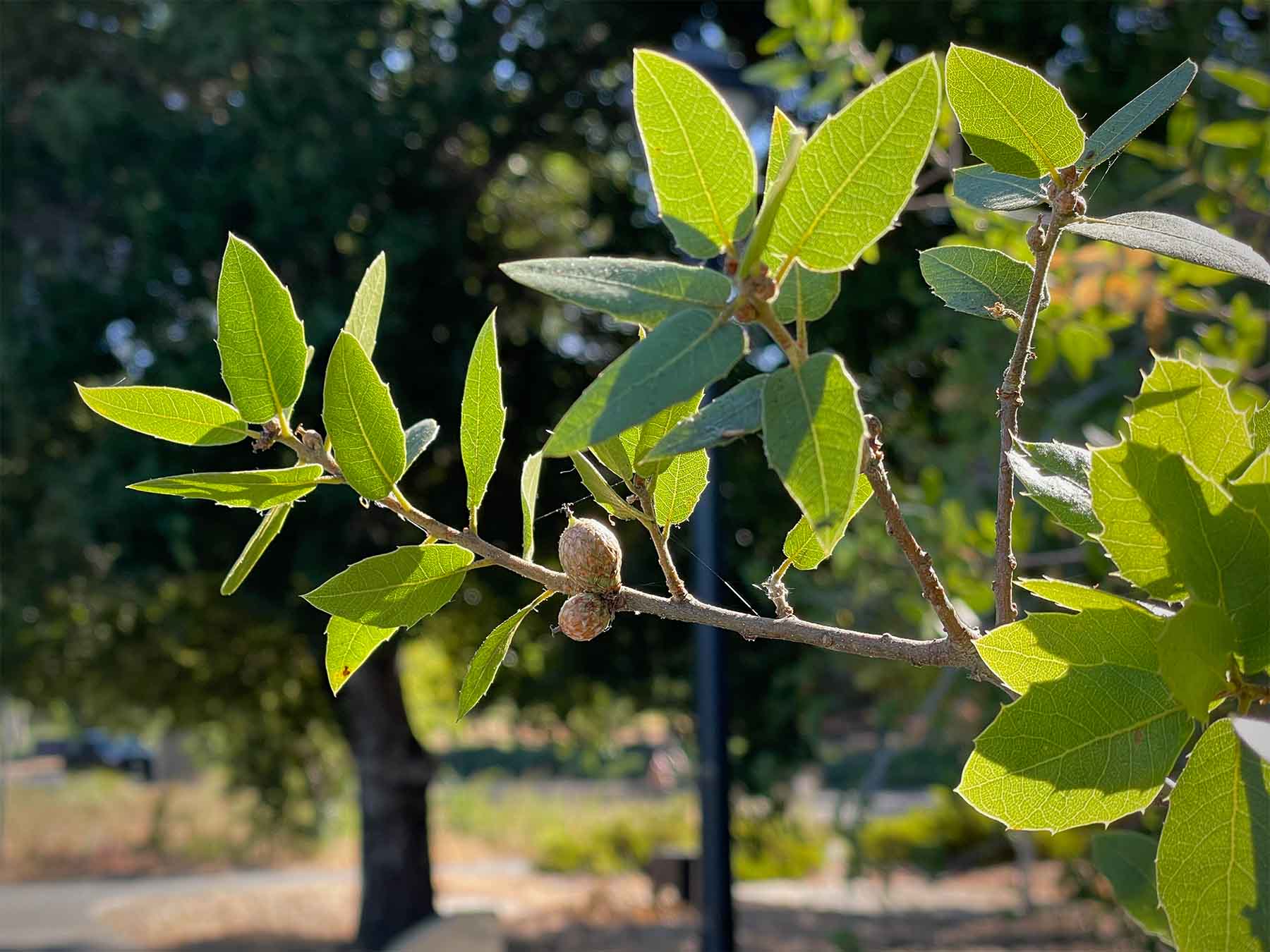
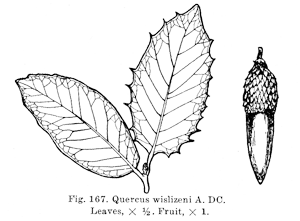
Along with coast live oak, this is the common evergreen oak of California, but chiefly of the hot interior valleys and slopes; Encino and Live Oak are both towns near Sacramento. Frederick Law Olmsted, when drawing up a planting list for Stanford’s newly founded university in 1886, called for 6,000 “Live Oaks” – he included both species in this item – to be propagated, the most numerous entry on his plan. The dark green leaves are indeed similar, though those of the interior live oak lack the characteristic tufts of fuzz at the vein junctions on the undersides, have more than 12 lateral veins, and are flat, not concave. The leaves are shaped quite variably; the margins may or may not have teeth or spines (coast live oak’s are always spiny), and hybridization between the two species is known.
Though no venerable specimens have been found on campus, interior live oak has been planted in recent years. Young trees show an upright, smooth gray trunk and a rather tangled crown structure due to branches jutting at right angles. A pair stands at the northwest corner of Campus Drive with Santa Teresa Street (planted in 2016); more are scattered along Serra Street, including in the median, near the Pampas Lane intersection and south of it. Three were planted on the Via Ortega side of the Neurosciences building, mingled with valley oaks, when the building itself was completed (2020); others stand across the street at the bike racks. In winter they shed a scattering of leaves, enough to appear sparser.
At Jasper Ridge, what was long thought to be a dwarf form of interior live oak (var. frutescens) has proved to be something different: the Shreve oak (Q. parvula var. shrevei). Compared with interior live oak, the Shreve has larger leaves, acorns with blunter tips, and a wider hilum scar – the round mark in the acorn cup where the nut was attached – about 8 mm across instead of 5. DNA analysis has confirmed its distinctness, though the Flora of North America (2025 online edition) treats Q. parvula var. shrevei simply as a synonym for Q. wislizeni. The same genetic work even suggests that Q. parvula var. parvula itself may be of hybrid origin.
And if the taxonomic fog were not thick enough, the epithet wislizeni has been subject to nomenclatural confusion as well: important oak references and gardening books have appended a spurious i, perhaps by mistaken analogy with Q. douglasii and Q. kelloggii. But unlike Douglas and Kellogg, Friedrich Wislizenus’s surname was already in Latinized form and required only a single i. (What about Q. palmeri? Well, there is an exception for names ending in -er. If this sort of arcana makes you laugh aloud in delight, you may enjoy perusing the International Code of Nomenclature; skip directly to Article 60.8.)
- Main References for New Tree Entries.
- Flora of North America Editorial Committee. 2022. “Quercus wislizeni.” Flora of North America. Last modified 2022. Accessed 31 Aug 2025.
- Hauser, Duncan A., Al Keuter, John D. McVay, Andrew L. Hipp, and Paul S. Manos. 2017. “The Evolution and Diversification of the Red Oaks of the California Floristic Province (Quercus Section Lobatae, Series Agrifoliae).” American Journal of Botany 104 (10): 1581–95.
- Jasper Ridge Biological Preserve. 2025. Vascular Plant List, Oakmead Herbarium.
- Keuter, Al, and Paul S. Manos. 2019. “Agrifoliae: The California Red Oaks.” International Oaks, no. 30: 191–202.
- Turland, N. J., J. H. Wiersema, F. R. Barrie, W. Greuter, D. L. Hawksworth, P. S. Herendeen, S. Knapp, et al., eds. 2018. International Code of Nomenclature for Algae, Fungi, and Plants (Shenzhen Code). Regnum Vegetabile 159. Glashütten: Koeltz Botanical Books.
About this Entry: Authored Aug 2025 by Sairus Patel.

