

Quercus tomentella
 island oak
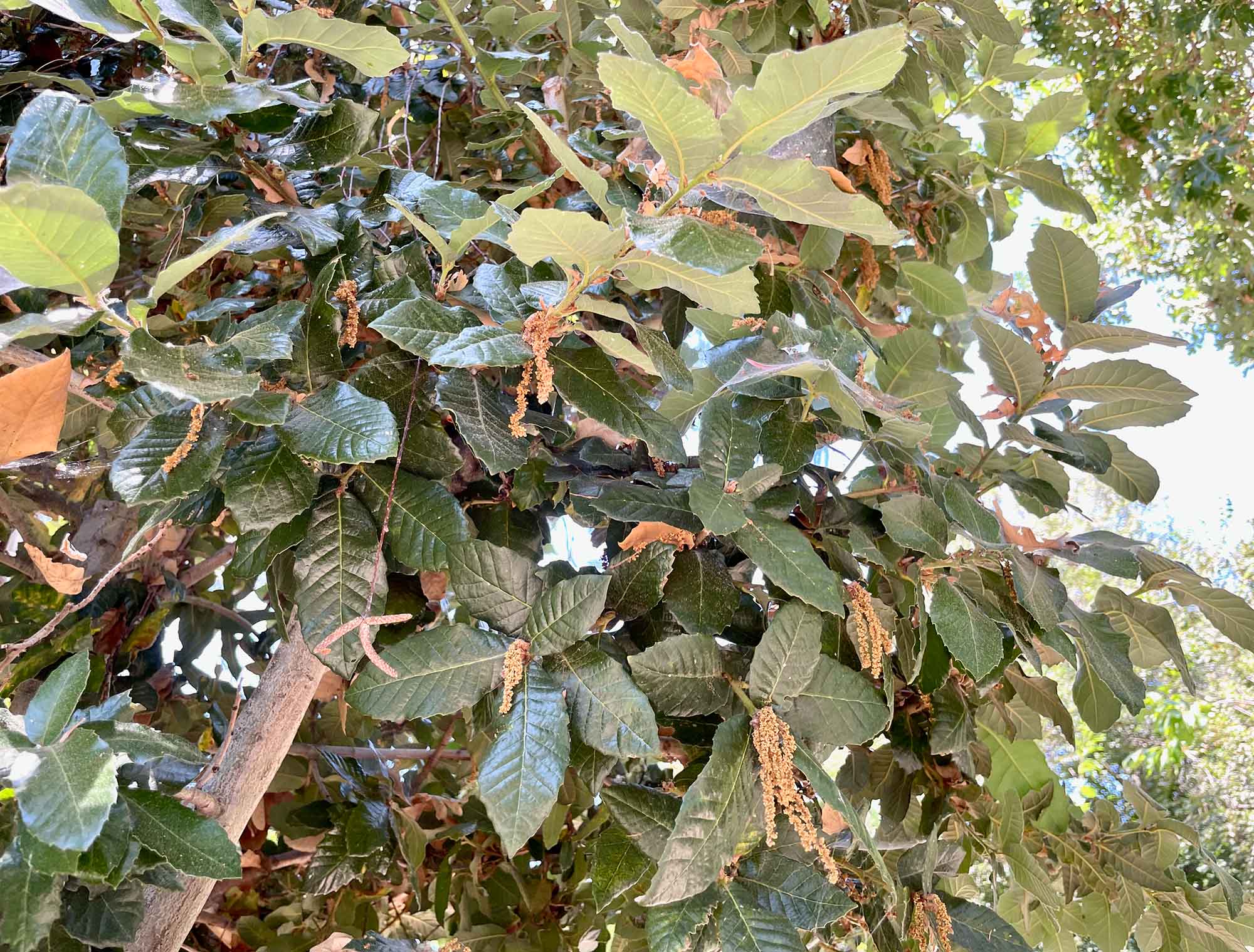
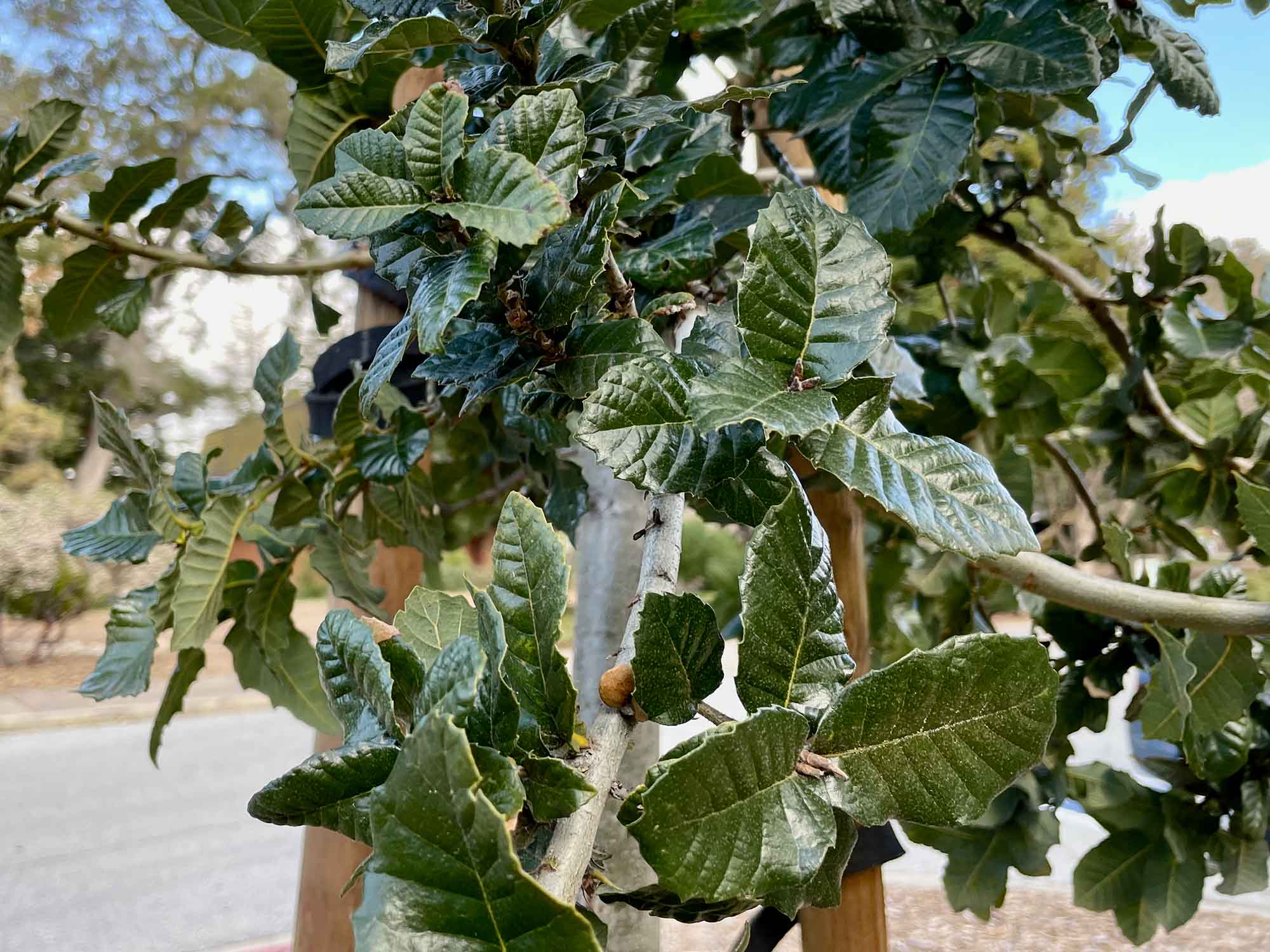
The rarest of California’s tree oaks, island oak has been in cultivation for nearly a century but has only recently found a place at Stanford. Glossy evergreen leaves, shallowly toothed, have distinctly parallel veins reminiscent of tan oak’s – veins that often lie inset in the plush, deep green upper surface, creating a pleasing quilted effect that can be quite dramatic in angled light. A buff fuzz or tomentum covers the undersides (hence tomentella), reminiscent of Q. chrysolepis, with which it hybridizes.
The first specimens on central campus appeared in 2025: a young tree on Jane Stanford Way at Encina Hall, on the left; another at the northwest corner of Crothers Hall; and a third at the north edge of the parking lot east of Florence Moore Hall. A year later, a gleaming row followed at the south end of Sam McDonald Way and around the corner on Campus Drive.
A year or two earlier, a scrawny youngster had been planted about 40 feet south of 40 Peter Coutts Circle, at the edge of the greenbelt, and another at the west corner of the vegetable garden at the Meyer-Buck Estate. A young tree grows in the planting island – presumably a coincidence! – at the north corner of the Menlo Park Library parking lot. The oldest island oaks in the area were planted by Canopy in 2007 along the freeway sound wall in East Palo Alto, for example on West Bayshore Road where Euclid Avenue meets it, and further north near Donohoe Street.
About this Entry: Authored Aug 2024 by Sairus Patel. Updated Jun 2025 (SP). Updated May 2026 (SP).

