

Phoenix dactylifera
 date palm
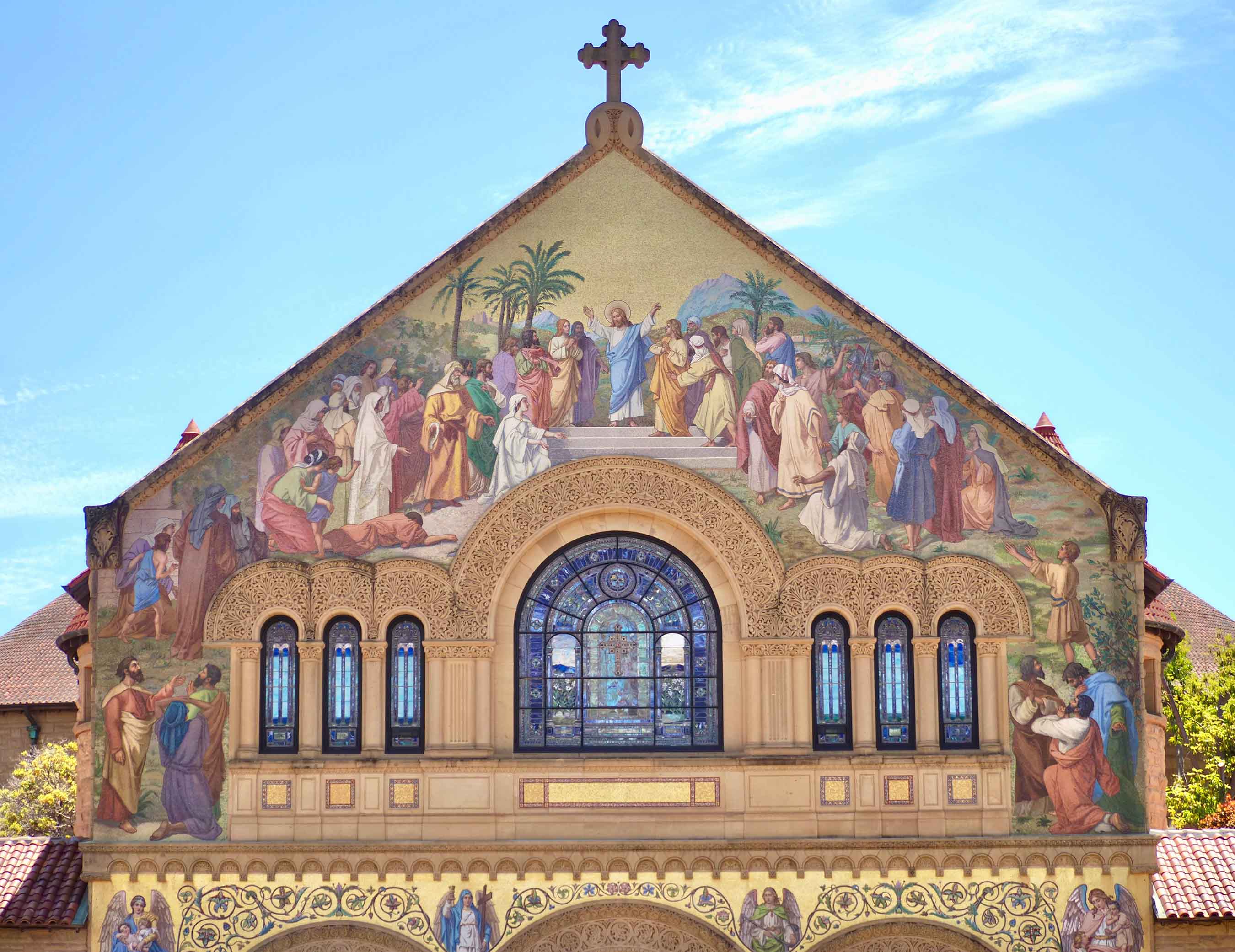
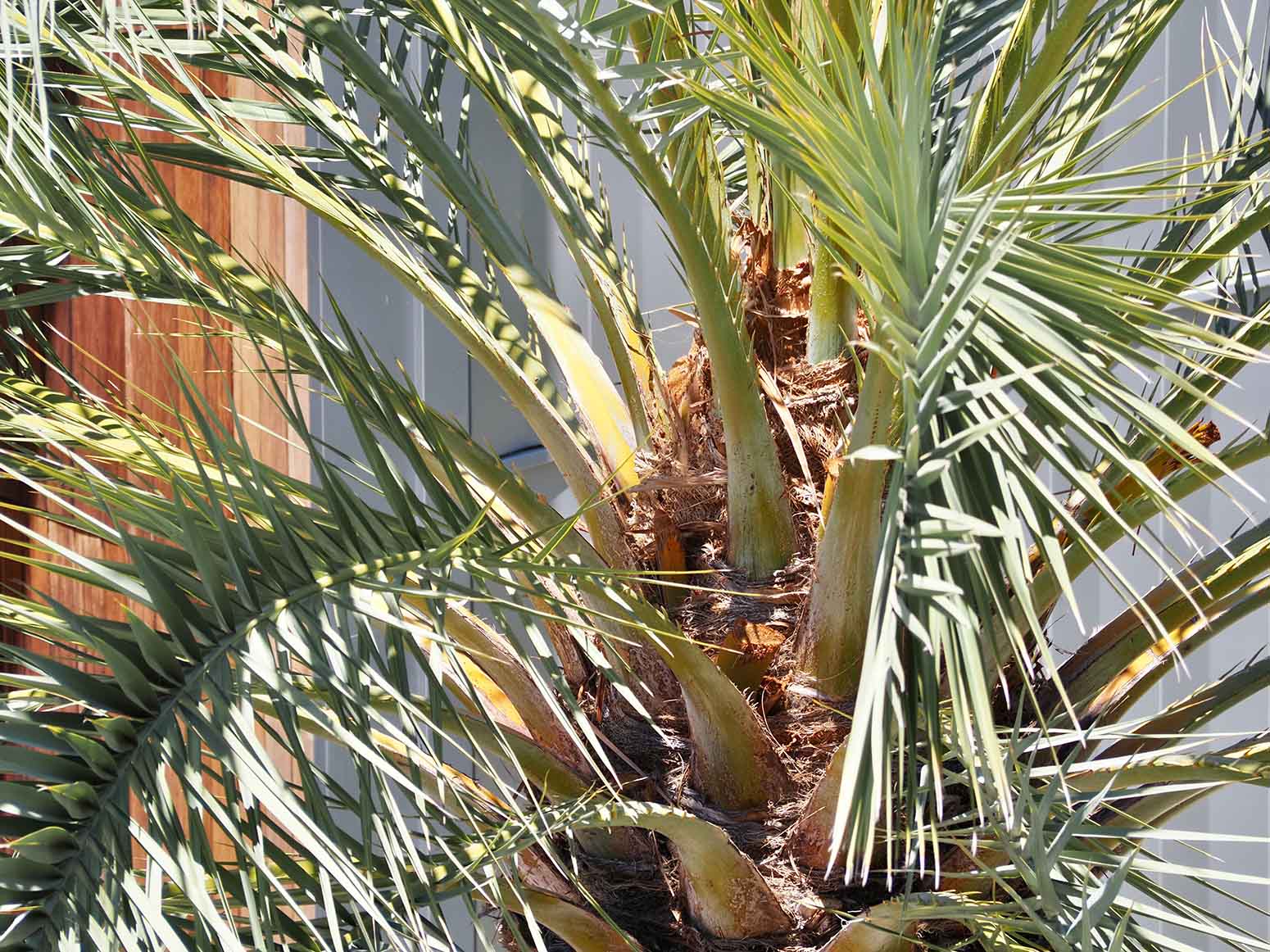
The only true date palms on campus, as long pointed out on campus walks, were those gracing the hills of Bethany in Christ Blessing the People, the façade mosaic of Memorial Church (then the largest mosaic installed in the country). But in 2021, a stroll past the hoary specimen of what had long been assumed to be a Canary Island date palm (Phoenix canariensis) tucked between Okada and its Resident Fellow’s cottage in Wilbur Hall, revealed that the prized date palm of the Middle East has in fact long been growing on campus. Its fronds were grayer than its Canary Island cousin’s, and the flesh of a fallen date, though thin, was distinctly sweet. But the clearest tip-off was the throng of buds leafing out from its base: the true date palm, like the Mediterranean fan (Chamaerops humilis), wants to form a clump of stems.
Frederick Law Olmsted’s detailed sketch study, circa 1889, for planting circles in the Inner Quad shows the plan for a sample island: P. dactylifera at its center, with P. rupicola, P. sylvestris, Washingtonia, and Trachycarpus fortunei arranged around it – a dozen palms, five species – along with four loquat trees, and a couple of dozen other types of substantial shrubs and groundcovers. A riot of bamboo runs through it all: a veritable arboretum jungle. In remarkable contrast, other sketched proposals from Olmsted and the architects he worked with showed markedly spare plantings in the circles – a single palm with low shrubs or succulents around it. Photographs of the planted islands in their early years do indeed show very dense plantings, but there is no evidence that any of the Phoenix species in Olmsted’s study were employed; rather, P. canariensis was used, survivors of which stand to this day.
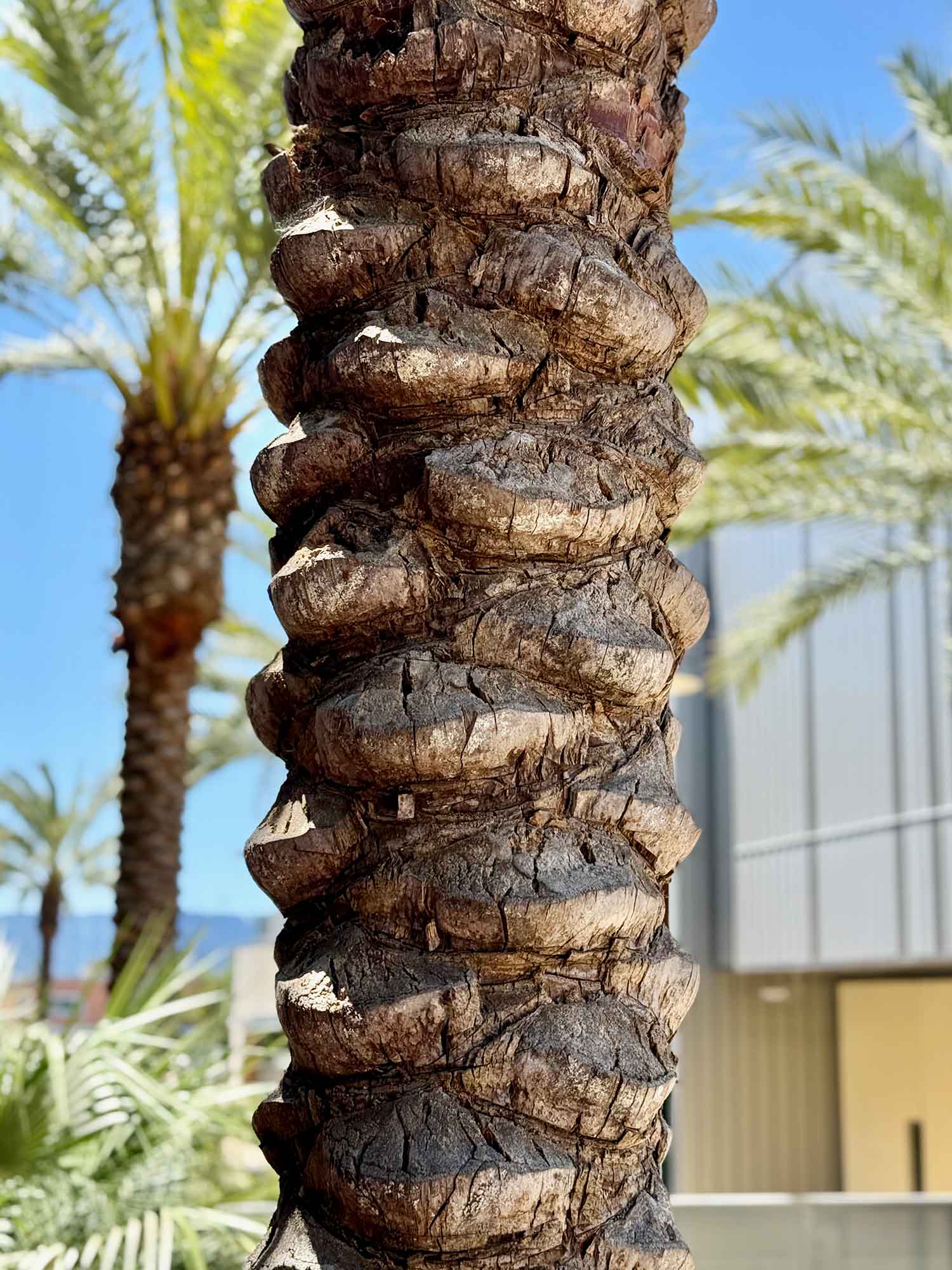
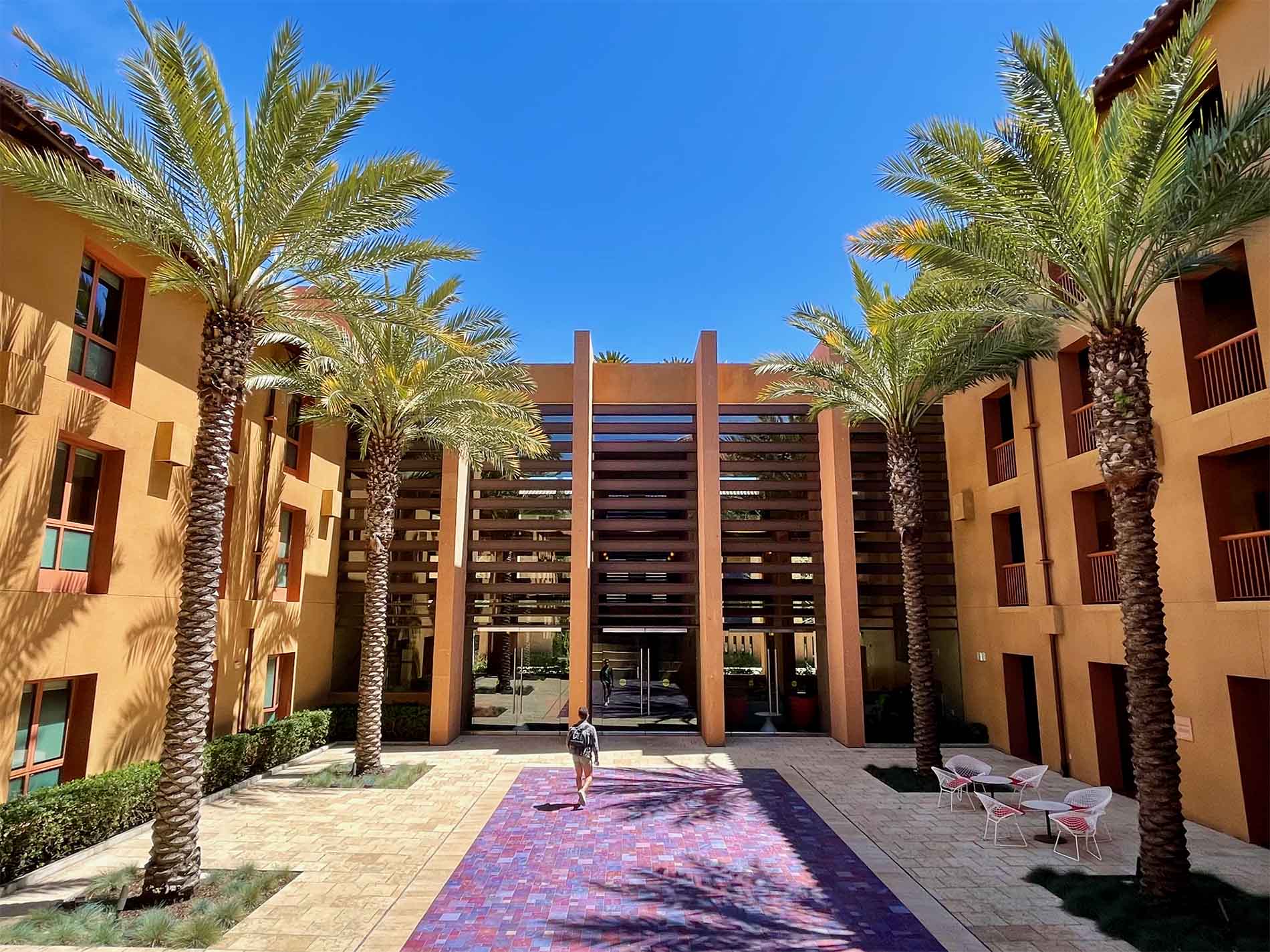
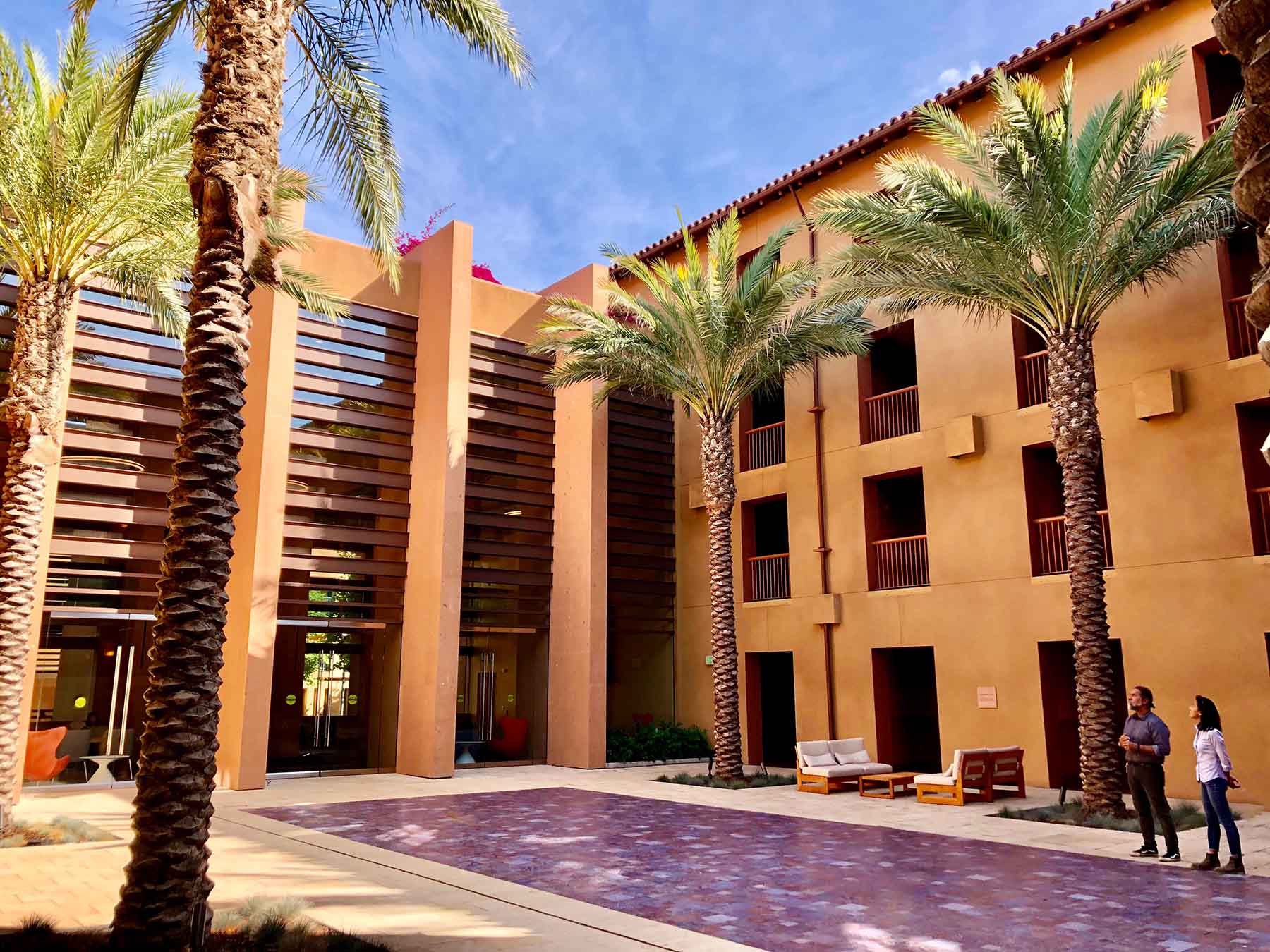
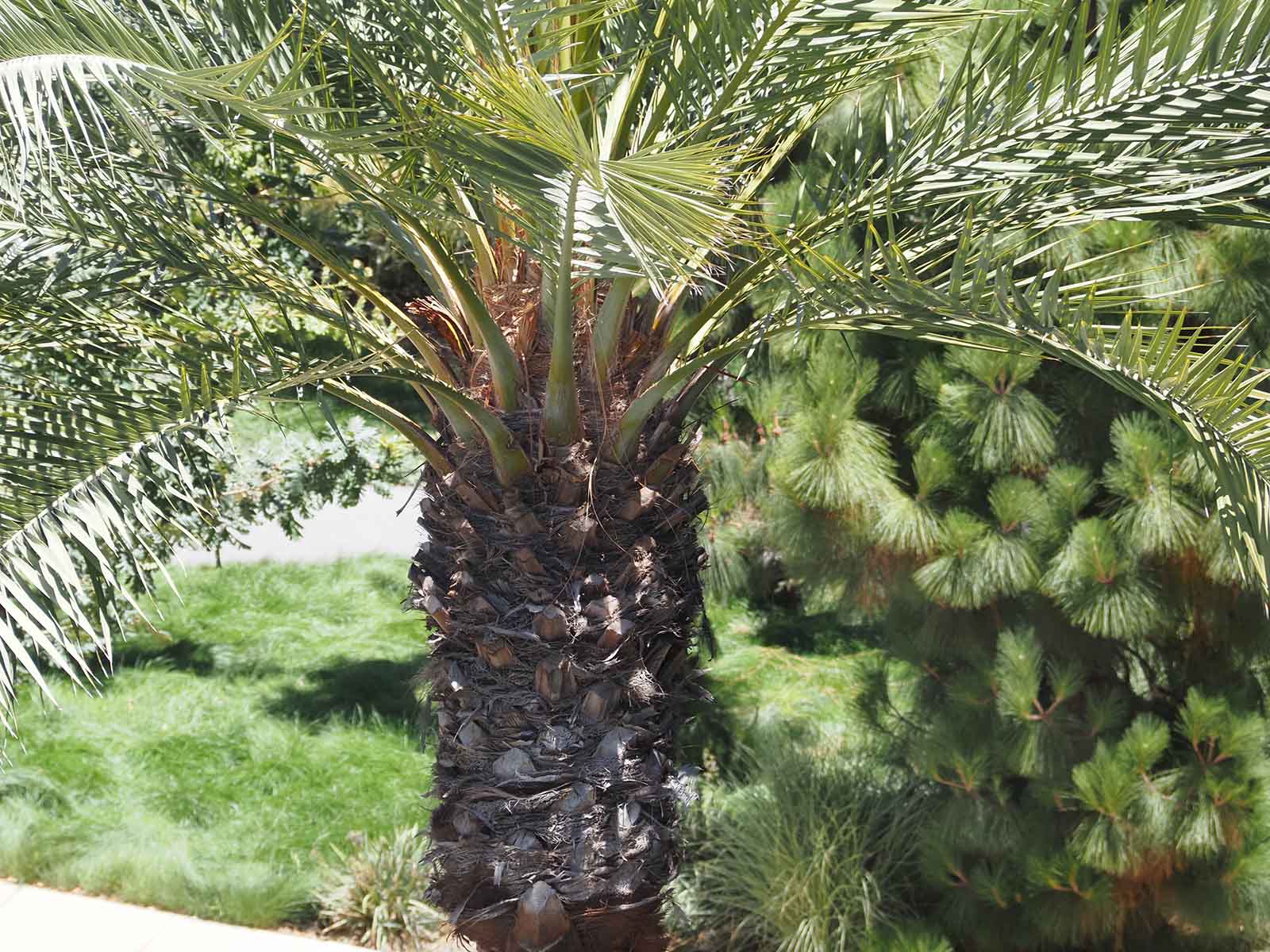
In 2016, six specimens of the famed P. dactylifera variety ‘Medjool’ – a female clone – with trunks some 25 feet tall were transplanted into the east inner courtyard of McDonald Hall (then named Highland Hall), a Graduate School of Business dormitory. Dead fronds are pruned so that the leaf-base stubs protrude in an attractive three-dimensional diamond-cut along the trunk, shaped partly by inherent structure and partly by utility and, now, tradition – a feature that can alone identify this species. You can grasp these sculpted chunks to clamber up the trunk to hand-pollinate the female flowers and, if successful, later to harvest the dates. Enterprising students might devise easier access from the balconies, perhaps. High-quality date palm pollen commands a notable premium in the market; some growers simply tie clusters of male flowers beside the female ones. The courtyard specimens’ flowering and fruiting, if any, warrant close observation.
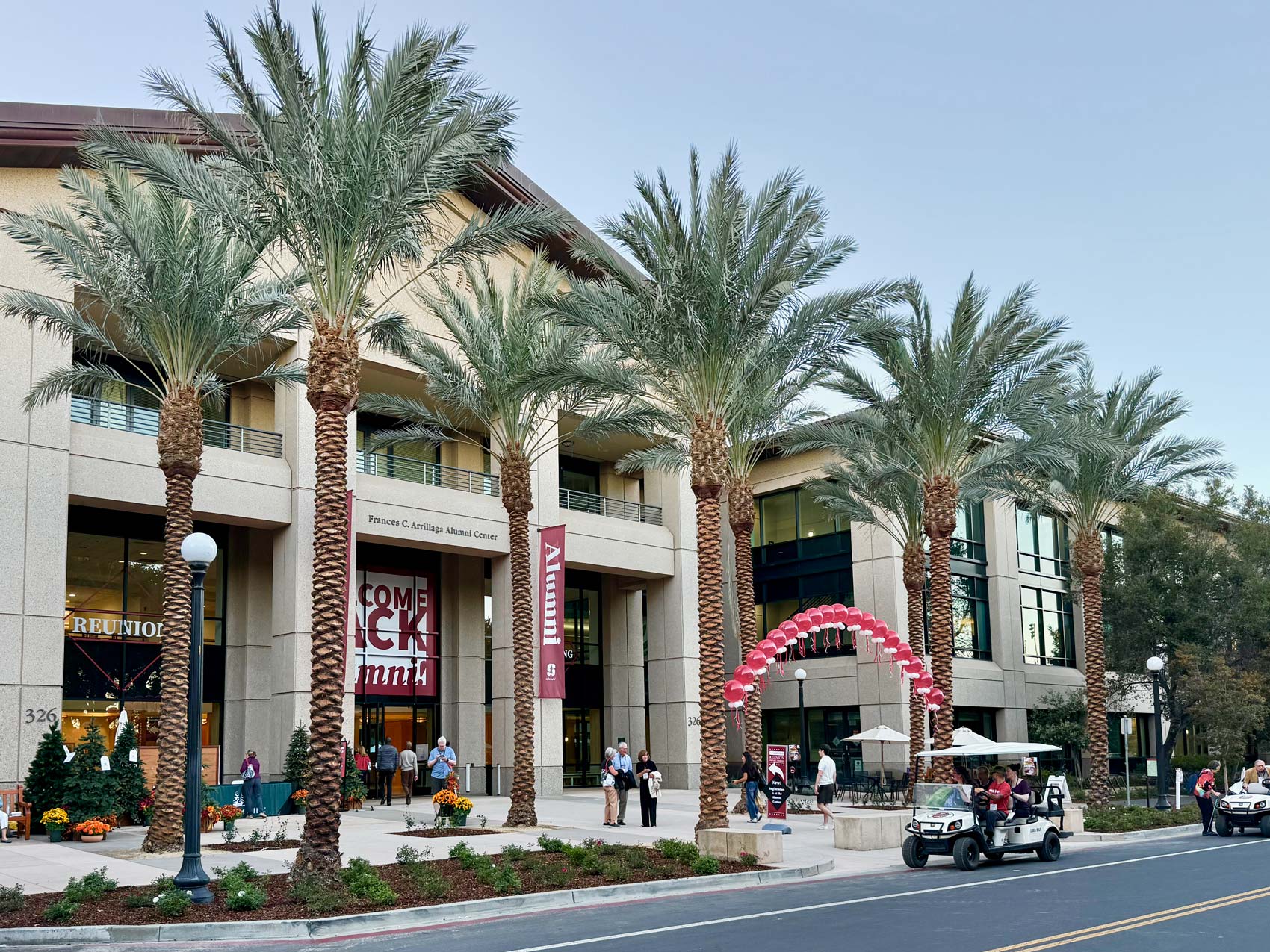
‘Medjool’ date palms were planted in two parallel rows of four along the sidewalk in front of the Arrillaga Alumni Center in 2026, replacing Canary Island date palms, some of which were suffering from fusarium wilt. One of the Canaries next to the front door had had its entire crown cut off, leaving the bare trunk standing for several years; a building manager remarked that visitors hadn’t seemed to notice!
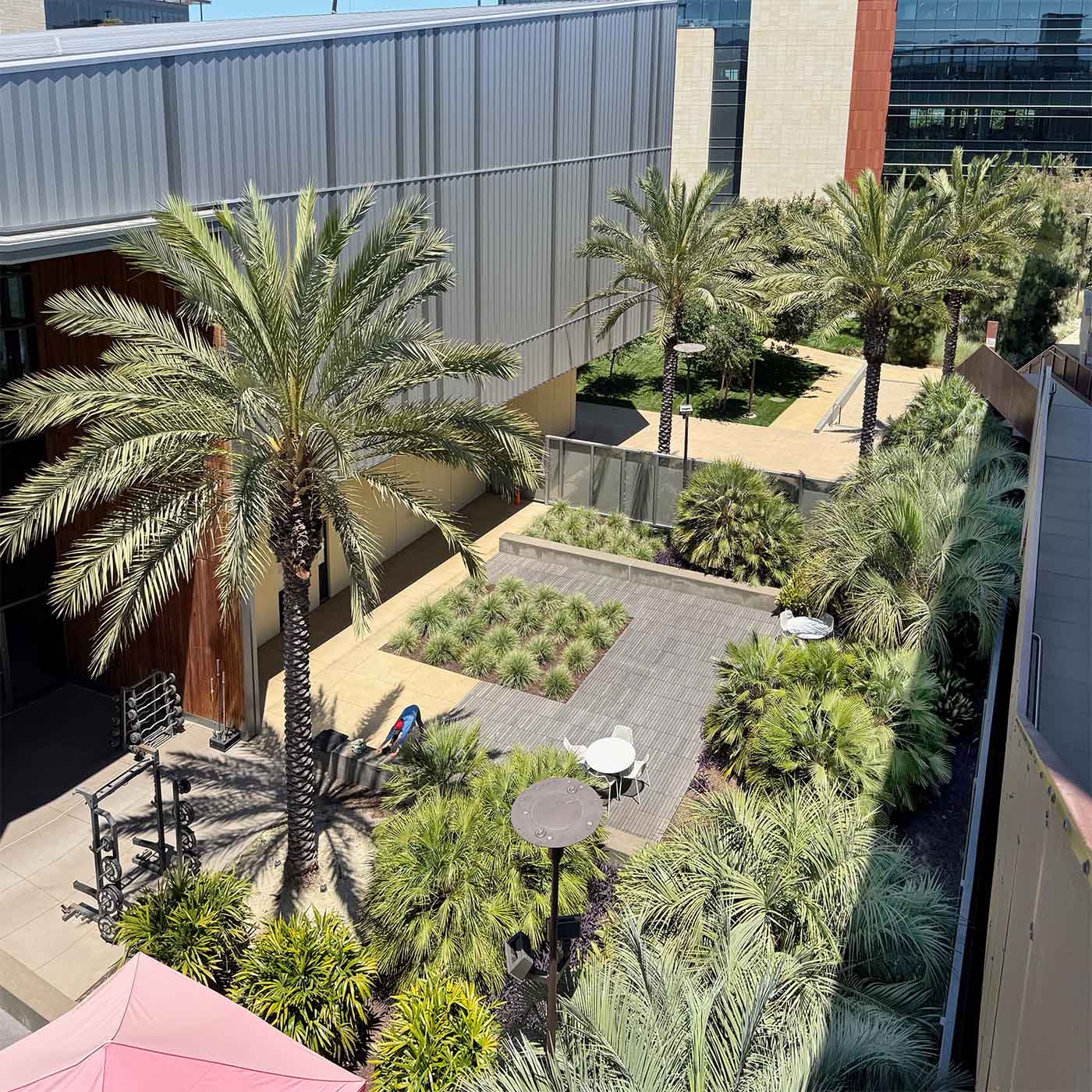
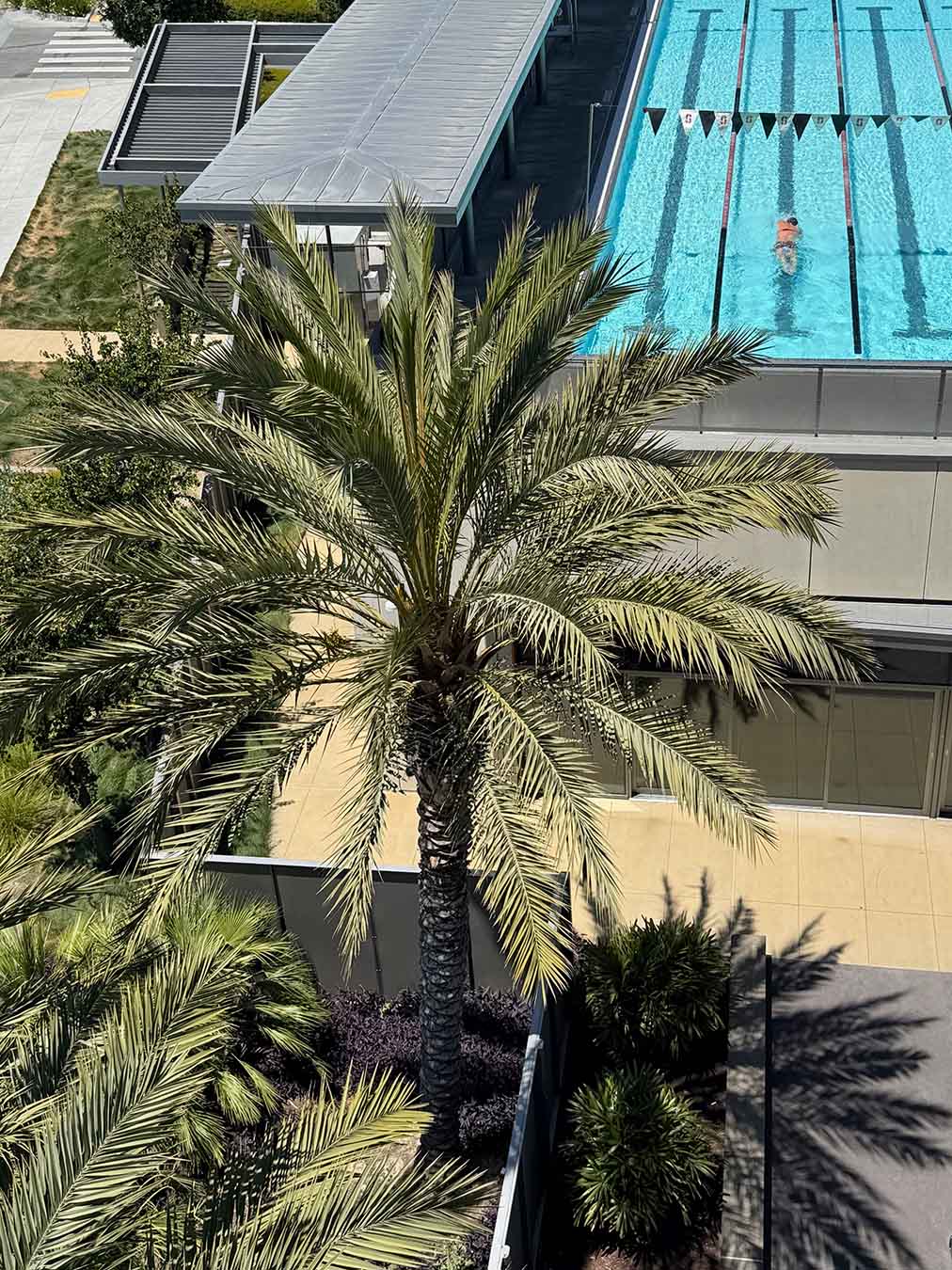
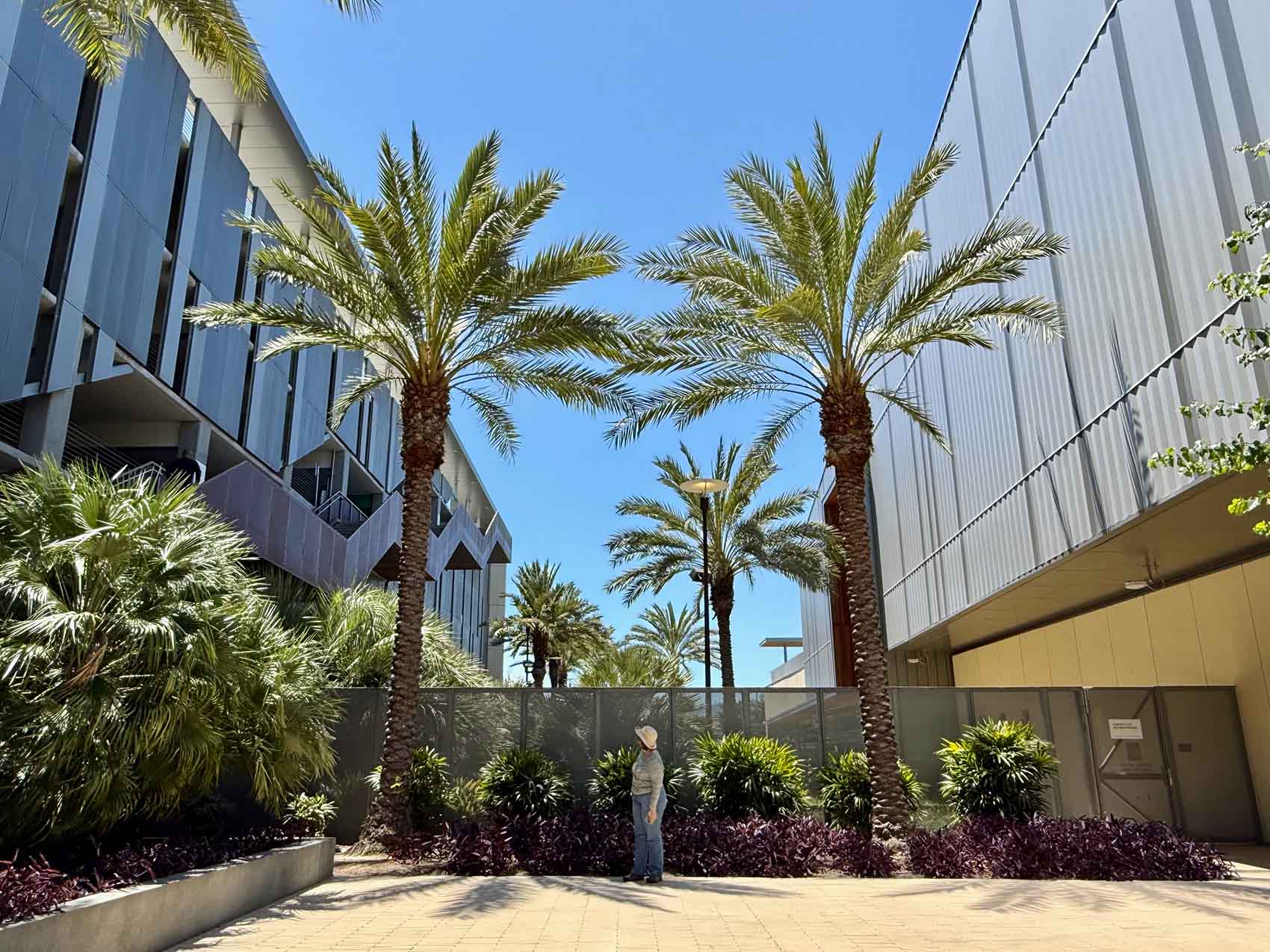
Two date palms grow by the pool at the Stanford housing complex at 2500 Columbia Street; another is nearby, in the Research Park at 1400 Page Mill Road. Eight or so stand on the east side of the recreation center at Stanford Redwood City (900 Warrington Avenue), intermixed with pindo palms and Mediterranean fan palms. In Palo Alto, date palms can be seen in the bus stop island at the downtown Caltrain station. Several, all of them female, surround tranquil pools in the Rosicrucian Park’s Peace Garden in San Jose. Their fallen dates are easily wolfed down by visitors’ pet dogs: unlikely to have been fertilized by any distant male’s pollen, they do not develop the hard pit within. Coachella Valley in Southern California is the center of North America’s date industry. Date palms in the Furnace Creek area of Death Valley National Park have naturalized.
The same Greek word phoinix was used for the mythical bird; the date palm and its fruit; a Phoenician, a member of a Canaanite people from the eastern Mediterranean; and Tyrian purple, the prized reddish-purple dye secreted by murex snails and famously produced by the Phoenicians. A swirl of conjectured connections tries to link these meanings: the purplish hue of ripe dates; the phoenix rising from ashes, like a date palm regenerating from its basal buds; and even the ruddy, sunburned complexion sometimes invoked as characteristic of the seafaring Phoenicians.
Dactylifera, somewhat more straightforward at first glance, means furnished with fingers, the date clusters presumably evoking stubby fingers. Greek daktulos, finger, also started to mean the date itself – and is in fact the ancestor of our English word “date.” Tamar, ancient Hebrew for the date and date palm, is also the name of two Biblical characters, and continues to be used as a given name today along with Tamara.
Gallery
Name derivation: see text above.
- Main References for New Tree Entries.
- Liddell, Henry George, Robert Scott, and Henry Stuart Jones. 1940. A Greek-English Lexicon. Revised and augmented throughout. Oxford: Clarendon Press.
- Olmsted Archives. Undated. “Stanford Univ/Study for Planting Circles in Quadrangles/Project: 01032.” National Park Service, Frederick Law Olmsted National Historic Site.
About this Entry: Authored Apr 2023 by Sairus Patel. Last updated Oct 2026 (SP).

