

Nerium oleander
 oleander
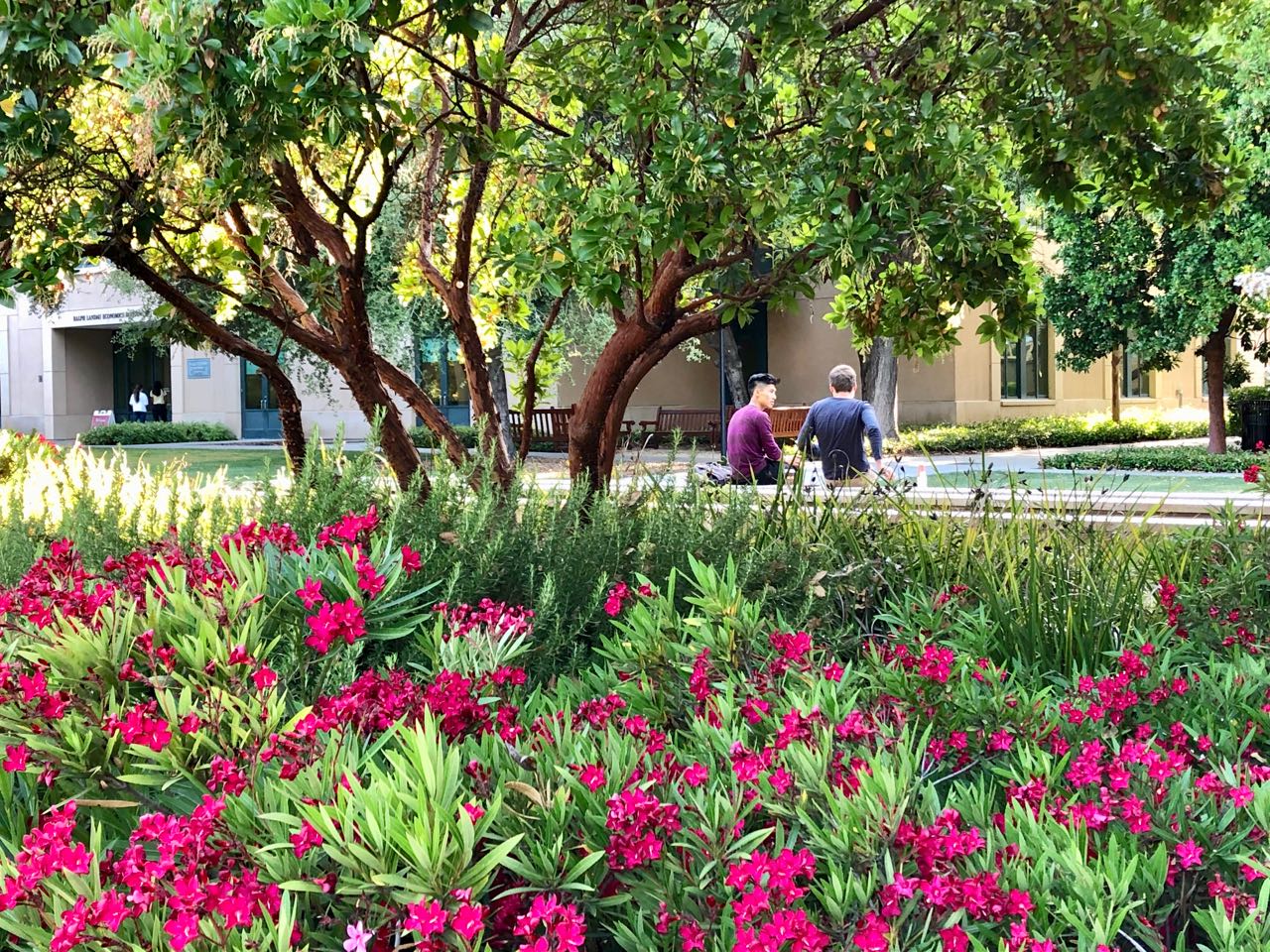
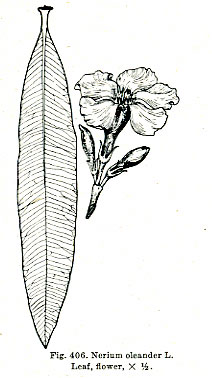
Used most often these days as a low- to medium-height hedge, and adorned in the summer months with flowers of a clear and brilliant white, light pink, dark pink, wine-red, and sometimes salmon, this workhorse of a shrub can also be shaped into a small tree with a trunk as thick as – per the 19th-century Belgian botanist P.A.J. Drapiez – a man’s torso. Minimize pruning: the plant needs ample space, especially in width, as shearing to fit narrow spaces exposes bare stems and defeats its use as a screen. Fortunately, cultivars specify ultimate dimensions. The sap may irritate the skin – another reason to avoid pruning. All parts are highly poisonous: its family name, Apocynaceae, is from the Greek for canine-repelling.
The flowers, single or double, may carry a faint talcum-powder or vanilla scent. Petals overlap to the right. Peer into the center and you’ll find an exquisite, crown-like arrangement of fringed or petal-like extensions, noticed by almost no one. The narrow, leathery leaves are in whorls of three, uncommon in woody plants. Each flower gives rise to a pair of unexpectedly pod-like follicles, 4 or so inches in length, which split when mature to release a myriad of seeds equipped with silky hairs for windborne travel.
Short hedges can be seen throughout campus, for example on Escondido Road at Branner Hall, and on Galvez Street at the John A. and Cynthia Fry Gunn Building. Tall hedges appear widely in the residential area, such as at 727 Mayfield Avenue. Tree forms stand at the intersections of Welch Road and Pasteur Drive, and in Palo Alto at 642 California Avenue, and on the Wellesley Street side of 790 College Avenue.
Often thought of as native just to the Mediterranean, oleander also ranges eastward across Asia to Myanmar. Nerium is from the Greek for oleander, which Drapiez claims the ancient Greeks dedicated to the Nereids, sea nymphs invoked as guides during nautical expeditions, raising altars to them in sacred groves planted entirely in oleander. Though no classical source corroborates this, it remains a marvelous mnemonic, given the species’ natural occurrence on streambanks and other watery places. The origins of oleander, one of the few species names that also functions directly as a common name, is contested.
Name derivation: see text above.
- Main References for New Tree Entries.
- Drapiez, P.A.J. 1835. Herbier de l’Amateur de Fleurs, avec un précis d’organisation et de physique végétales, servant d’introduction à l’ouvrage. Vol. 8, plates 563–564. Bruxelles.
About this Entry: Authored Jul 2025 by Sairus Patel.

