

Lagerstroemia indica
 crape myrtle

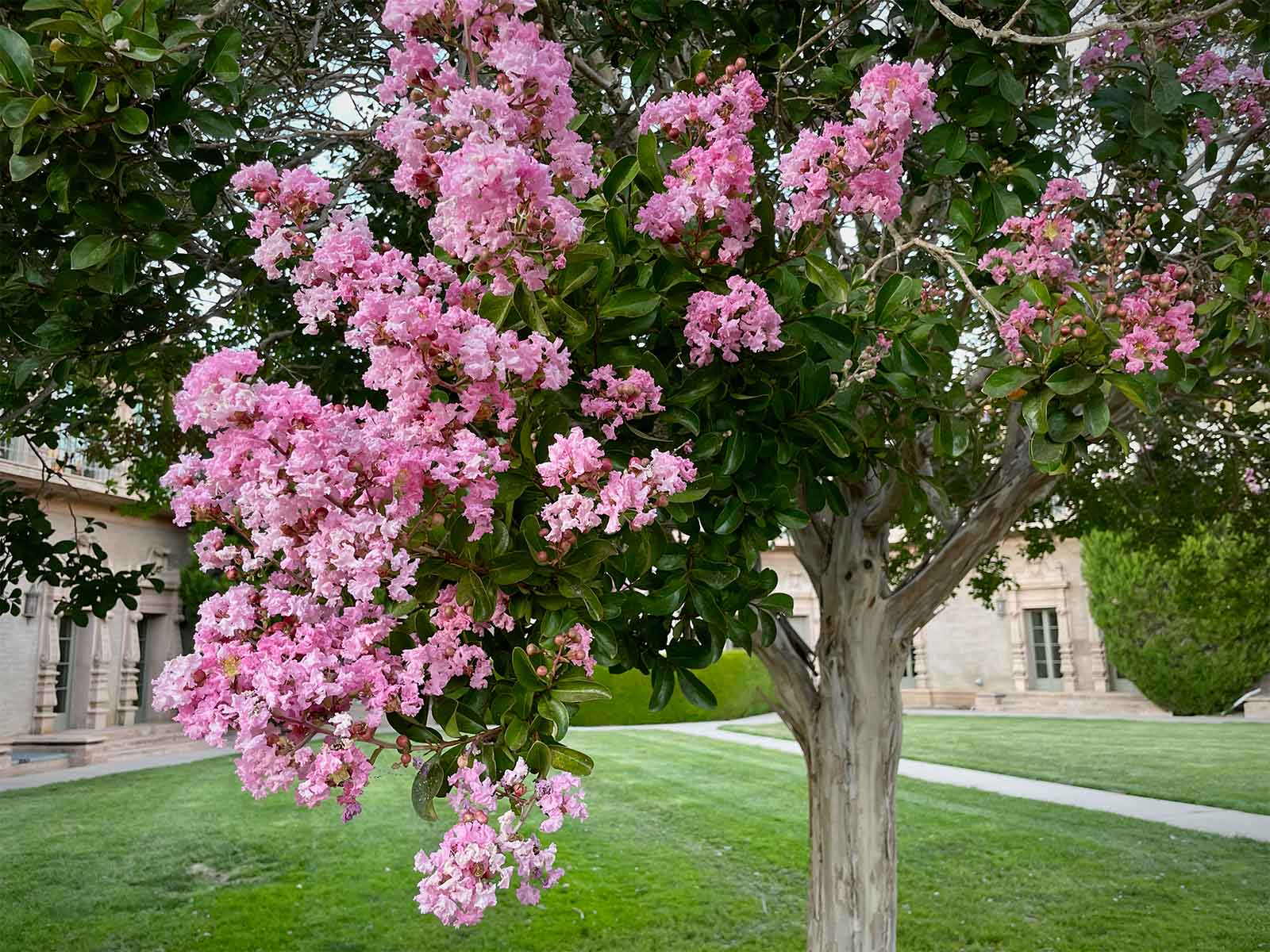
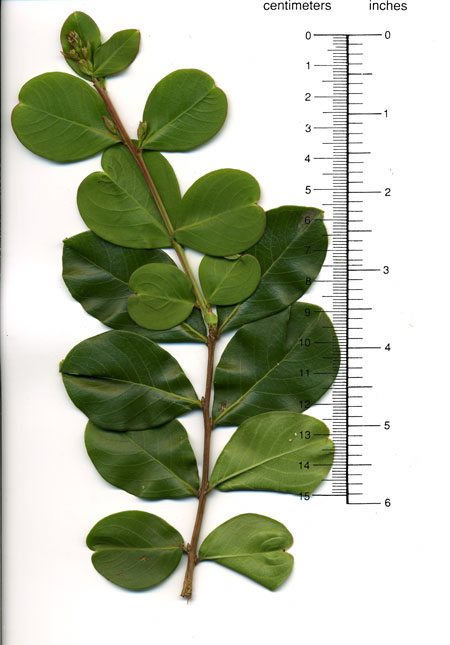
Crape myrtles are outstanding shrubs or trees in every season: lavish masses of summer flowers, handsome fall foliage, and striking mottled bark all year. They thrive in summer heat, which is essential for abundant bloom; it is the Texas state shrub. Flowers appear in terminal panicles on new growth, a fact that has unfortunately encouraged the harsh pruning of branches to stimulate fresh shoots. These spindly sprouts bow under the weight of the heavy floral clusters, marring the tree’s naturally graceful architecture. Sturdy, sinewy stems taper elegantly into finer branchlets, a structure best left unspoiled except perhaps for removing spent inflorescences.
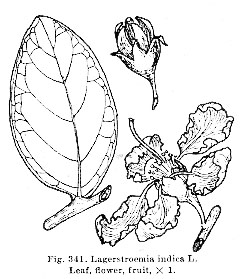
The flowers’ characteristically crinkled petals (“crape” is an archaic form of “crepe”) range from white through pinks and reds, with a few verging on purple. Golden anthers in the center lend a pleasing touch of contrast. Later, the dry seed capsules form and persist into winter, their seeds feeding birds. In summer, the bark exfoliates, revealing a mosaic of colors and textures beneath – don’t resist the urge to caress it as you walk by.
An old, multi-trunked specimen stands to the left of the house at 611 Alvarado Row. Remnants of groups planted in 1975 grow on Campus Drive just east of the driveway to Enchanted Broccoli Forest (1115 Campus Drive), likely L. indica. Powdery mildew can be troublesome, but mildew-resistant plants emerged from an extensive U.S. National Arboretum crape myrtle breeding program begun in the 1960s. These hybrids, mostly with the Japanese crape myrtle, L. fauriei (sometimes known as L. subcostata var. fauriei), have proved immensely successful in horticulture. The program’s late head, Donald Egolf, was honored posthumously in the name given to L. indica and L. fauriei hybrids: L. ×egolfii.
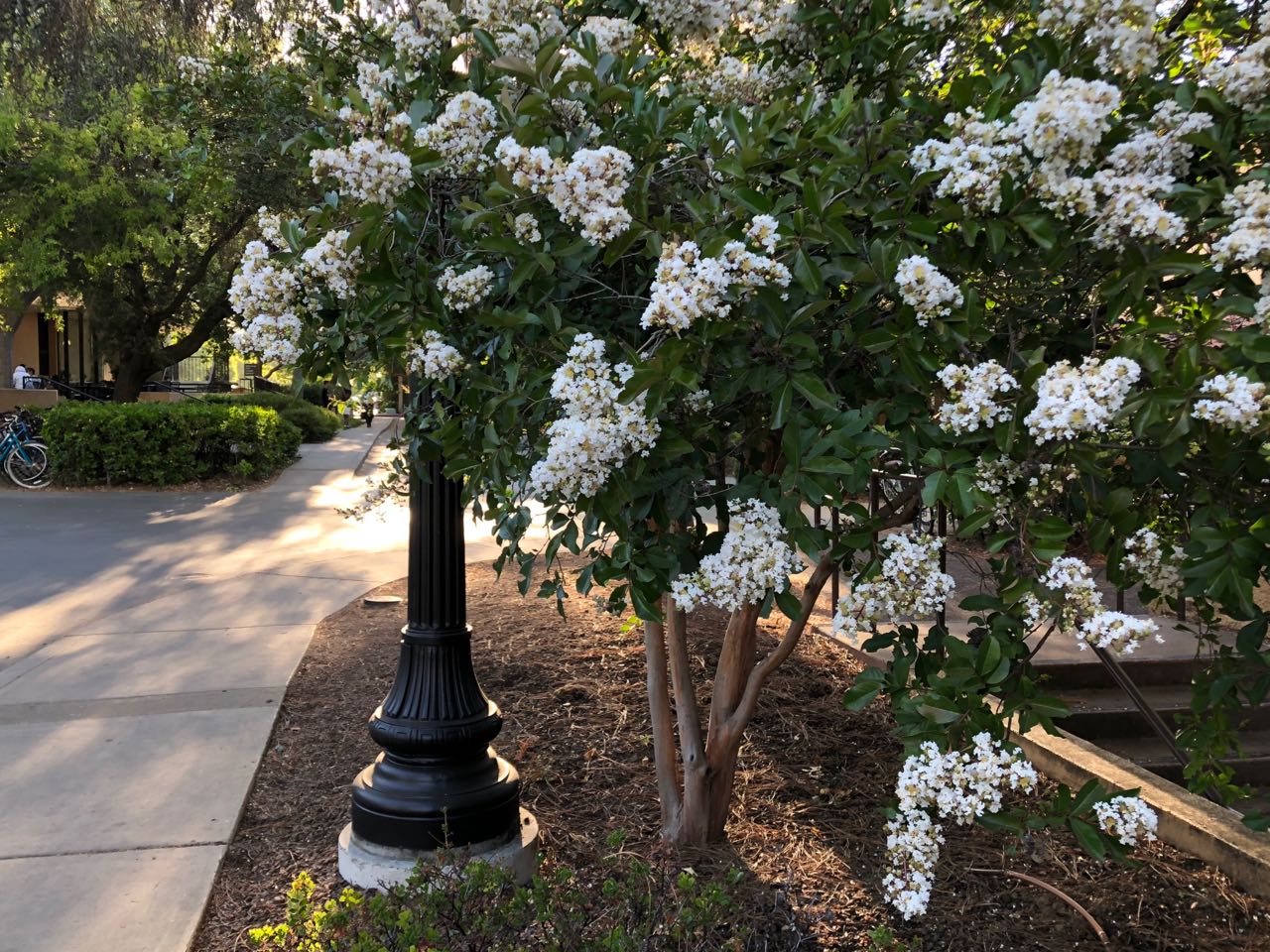

Early plantings on El Camino Real in Menlo Park near Menlo Avenue naturally drew attention. Campus’s first L. ×egolfii, a multi-trunked ‘Tuscarora’, with dark coral pink flowers, was planted in the inner northeast island of the Inner Quad in 1985, soon after the Quad was paved. Significant plantings of sizable hybrids began in the 1990s: ‘Tuscarora’ on Galvez Street between Jane Stanford Way and Campus Drive, and a row of white-flowered ‘Natchez’ between Lagunita Eucalipto and Murray Hall. The bark of ‘Natchez’ shows the most dramatic contrasts of the common cultivars, with dark cinnamon-brown and creamy tan patches. A group of 10 ‘Tuscarora’ forms the east boundary of Knight Plaza, north of Lathrop Library, accompanied by rows of afrocarpus and hornbeams, and a colonnade.
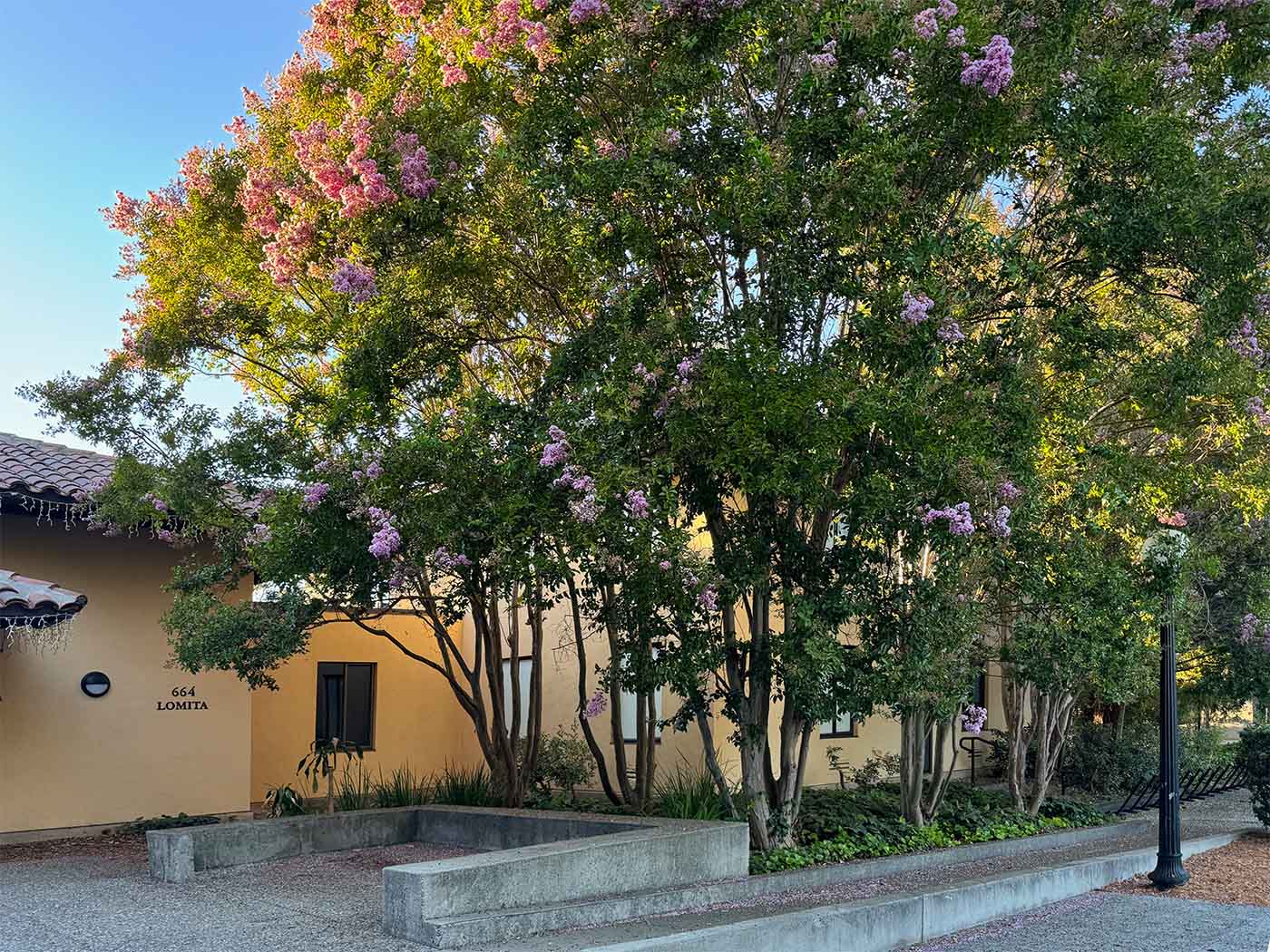
‘Natchez’ was planted at the Old Union in 2007, after renovation, and has since been extensively used, including a row at 366 Galvez Street adjacent to the sidewalk. Several flank the front entrance to Vaden Health Center; a formal grid of 20 stands at Crothers Hall near Crothers Way. A few ‘Muskogee’, with light lavender-pink flowers, can be seen around the entrance of Kappa Alpha (664 Lomita Court) and at 719 Alvarado Road on campus. The ‘Natchez’, ‘Muskogee’, and ‘Tuscarora’ trifecta reigned in Palo Alto for many years, favored by City arborists for their disease resistance.
A pale lavender with almost no pink undertone distinguishes the substantial late-summer trusses of ‘Yuma’ in front of Enchanted Broccoli Forest (six specimens). This cultivar is of the same hybrid parentage but includes a soupçon of L. amabilis. Petals fade to a dried fawn while still attached. Compare these to the multi-trunked shrubby ‘Muskogee’ near the front tables. An attractive row of crape myrtles, one purple, the others in shades of clear pink, edges the back lawn of The Knoll.
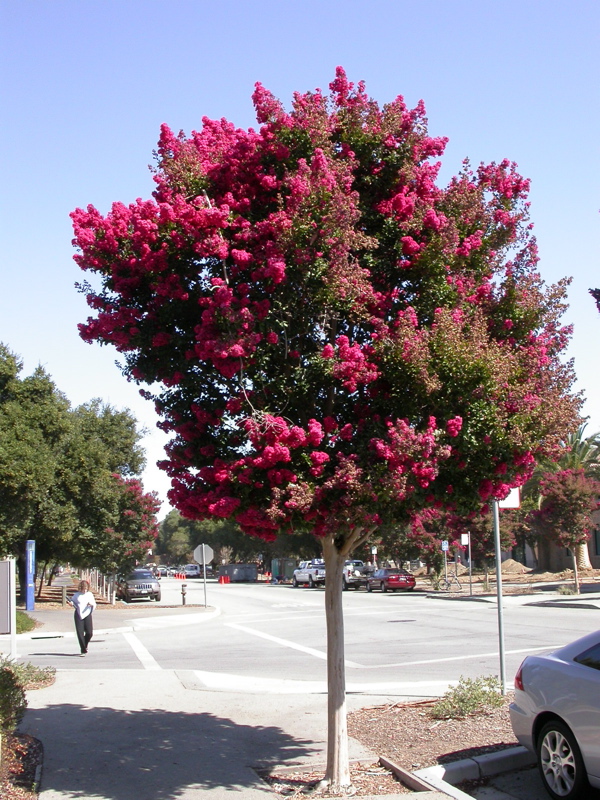
In recent years, pure red Dynamite, the trade name of a L. indica cultivar, has appeared on campus, for example at 828 Pine Hill Road, intermixed with ‘Tuscarora’, and at 34 Pearce Mitchell Place. Occasional medium-pink flowers appear among the masses of red. A former row along the northwest side of Arrillaga Family Sports Center was removed in 2024 during construction. In Palo Alto, several Dynamite can be seen at 2075 Yale Street. Nearby, deep purple–flowered L. indica ‘Catawba’ grows on the Oberlin Street side of 1080 College Ave and along the left side of 2140 Bowdoin Street.
Gallery

- Main References for New Tree Entries.
- Rubenstein, Debbie. 1985. “Quad work nears finish.” Stanford Daily, April 3. (Re. year of planting of Inner Quad crape myrtle.)
- U.S. National Arboretum. 2016. Cultivar Names of Lagerstroemia (Crapemyrtle).
About this Entry: Authored May 2025 by Sairus Patel.

