

Grevillea robusta
 silky oak
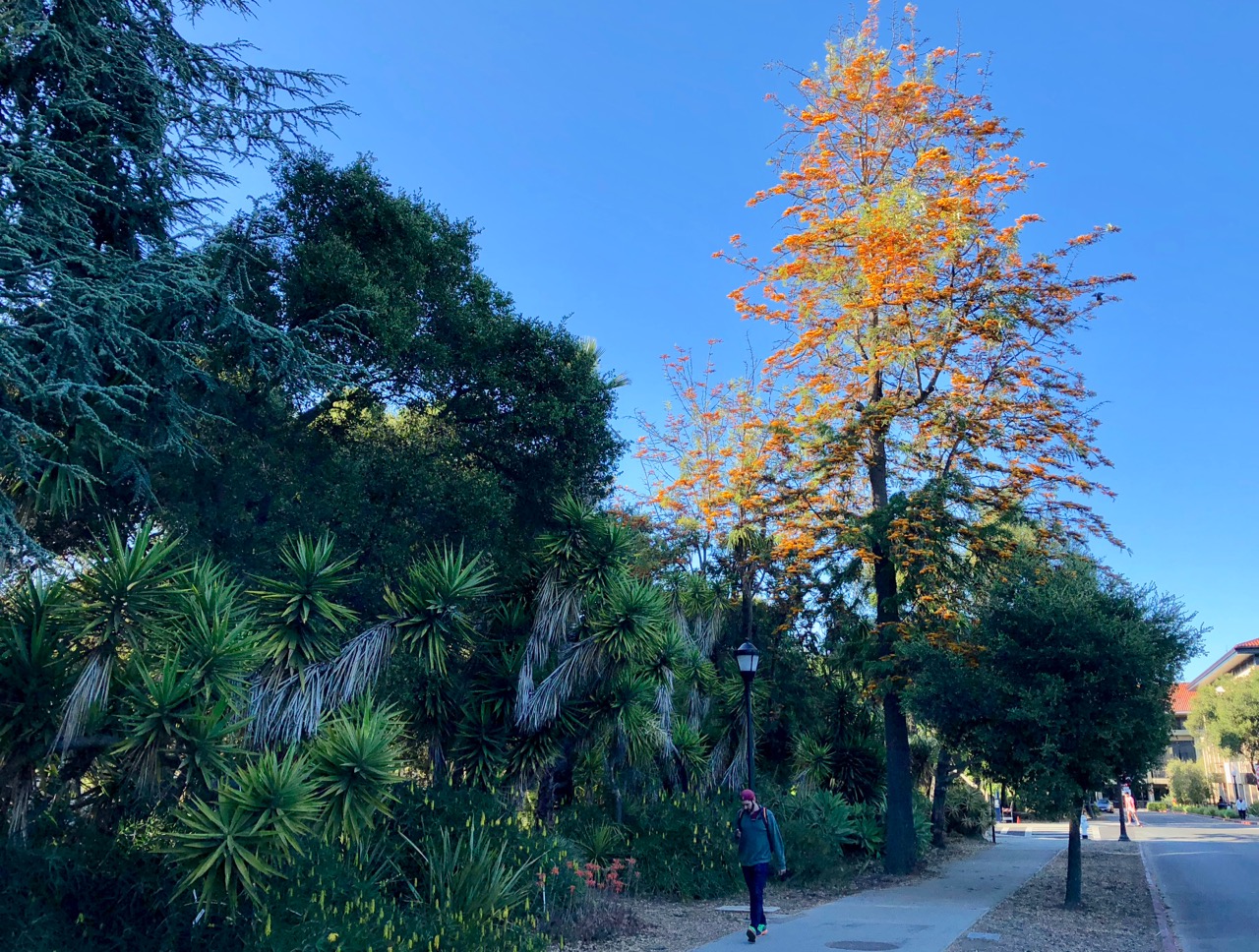
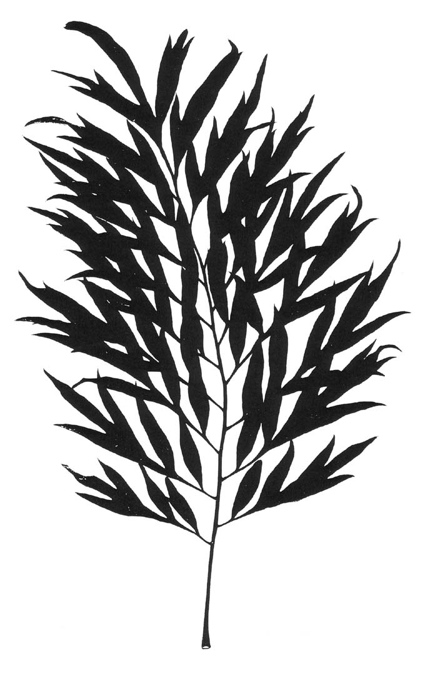
This rapidly growing evergreen tree is renowned for its spectacular coppery-orange flowers that appear in early May. Its feathery leaves make it recognizable year-round: they are pinnate, with elongated leaflets often further cleft into several long lobes, an intricate leaf structure matched on campus only by that of Lyonothamnus. The undersides of the deep green leaves are covered with silky, silvery hairs, creating a striking contrast when stirred by the breeze. Leaf drop in spring can be prodigious, but makes for some of the most attractive litter.
The delicate, nectar-rich flowers are neatly arranged – though crowded – along one side of a 4-inch axis, rather like a toothbrush. The loops visible when the buds start to develop are the colorful styles, the stigmas at their tip trapped within the fused sepals, rubbing against the pollen on the anthers within like a swan with its head stuck in a feeding pouch. The style then unfurls, presenting the pollen to passing pollinators, who are attracted by the deep claret nectar that beads at the flower’s base. One can tell at a glance what stage a cluster is in: a bed of tight loops or a wiry brush of extended styles. Nectar is produced copiously and will sometimes drip onto you. One student, on hearing that indigenous Australians made a sweet beverage from the flowers, painstakingly harvested the nectar, made a syrup, and wolfed it down with pancakes on a video he posted online – not recommended.
The hook-like styles persist in the dark, leathery follicles that follow. Papery winged seeds can be sown, or volunteer seedlings transplanted, and can make attractive houseplants.
The species is widely planted around the world as an ornamental and a shade tree. In Kenya, it was once grown between tea bushes for shade, though the practice has declined due to disease concerns. The wood, often referred to as silky oak, has a lustrous shine and conspicuous medullary rays, similar to that of oak. It was once popular for furniture, cabinetry, and veneer, including for the paneling in numerous elevators in Sydney. The name silky oak has been used, with various qualifiers, for the wood of dozens of species.
In the late 1880s, gardener Thomas Douglas raised silky oaks from seed for the Arboretum, at the direction of Olmsted, who followed the recommendations of John McLaren, superintendent of San Francisco’s Golden Gate Park. It is unlikely, however, that the large specimens in the Arboretum, mostly near the Mausoleum, date from that era.
Two large specimens grow just north of Old Chemistry. Two others stand on the eastern edge of the Papua New Guinea Garden. One is in the grove north of the Lou Henry Hoover Building, and another in front of Escondido School. A row stands behind 801 Welch Road. After several decades during which the species was no longer planted on campus, a few new individuals were installed in 2020 along Campus Drive, just north of Studio 2 (729 Escondido Road).
Popular smaller cultivars of other Grevillea species abound. Hybrid ‘Noel’, a vigorous bush, has recognizably similar (pink and white) flowers and pods.
- Main References for New Tree Entries.
- Douglas, Thomas H. 1889–1991. “Daily Journals.” SC 195, Stanford University Libraries Special Collections.
- McLaren, John. 1887. “List of Trees at Palo Alto Nursery (to accompany letter from John McLaren – 10/30/87).” Copy from the Office of Olmsted Brothers. In SC 125, Box 2, Stanford University Libraries Special Collections.
About this Entry: Authored Jun 2025 by Sairus Patel.

