

Corylus avellana
 hazelnut
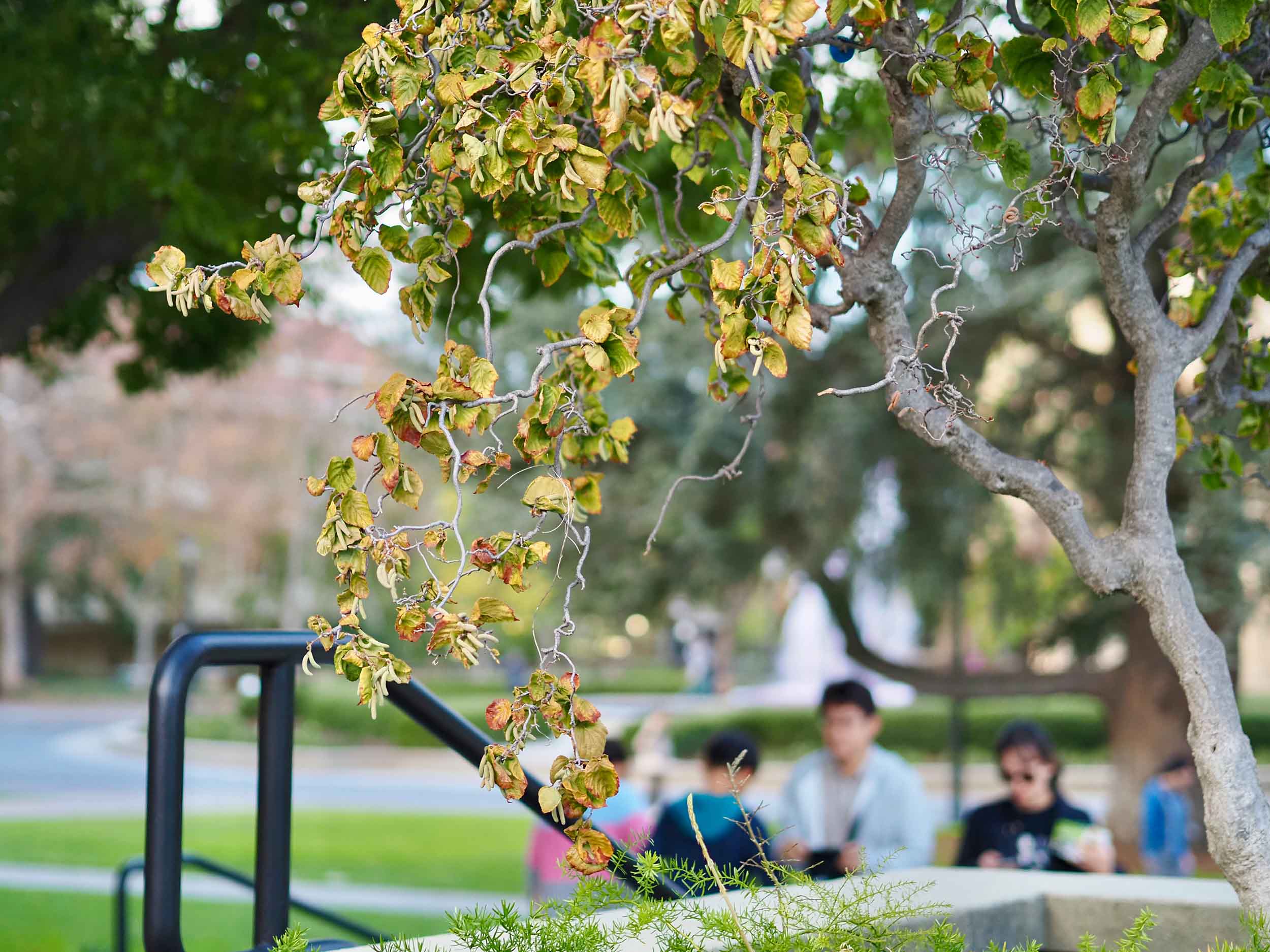
The hazelnut, Corylus avellana, enjoyed most recognizably in confections but having many other uses, is native across an enormous sweep of Europe to western Asia, though production is especially concentrated along the humid southern shore of the Black Sea in Turkey, around Giresun (see also Prunus cerasus). Avella in Italy was likewise associated with hazelnuts by at least the 1500s and perhaps since antiquity, giving rise to avellana. Corylus is the ancient Latin name for hazel.
The shrubby cultivar ‘Contorta’, corkscrew hazel, has intricately twisted branchlets from which delicate male catkins hang, and is also called Harry Lauder’s walking stick after the twisted stick carried by the Scottish entertainer. One is in the circular planter in the space east of Hoover Tower, while another is left of the driveway at 805 San Francisco Court. Two flank the front walkway at 890 California Avenue in Palo Alto.
The broadly rounded, downy leaves of the species, coarsely serrated and held horizontally to catch woodland light, will be familiar to anyone who has traveled across much of Europe, where hazels spring up along riverbanks, woodland edges, and even in cities. California hikers may recognize something of the same aspect in California hazelnut (C. cornuta subsp. californica), native to the Santa Cruz Mountains, including Jasper Ridge. On campus one can be found on the right of the pathway on Lomita Drive that leads to the California Garden, just south of the intersection with Roth Way. Occasional small nuts can be found on it, with the characteristic beak-like husk surrounding the nut; cornuta means horned.
Magic also trialed Turkish hazel (C. colurna) and a hybrid between it and C. avellana on campus; one of these plants may remain near the vernal pool in the Arboretum.
About this Entry: Authored Sep 2026 by Sairus Patel.

