

Ceiba speciosa
 floss-silk tree
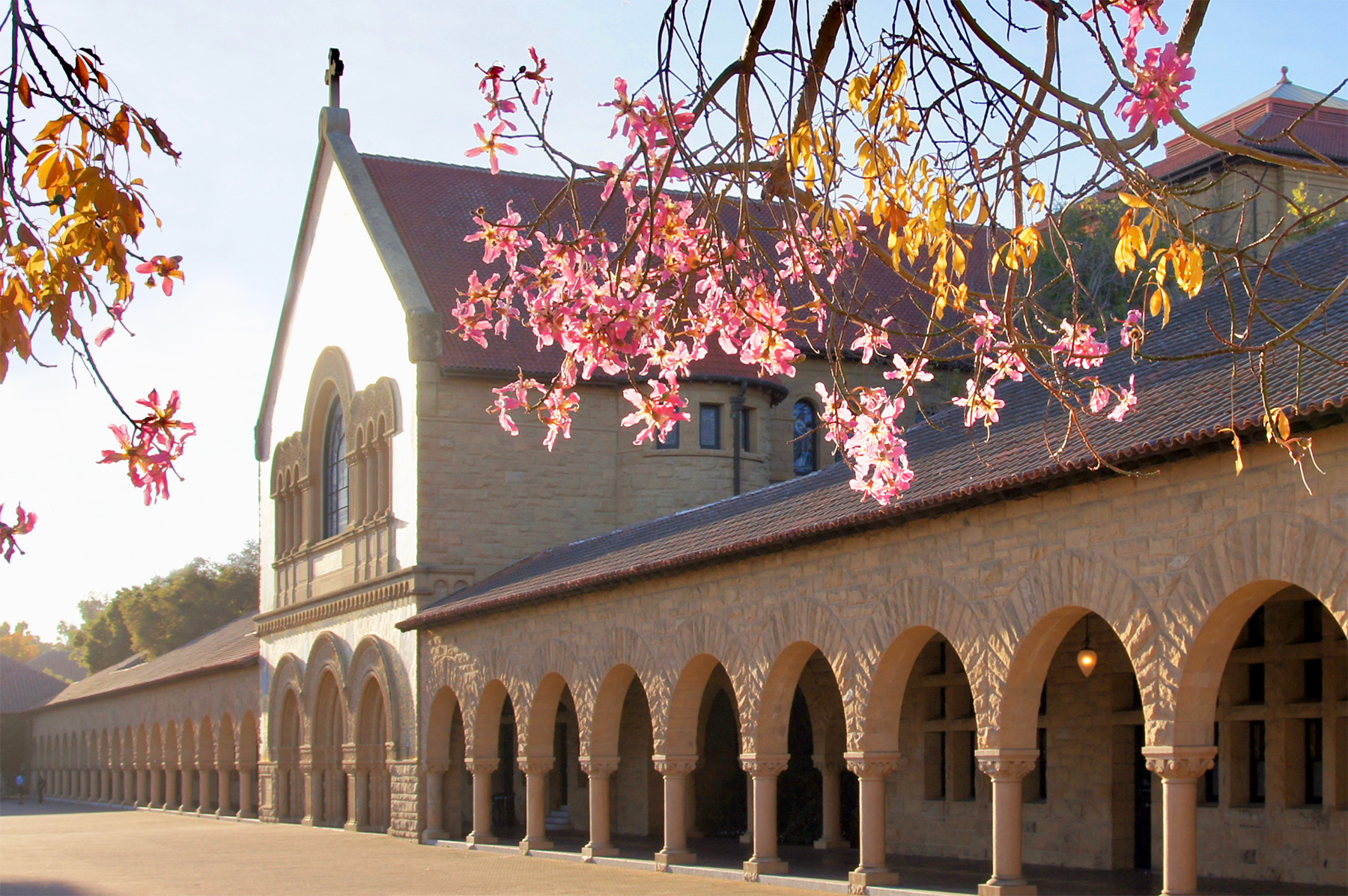
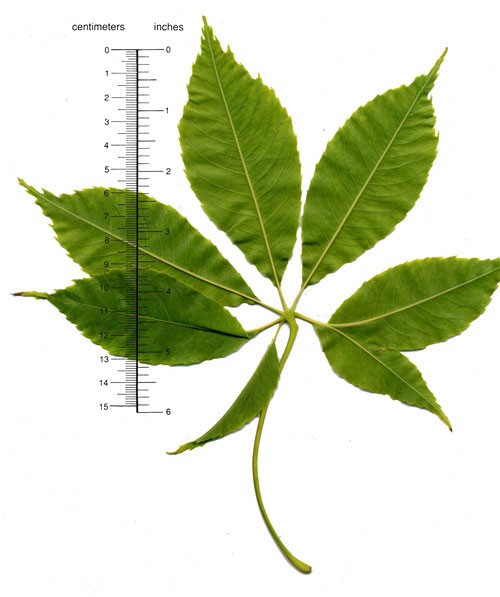
The most unexpected – and delightful – tree plantings on campus are the rows of floss-silk trees in the two light wells of the Roth Parking Garage, planted in 1987 when the structure was built. The seven trees in each bed soar up the four stories and branch out above, their upright habit – constrained by the walls and each other (though also pruned of their lower branches over the decades) – responding as they might in a forest environment. Their trunks, similar in girth to the columns around them, are no doubt easily overlooked by those struggling with the parking payment system. Climb to the top floor to examine their crowns as closely as you want. The light green, faintly toothed leaflets are arranged palmately in groups of five or seven.
The trunks and branches are often covered in greenish bark; fierce prickles emerge from them. Green chloroplasts in the bark help the tree photosynthesize even when leafless, a valuable adaptation in its seasonally dry semi-deciduous woodland native habitats (it also grows in moist forests). The conical prickles may once have helped deter hungry herbivores from nibbling on the delectable bark.
And if this weren’t enough, come September, masses of flamboyant hibiscus-like blossoms emerge from the leafless sections of the canopy: five spreading magenta-pink petals, with slightly undulating margins, narrow at their base to a creamy yellow with longitudinal streaks of deep carmine pointing to the center. The male parts are highly unusual: the filaments fuse to form a hollow pinkish tube topped by a high, plush collar of creamy anthers. At the base of this column is a ring of velvety, dark red petal-like lobes with contrasting silvery fuzz. These are actually infertile staminal lobes (staminodes) and may serve to guard the floral throat, regulating access to the sparse nectar. Within the hollow tube grows the style, topped by a tiny round pinkish stigma that emerges as the flower matures.
By spring, dark pod-like capsules form, similar to large avocadoes. These split to reveal white cottony wool, the “floss,” packed into exquisite patterns within. This kapok-like material floats to the ground, aiding the dispersal of the seeds embedded within.
Near the Clock Tower grows a fantastical seven-trunked individual. A stout specimen is on Galvez Mall, east of Green Library, next to two immense ginkgoes. A rather rangy tree stands in the outer southwest island of the Inner Quad, a favorite haunt of hummingbirds. Another south of the Post Office has a window in its trunk.
Ceiba speciosa is known to the Guaraní as yvi, the word for fibers used in textiles. The floss was used for making thread, and the fibrous inner bark for cordage and hammock rope. (“Bast” and “liber” are both words for the inner bark or phloem. Latin liber also means book.) True commercial kapok primarily comes from Ceiba pentandra, a taller rainforest cousin native to tropical America. Its opened pods, masses of silvery cotton, resemble the silky anteater so closely that they are nearly indistinguishable, affording those arboreal creatures some protection from raptors.
The older genus name, Chorisia, honors Ludwig (Louis) Choris (1795–1828), the Russian-German artist who circled the globe with Otto von Kotzebue. During their 1816 stopover in California, he painted Native American life at the missions in Carmel and San Francisco; the works are now housed in the Bancroft Library at UC Berkeley.
Name derivation: Ceiba – version of South American name; speciosa – beautiful.
- Main References for New Tree Entries.
- Brigham, Steve. 2004. “Trees of San Diego: Floss-Silk Trees.” Pacific Horticulture, October.
- Gibbs, Peter E., and João Semir. 2003. “A Taxonomic Revision of the Genus Ceiba Mill. (Bombacaceae).” Anales del Jardín Botánico de Madrid 60 (2): 259–300.
- Nowak, Ronald M. 1999. Walker’s Mammals of the World. United Kingdom: Johns Hopkins University Press. (Silky anteater.)
- Palo Alto Historical Association. 1969. “The Tall Tree,” vol. 3, no. 2 (October). (Choris in California.)
About this Entry: Authored Jun 2025 by Sairus Patel.

