

Callistemon citrinus
 lemon bottlebrush

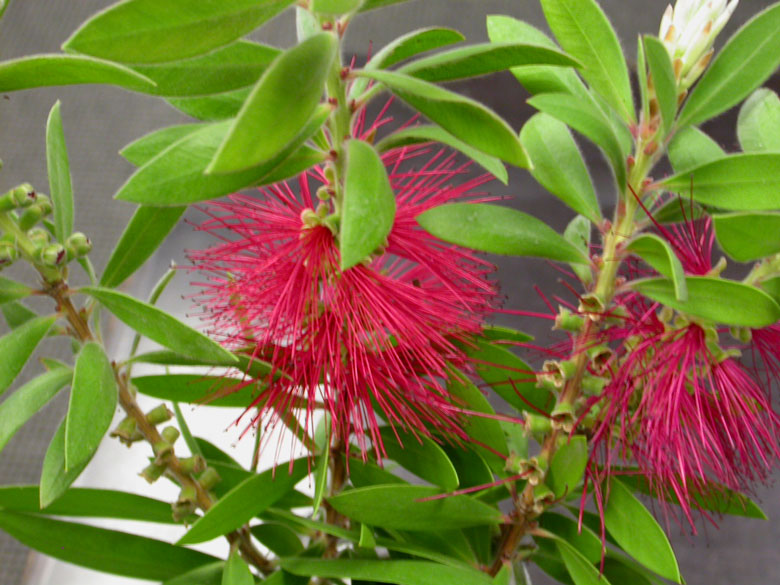
Red bottlebrush spikes are borne in profusion in summer, with scattered blooms through much of the rest of the year. Similar to C. viminalis, though a vigorous, multi-stemmed shrub rather than a tree, its narrow leaves are held almost at right angles to the branchlets, stiff and alert where C. viminalis is relaxed. The fibrous bark is quite different, too, shearing away in vertical stringy strips. Look closely at the sticky flowers and you’ll see the stamens are not fused in a ring at the base, as they are in C. viminalis.
The leaves are aromatic when crushed, though citrinus strains credulity. Lemon bottlebrush can be seen between Hulme and Building 86 in Escondido Village; they are plentiful in campus greenbelts and as hedges in neighboring cities.
The pink-flowered cultivar Callistemon ‘Jeffers’, of uncertain parentage, grows in a hedge at the southwest corner of the vast inner courtyard of the Science and Engineering Quad. Additional hedges can be found along the west side of Ventura Hall and nearby at Cordura Hall.
Melaleuca species produce similar bottlebrush flowers, though there the stamens are fused into five bundles. Some authorities now treat all Callistemon species as Melaleuca, though the Australian Plant Census has declined to follow.
· Callistemon and Melaleuca: Key to Species
Name derivation: Callistemon – see C. viminalis entry; citrinus – see text above.
- Likely removed: several staked plantings in the Greenbelt about 200 yards south of Stanford Avenue on the west side of the path (2007).
About this Entry: Authored May 2026 by Sairus Patel. Last updated Aug 2026 (SP).

