

Brahea edulis
 Guadalupe palm
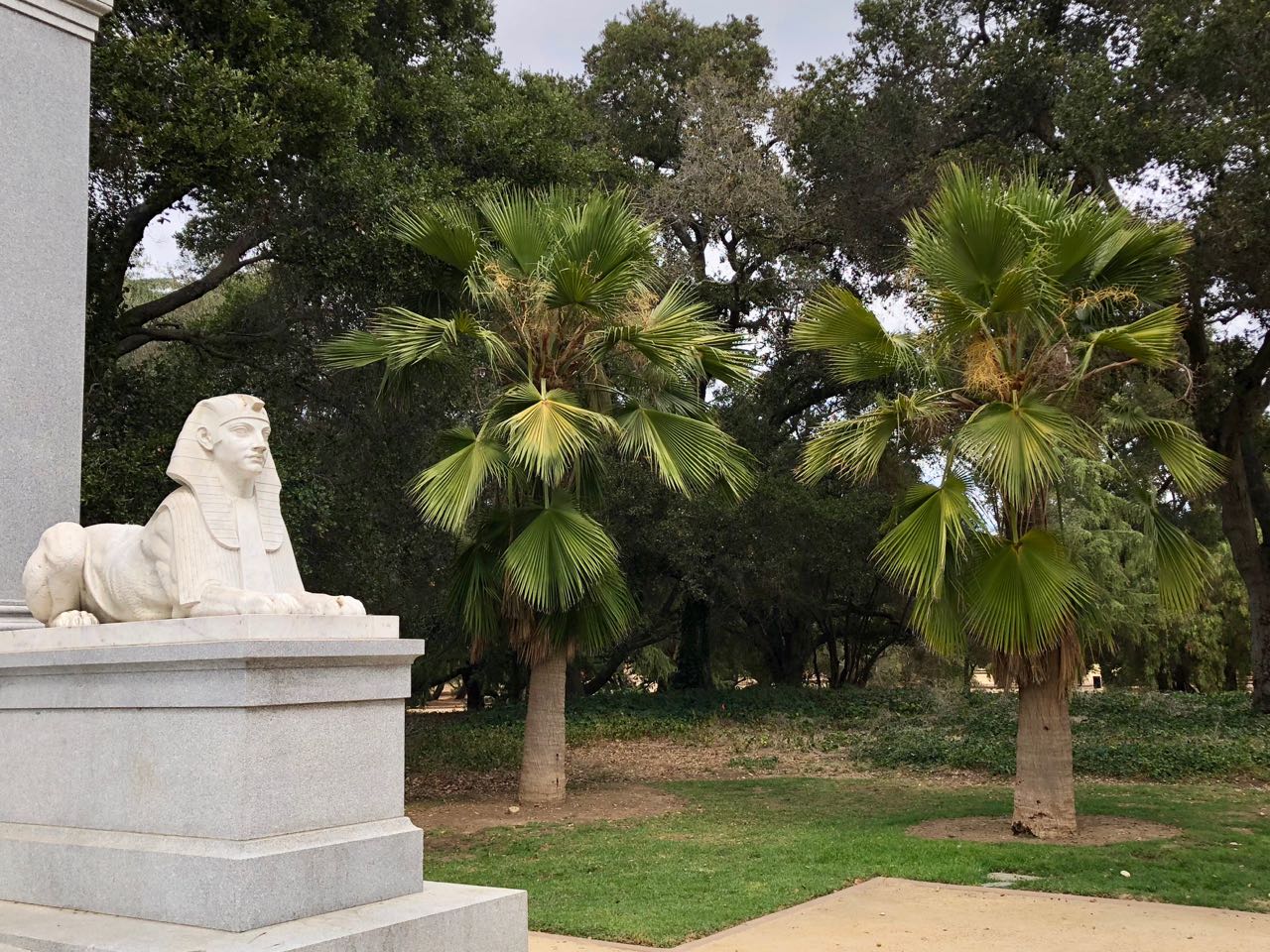

A fan palm of modest stature from Guadalupe Island, the westernmost point of Mexico – within the California Floristic Province, even if not within our state’s political boundaries. It tolerates a wide range of growing conditions, reaching about 10 feet fairly quickly before slowing down – perfect for a more intimate, human-scale planting compared to the towering Mexican fan palm.
The oldest specimens on campus are a pair just north of the Mausoleum, brought together there in 1996 during one phase of construction of the Science and Engineering Quad at the site of the original women’s dormitory. Professor Ron Bracewell writes that the palms were shipped from Baja California to Stanford around 1900 and planted at the dormitory – old Roble Hall, now the Packard Building site – though at least one appears to have been transplanted more than once before reaching its present home.
Photographs of the dormitory from around 1900–1910 indeed show small palms that look like the Guadalupe. An undated photograph, perhaps earlier, also appears to show a full-crowned specimen rising behind a snarling feline statue at the Stanford residence, suggesting the species had already entered the university’s landscape. It could have reached Stanford by several routes, especially after the university’s financial constraints eased with the resolution of the Stanford estate litigation in 1898. Since 1875, early botanizing expeditions to Guadalupe island had brought back small quantities of seed; by 1893, only about a dozen Guadalupe palms were known to grow in California, including a fine fruiting specimen at U.C. Berkeley, now long gone. Santa Barbara horticulturist Francesco Franceschi and a colorful sailor “Dutch Harry” Drent brought seed back to the mainland, and seeds and plants for the palm were available through the Sherwood Hall Nursery Company in Menlo Park by the mid-1890s. Expeditions in the late 1890s included Stanford professors on a fur seal survey, and a Stanford undergraduate who helped collect large quantities of plant and other material.
A 1900 vintage would make the Mausoleum pair among the oldest Guadalupe palms in the state, yet remarkably, they stand only about 17 feet tall. Very old examples can also be seen in Dolores Park in San Francisco.
A more recent specimen was planted in front of the Mausoleum in 2021, in the lawn on the left, replacing a monkey puzzle at that spot.
Cream-colored clusters of flowers give way to dark, perfectly round fruit about an inch wide, borne in profusion and edible – hence edulis – with a flavor likened to apricots or prunes. The leaf stalks bear tiny spines, easily traced with a finger, nothing like the formidable armature of its cousin B. armata.
An intimate group of about a dozen, varying in height, grows on the west side of Branner Hall’s north wing. The trunks all tilt slightly at the base, making them look like a group of people standing about at a party, chatting, leaning this way and that. They self-sow gently, explaining the different sizes, a seedling occasionally coming up just under the native buckeye about 60 feet away. Other examples are at Rains Houses near the community building, next to a tall Mexican fan palm; a couple appear to have grown from seed in the central circle. A solitary specimen stands behind Lasuen (572 Mayfield Avenue).
- Bracewell (2005) states the Mausoleum pair was shipped from Baja California to Stanford around 1900, and, in the Noteworthy Trees blurb, that this pair originally grew at the first women’s dormitory. In the earlier Trees on the Stanford Campus (1984), however, he mentions only a single specimen on Serra Street between Via Crespi and Via Palou – the site of the original women’s dormitory, though he does not note that connection – also stating that it had been shipped from Baja California around 1900. Fong recalls that the palms underwent multiple transplants, with one moved to the Mausoleum from the old steam plant site and another from the former dormitory site.
- Julie Cain and Jason Dewees provided invaluable assistance in researching this entry.
- Main References for New Tree Entries.
- Dewees, Jason. 2023. A Plant-Love Story: A Palm Tree on an Island of California. Pacific Horticulture (Fall).
- Fong, Herb. 2026. Pers. comm.
- Moran, Reid. 1996. The Flora of Guadalupe Island, Mexico. Memoirs of the California Academy of Sciences, no. 19. San Francisco: California Academy of Sciences.
About this Entry: Authored Jul 2025 by Sairus Patel. Updated Jul 2026 (SP).

