

Ailanthus altissima
 tree of heaven
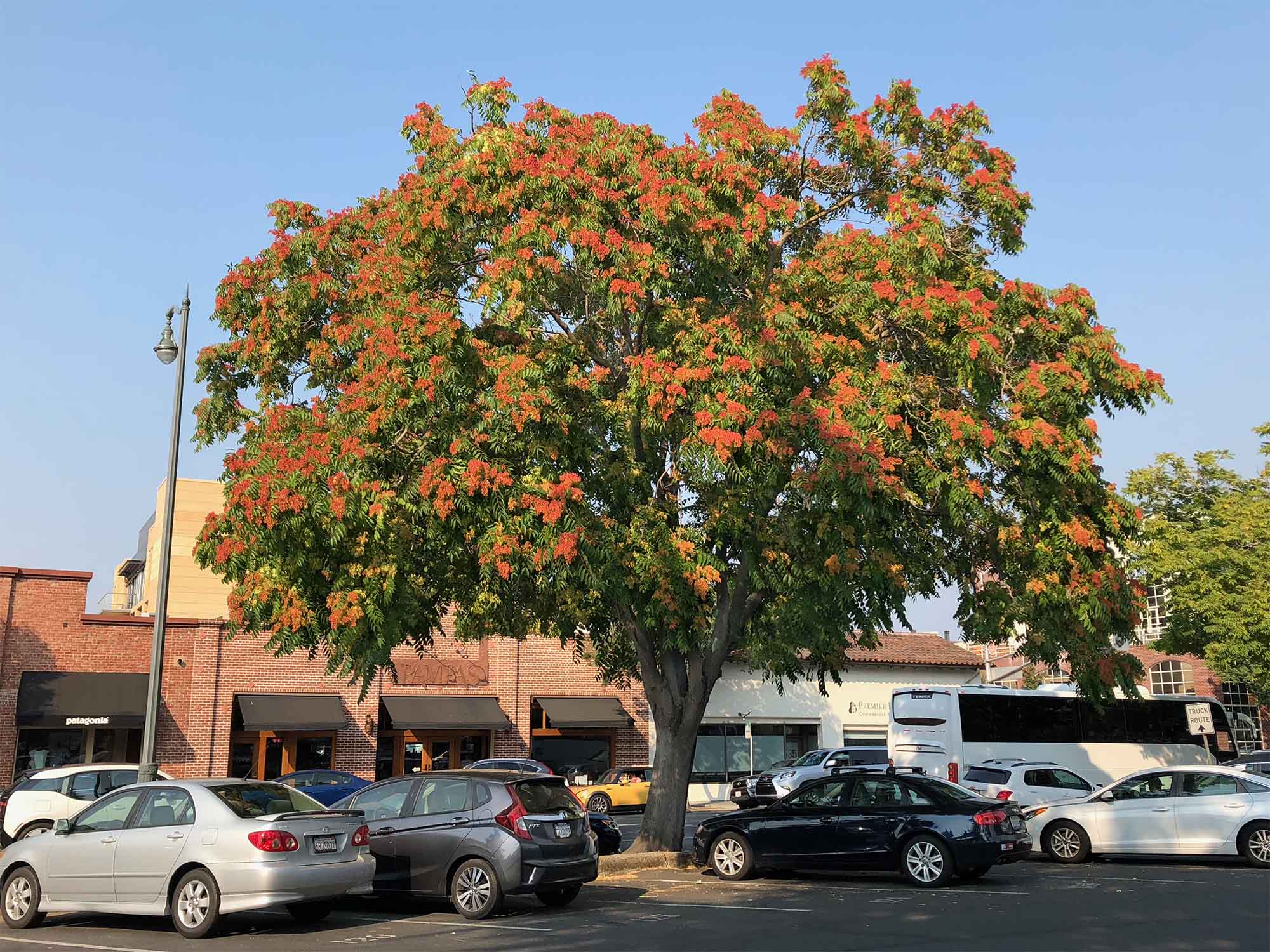

Like the glossy privet, tree of heaven is a shapely tree of undeniable beauty, yet much maligned for its by-now legendary invasiveness. Long, pinnately compound leaves droop gracefully, and can be told at once from those of our native walnut and similar trees by the pair of coarse gland-tipped lobes at the base of each leaflet and by the sharp garlicky odor released when crushed. Scratch the bark and you get this same scent, a fact well known to the volunteer ailanthus-removal crews who work the local creeks in winter after leaf-fall.
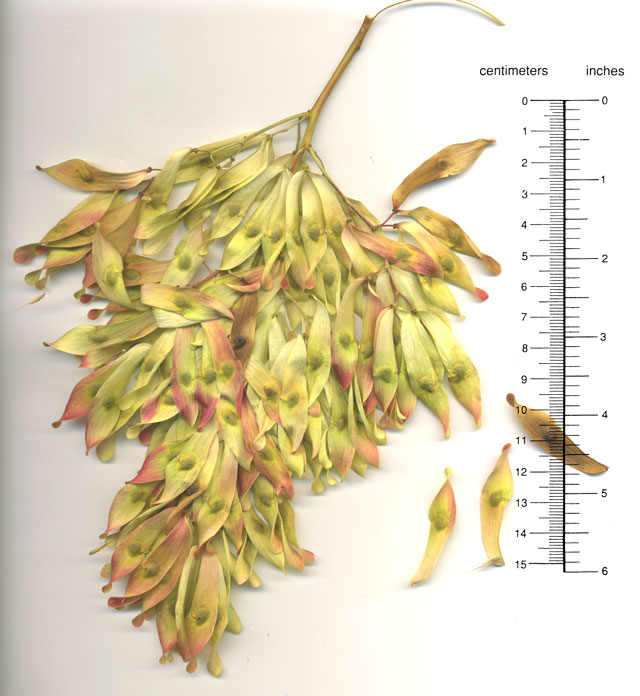
Some don’t mind the yeasty odor of the flower clusters on male trees; others insist they reek to high heaven, and are, curiously, more vocal about it – especially online – than the former group. This distaste once led, when intentional planting still occurred, to the preference for female trees only. On these, clusters of greenish-yellow samaras – jauntily twisted at both ends – mature through apricot to a rich terracotta red by midsummer, several stages of color present at once, producing a glorious spectacle for months, as can be seen on the full-canopied standalone exemplars at the downtown Palo Alto train station on Alma Street, opposite 663. Not bad for unwatered trees rooted in hardpan, rising from two-foot-wide slots in concrete and faithfully shading commuters’ cars in a stark parking lot for decades.
Nearby, feral ailanthus run in bands along the tracks, a familiar sight to train passengers. “It will grow where all else fails. And it’s better to have an ailanthus than nothing,” said Howard Irwin, Executive Director of the New York Botanical Garden, in the 1970s – perhaps with Betty Smith’s 1943 novel A Tree Grows in Brooklyn somewhere in mind. Something of an ailanthus centrist myself, I am always tickled to encounter the species in gardens of repute: a red-fruited form (labeled A. altissima forma erythrocarpa) at the Arnold Arboretum, and a commemorative tree at the Oxford Botanic Garden. Whatever the present consensus, it should not dull our marvel at the species’ grit and grace.
Two large female specimens remain on central campus today, behind Phi Kappa Psi (592 Mayfield Avenue) and nearby Haus Mitteleuropa (620). A giant at the southeast corner of the Kingscote Gardens building was lost to a landscape renovation in 2015. A few palm-like suckers spring up in the Arboretum north of the Mausoleum now and then – fitting, perhaps, since nearby stood the former nursery where gardener Thomas Douglas propagated ailanthus for Stanford’s original landscape plantings before the University opened in 1891. A formerly resplendent multi-trunked female, now in decline, persists in the parking lot south of the Stanford Arboretum Children’s Center.
Gallery
Name derivation: Ailanthus – from Ambonese Malay ai lanto (tree [of] heaven); altissima – tallest.
- Main References for New Tree Entries.
- Douglas, Thomas H. 1889–1991. “Daily Journals.” SC 195, Stanford University Libraries Special Collections.
- New York Times. 1981. “Topics; The Tenement Palm.” New York Times, October 29. (Re. Howard Irwin quote.)
About this Entry: Authored Jul 2025 by Sairus Patel. Updated May 2026 (SP).

