

Acer circinatum
 vine maple
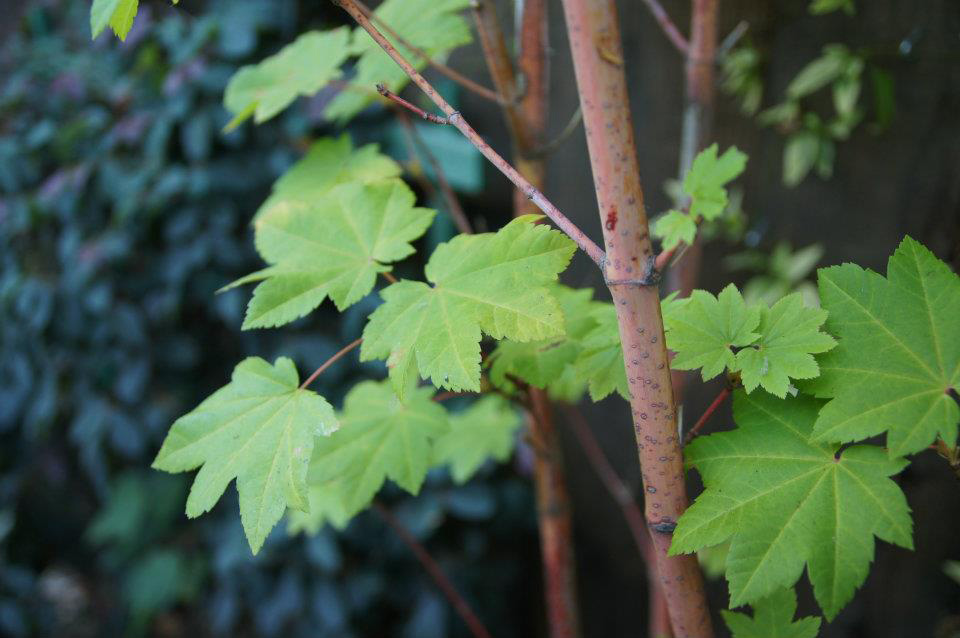
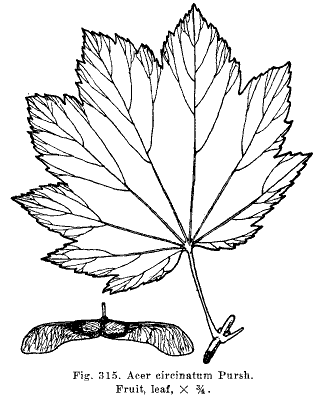
Evoking the familiar grace of the Japanese maples (A. palmatum, A. japonicum, and their kin), this is indeed the only North American member of its otherwise east Asian series, suggesting an earlier trans-Pacific land connection. A small, multi-stemmed tree, it may sprawl outward or twine upward toward light in the forest understory, hence its common name. The 7- or 9-lobed leaves form a nearly round, fan-shaped outline – circinatum means rounded – and are clearly similar to those of A. japonicum. The wings of the samaras extend almost in a single straight line, as in A. campestre.
It is native in the vicinity of Stanford Sierra Camp. On campus, however, it has been lost: two mature plants, last reported in 2003, once stood on the east side of the Carnegie Institution main building. In Palo Alto, a pair grows near the garden wall at 2297 Harvard Street.
The cultivar ‘Pacific Fire’, seen in a nearby garden, has orange-tinged yellowish fall color and coral-red branches and stems that fade to salmon – a California-native answer to the ubiquitous coralbark Japanese maple (A. palmatum ‘Sango-kaku’). Narrow-crowned and dwarf in stature, it tucks neatly against a fence when space is scarce. A larger vine maple, with yellow to scarlet autumn leaves, grows in the native-themed garden behind the Woodside Library.
About this Entry: Authored Feb 2026 by Sairus Patel.

